Valsartan
is the main pressure-raising signal of the renin-angiotensin system. Valsartan blocks it from binding its on blood-vessel muscle and in the adrenal glands, whichever way the angiotensin II was made, so vessels tighten less and blood pressure falls. and angiotensin II rise in response, but not enough to overcome the effect on blood pressure. In studies, fell only a little.
- Acts on
- Angiotensin II type 1 (AT1) receptor
- Where
- Blood vessels and adrenal glands
- Medicine type
- Small molecule
- Used for
- Heart & circulation
- Drug class
- Angiotensin receptor blockers (ARBs)
Also called Diovan.
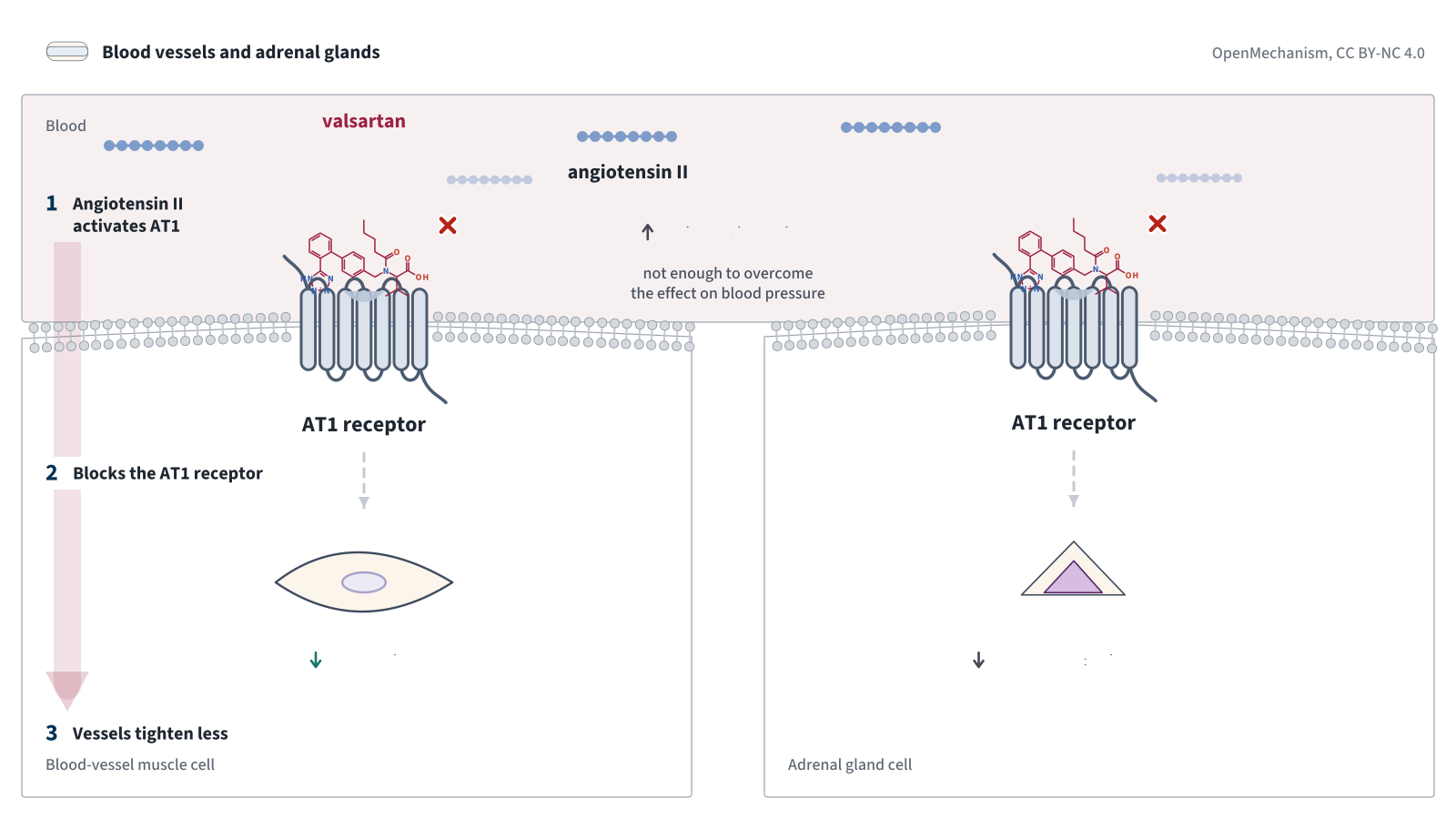
Key terms in this drawing
- aldosterone
- Aldosterone. Released by the adrenal glands, it helps the body keep sodium and fluid; angiotensin II stimulates its release.
- angiotensin II
- Angiotensin II. A hormone that strongly tightens blood vessels; ACE makes it from angiotensin I.
- AT1 receptor
- Angiotensin II type 1 receptor. The receptor angiotensin II acts on to tighten blood vessels and stimulate aldosterone release.
- renin
- Renin. An enzyme that cuts angiotensinogen to make angiotensin I.
How it works
Angiotensin II activates AT1. Angiotensin II, made from angiotensin I by the enzyme (angiotensin-converting enzyme), is the main pressure-raising agent of the renin-angiotensin system. Its effects include tightening blood vessels, stimulating the making and release of aldosterone, stimulating the heart and making the kidneys take back sodium.1
Blocks the AT1 receptor. Valsartan selectively blocks angiotensin II from binding the AT1 receptor in many tissues, such as blood-vessel muscle and the adrenal gland. It binds AT1 about 20,000 times more strongly than the AT2 receptor (a second angiotensin II receptor, found in many tissues but not known to be linked to the steady control of the heart and circulation), and because it acts at the receptor, it works however the angiotensin II was made. It does not inhibit ACE, the enzyme ACE inhibitors block, so it does not affect the response to bradykinin, which ACE also breaks down; the label says whether this difference has clinical relevance is not yet known.1
Vessels tighten less. Valsartan blocks angiotensin II's vessel-tightening and aldosterone-releasing effects: an 80 mg dose by mouth blocks about 80% of the pressure rise from infused angiotensin II when its effect peaks, and about 30% is still blocked after 24 hours. Blocking the receptor also lifts angiotensin II's brake on renin release (negative feedback): in people with high blood pressure this raises renin 2- to 3-fold, and angiotensin II with it, but not enough to overcome valsartan's effect on blood pressure. In studies, plasma aldosterone fell only a little.1
For teachers: download this drawing.
See also
Condition pages: heart attack, heart failure and high blood pressure.
Other angiotensin receptor blockers (ARBs): irbesartan, losartan and olmesartan.
Explained: why ACE inhibitors and ARBs can harm a fetus; and ACE inhibitors with ARBs or aliskiren.
Body system: heart, vessels & cholesterol.
Sources
- 1Diovan (valsartan) tablets: FDA label1 Indications and Usage; 12.1 Mechanism of Action; 12.2 Pharmacodynamics
- 2ChEMBL CHEMBL1069Target and action classification: Type-1 angiotensin II receptor antagonist
Spotted a mistake? Report an error (hello@openmechanism.com). Since launch, every published error we fix is listed on the corrections page.
Notes and limits
- A schematic teaching drawing: not to scale, not exact structures, binding poses or a complete pathway, and not a guide to dosing, treatment or how a person will respond.
All recorded limits are on the evidence page, and notes that apply to every page are on How to read a page. Version 1.0.1, medically reviewed by Daniel Tran, PharmD, on 28 October 2026.
Cite this page
Tran D. Valsartan [Internet]. OpenMechanism; 2026 [updated 2026 Oct 28; cited 2026 Oct 28]. Available from: https://openmechanism.com/medicines/valsartan