Metoprolol
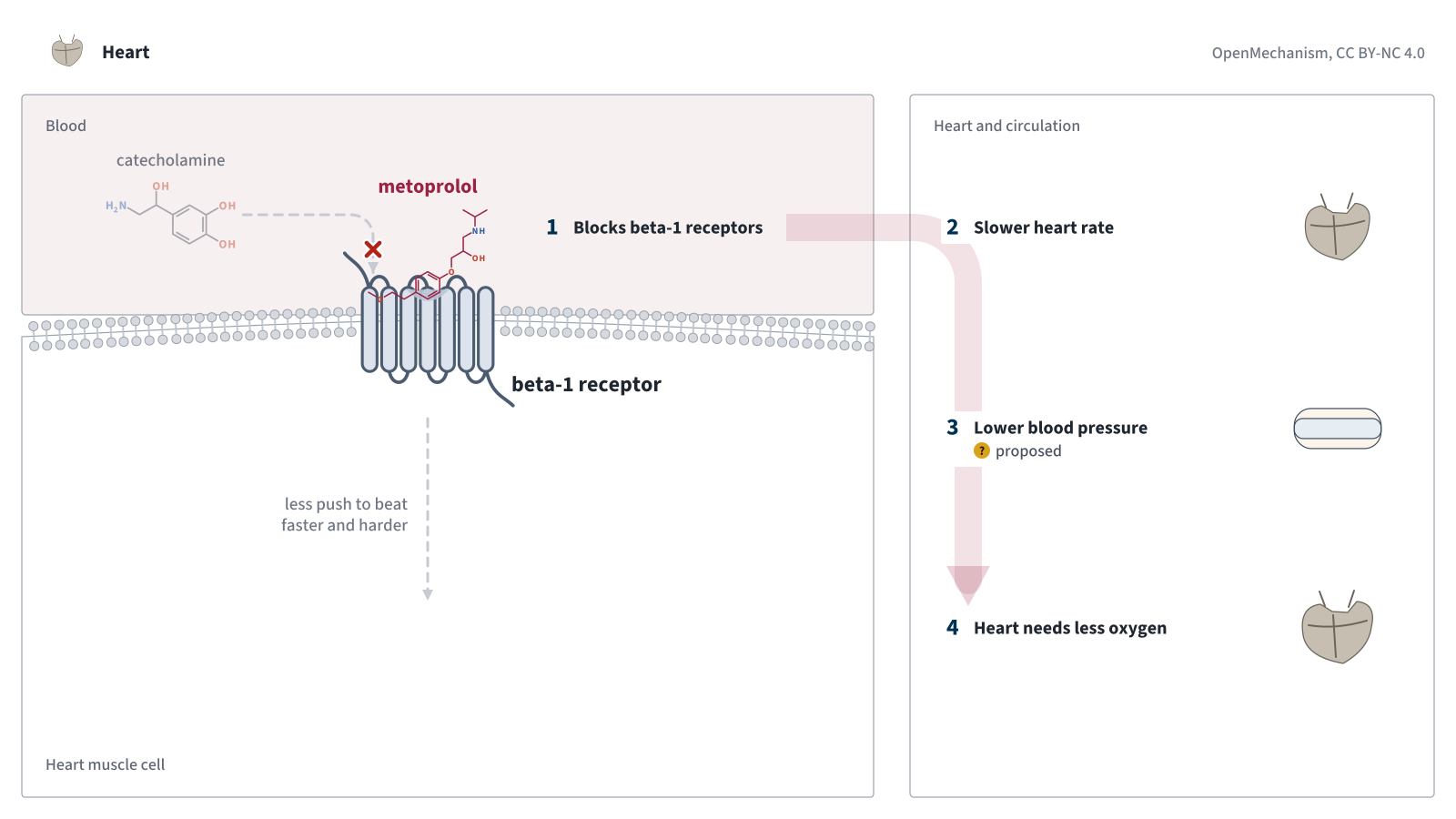
Metoprolol blocks , mainly in the heart (at higher levels it blocks beta-2 receptors too), so catecholamines speed the heart up less. The heart beats more slowly and needs less oxygen. It also lowers blood pressure; the label lists proposed mechanisms, as how is not fully worked out.
- Acts on
- Beta-1 adrenergic receptors (beta-1-selective; not absolute)
- Where
- Heart
- Medicine type
- Small molecule
- Used for
- Heart & circulation
- Drug class
- Beta blockers
Also called Toprol-XL (extended-release metoprolol succinate).
Step 3: proposed
The Toprol-XL (metoprolol) label says: The mechanism of the antihypertensive effects of beta-blocking agents has not been elucidated. However, several possible mechanisms have been proposed
Source 1: Toprol-XL (metoprolol succinate) extended-release tablets: FDA label, 12.1 Mechanism of Action
Clinical study: In a 1984 study in people with essential high blood pressure, recordings from a leg nerve made before and during long-term metoprolol treatment showed less sympathetic activity during treatment than before it: Metoprolol treatment lowered blood pressure and heart rate in all subjects. … It is suggested that the reduction of sympathetic vasoconstrictor outflow to muscles contributed to the blood pressure reduction.
Wallin BG et al., Hypertension 1984 (PMID 6378790)
Key terms in this drawing
- beta-1 receptor
- Beta-1 adrenergic receptor. A receptor, mainly in the heart, through which catecholamines make the heart beat faster and harder.
How it works
Blocks beta-1 receptors. Metoprolol is a beta-1-selective (cardioselective) adrenergic receptor blocking agent. The preference is not absolute: at higher plasma concentrations it also blocks beta-2 receptors, chiefly in the muscle of the airways and blood vessels.1
Slower heart rate. Animal and human experiments indicate that metoprolol slows the sinus rate and decreases conduction through the .1
Lower blood pressure. The label says how beta-blocking agents lower blood pressure has not been elucidated, and that several possible mechanisms have been proposed: competitive antagonism of catecholamines at peripheral (especially cardiac) adrenergic neuron sites, which decreases cardiac output; a central effect that reduces sympathetic outflow to the periphery; and suppression of activity. In a 1984 study of people with essential high blood pressure, nerve recordings during long-term metoprolol showed less sympathetic activity to the muscles than before treatment, which the authors suggested contributed to the fall in blood pressure.1,2
Heart needs less oxygen. By blocking catecholamine-driven increases in heart rate, in the speed and extent of heart muscle contraction, and in blood pressure, metoprolol reduces the heart's oxygen needs at any level of effort.1
For teachers: download this drawing.
See also
Condition pages: angina, heart failure and high blood pressure.
Other beta blockers: atenolol, carvedilol, esmolol, labetalol, nebivolol, propranolol, sotalol and timolol.
Explained: why beta-blockers can hide low blood sugar, why beta-blockers can tighten the airways and verapamil with beta-blockers.
Body system: heart, vessels & cholesterol.
Sources
- 1Toprol-XL (metoprolol succinate) extended-release tablets: FDA label12.1 Mechanism of Action
- 2Sympathetic outflow to muscles during treatment of hypertension with metoprololWallin BG et al., Hypertension 1984 (abstract)
- 3ChEMBL CHEMBL13Target and action classification: Beta-1 adrenergic receptor antagonist
Spotted a mistake? Report an error (hello@openmechanism.com). Since launch, every published error we fix is listed on the corrections page.
Notes and limits
- A schematic teaching drawing: not to scale, not exact structures, binding poses or a complete pathway, and not a guide to dosing, treatment or how a person will respond.
- The label says the mechanism of the antihypertensive effects of beta-blocking agents has not been elucidated, and neither has the precise mechanism of their benefit in heart failure.
All recorded limits are on the evidence page, and notes that apply to every page are on How to read a page. Version 1.0.1, medically reviewed by Daniel Tran, PharmD, on 28 October 2026.
Cite this page
Tran D. Metoprolol [Internet]. OpenMechanism; 2026 [updated 2026 Oct 28; cited 2026 Oct 28]. Available from: https://openmechanism.com/medicines/metoprolol