Verapamil
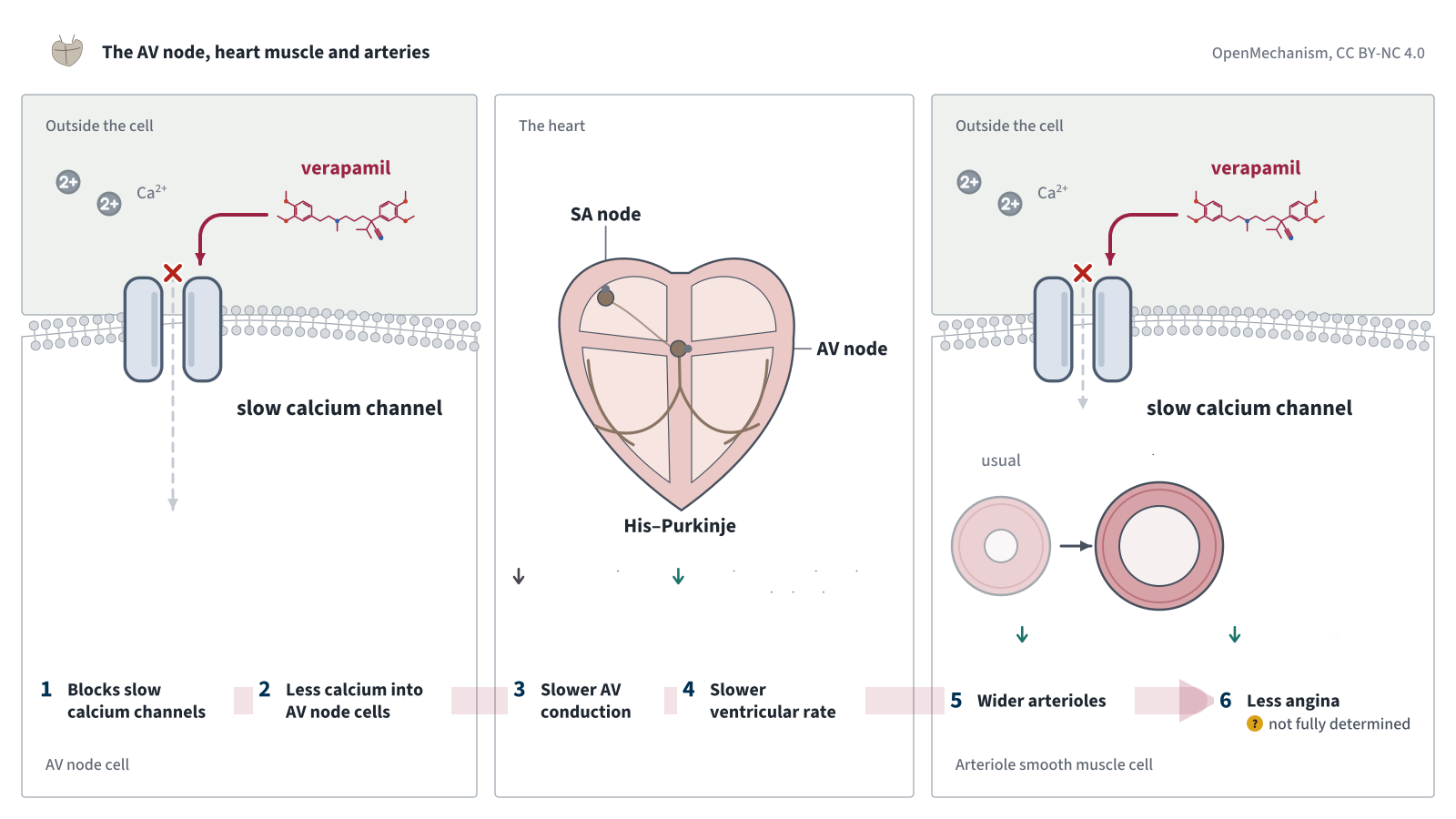
Verapamil blocks slow calcium channels. Conduction through the depends to a significant degree on calcium entering through them, so AV conduction slows and the node takes longer to recover; this slows the ventricular rate in chronic atrial flutter or fibrillation, though the label reports a faster ventricular rate or ventricular fibrillation when an accessory pathway is also present. It also widens arterioles, and blood pressure falls.
- Acts on
- L-type (slow) calcium channels
- Where
- The AV node, heart muscle and arteries
- Medicine type
- Small molecule
- Used for
- Heart & circulation
- Drug class
- Calcium channel blockers
Step 6: not fully determined
The verapamil label says: The precise mechanism of action of verapamil hydrochloride as an antianginal agent remains to be fully determined, but includes the following two mechanisms:
Clinical study: In a 1981 double-blind, randomized trial lasting nine months in 16 people with variant (vasospastic) angina, comparing verapamil with placebo; the trial measured chest pains, not how verapamil relieves angina: During treatment with verapamil, the frequency of angina fell substantially (12.6 +/- 25.9 chest pains per week with placebo, 1.7 +/- 2.8 pains per week with verapamil, mean +/- S.D.; P less than 0.01)
Johnson SM et al., N Engl J Med 1981 (PMID 6782480)
Key terms in this drawing
- AV node
- Atrioventricular node. The part of the heart's wiring that passes each beat's electrical impulse from the upper chambers (atria) to the lower chambers (ventricles).
- SA node
- Sinoatrial node. The place in the heart where each heartbeat's electrical impulse starts.
How it works
Blocks slow calcium channels. Verapamil is a calcium ion influx inhibitor (slow-channel blocker): it modulates the influx of calcium across the cell membranes of arterial smooth muscle and of conducting and contracting heart muscle cells.1
Less calcium into AV node cells. Electrical activity through the AV node depends to a significant degree on calcium influx through the slow channel, and verapamil decreases that influx.1
Slower AV conduction. It prolongs the effective refractory period within the AV node and slows AV conduction in a rate-related manner.1
Slower ventricular rate. This accounts for its ability to slow the ventricular rate in chronic atrial flutter or atrial fibrillation; it also reduces how often episodes of paroxysmal supraventricular tachycardia occur.1
Wider arterioles. Verapamil widens peripheral arterioles, lowering the total peripheral resistance (afterload) the heart works against at rest and during exercise, and it lowers blood pressure by decreasing systemic vascular resistance. It also weakens heart muscle contraction, which the lower afterload usually offsets.1
Less angina. How verapamil relieves angina remains to be fully determined. In effort angina, unloading the heart lowers its energy use and oxygen needs, which probably accounts for its effect; in vasospastic and unstable angina at rest, it widens the coronary arteries and blocks their spasm.1
For teachers: download this drawing.
See also
Condition pages: angina, atrial fibrillation, high blood pressure and supraventricular tachycardia (SVT).
Other calcium channel blockers: amlodipine, diltiazem, nicardipine and nifedipine.
Explained: colchicine with clarithromycin; digoxin and P-glycoprotein blockers; and verapamil with beta-blockers.
Body system: heart, vessels & cholesterol.
Sources
- 1Verapamil hydrochloride tablets: FDA labelClinical Pharmacology; Mechanism of Action; Indications and Usage
- 2ChEMBL CHEMBL6966Target and action classification: Voltage-gated L-type calcium channel blocker
- 3A controlled trial of verapamil for Prinzmetal's variant anginaJohnson SM et al. N Engl J Med 1981 (abstract)
Spotted a mistake? Report an error (hello@openmechanism.com). Since launch, every published error we fix is listed on the corrections page.
Notes and limits
- A schematic teaching drawing: not to scale, not exact structures, binding poses or a complete pathway, and not a guide to dosing, treatment or how a person will respond.
- Normal sinus rhythm is usually not affected, but in sick sinus syndrome verapamil may interfere with sinus-node impulse generation and may cause sinus arrest or sinoatrial block (per the label).
- In atrial flutter or fibrillation with an accessory AV pathway, a faster ventricular rate or ventricular fibrillation has been reported after verapamil (per the label).
- The label says the precise mechanism of verapamil as an antianginal agent remains to be fully determined, but includes those shown.
All recorded limits are on the evidence page, and notes that apply to every page are on How to read a page. Version 1.0.1, medically reviewed by Daniel Tran, PharmD, on 29 October 2026.
Cite this page
Tran D. Verapamil [Internet]. OpenMechanism; 2026 [updated 2026 Oct 29; cited 2026 Oct 29]. Available from: https://openmechanism.com/medicines/verapamil