Why stimulants can raise heart rate and blood pressure
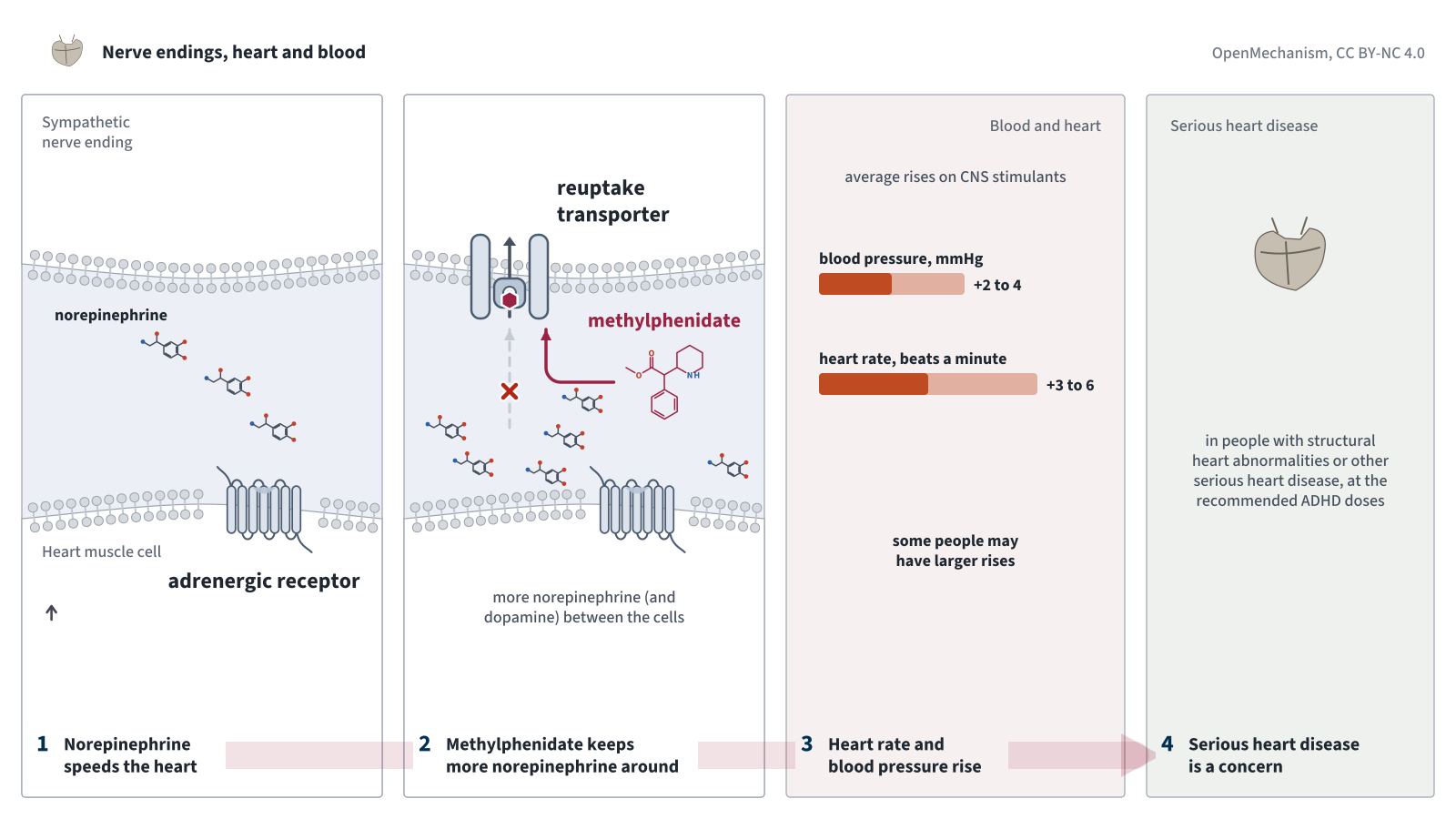
Norepinephrine and epinephrine raise the heart rate and blood pressure. Methylphenidate, an ADHD stimulant, blocks the reuptake of norepinephrine and dopamine and increases their release. Stimulants raise blood pressure by about 2 to 4 mmHg and heart rate by about 3 to 6 beats a minute on average, and some people may have larger rises.
- Kind
- Side effect
- Medicines
- Methylphenidate
- Sources
- 5
For teachers: download this drawing.
Step by step
Norepinephrine speeds the heart. Sympathetic nerve endings release norepinephrine, and epinephrine and norepinephrine (adrenaline and noradrenaline) act on adrenergic receptors on the cells of organs such as the heart. They raise the heart rate and blood pressure, readying the body to fight or flee.1,2,3
What the source says
“Examples of catecholamines are epinephrine (adrenaline), norepinephrine (noradrenaline) and dopamine, all of which participate in a wide variety of functions throughout the body.”
Source 1“By blocking catecholamine-induced increases in heart rate, in velocity and extent of myocardial contraction, and in blood pressure, metoprolol reduces the oxygen requirements of the heart at any given level of effort”
Source 2“During the "fight-or-flight response," the rise in circulating epinephrine and norepinephrine from the adrenal medulla and norepinephrine secreted from sympathetic nerve terminals cause increased blood pressure and cardiac output”
Source 3“The catecholamine neurohormones interact with adrenergic receptors present on cell membranes of all visceral organs and smooth muscles”
Source 3Methylphenidate keeps more norepinephrine around. Methylphenidate blocks the of norepinephrine and dopamine into the nerve endings that released them, and increases their release into the space outside the cells.4
What the source says
“Methylphenidate blocks the reuptake of norepinephrine and dopamine into the presynaptic neuron and increases the release of these monoamines into the extraneuronal space.”
Source 4Heart rate and blood pressure rise. Stimulants raise blood pressure by about 2 to 4 mmHg and heart rate by about 3 to 6 beats a minute on average, and some people may have larger rises.5
Serious heart disease is a concern. Sudden death has been reported in people with structural heart abnormalities or other serious heart disease treated with stimulants at the recommended doses.5
What the source says
“Sudden death has been reported in patients with structural cardiac abnormalities or other serious cardiac disease who are treated with CNS stimulants at the recommended ADHD dosage.”
Source 5
See also
Medicine pages: methylphenidate.
Other side effects (brain & nerves): why antipsychotics can cause movement problems; why antipsychotics can raise prolactin; why bupropion carries a risk of seizures; why clozapine can lower white blood cells; why lithium can cause diabetes insipidus; why morphine slows the gut and breathing; why ropinirole can bring on compulsive urges; why SSRIs can lower sodium; why SSRIs can raise the risk of bleeding; why too much acetaminophen harms the liver; and all 65 side effects.
Conditions: ADHD and high blood pressure.
Interactions: MAO inhibitors and tyramine.
Sources
- 1Catecholamine: NCI Thesaurus definitionNCI definition, concept C88516. Saved copy
- 2Toprol-XL (metoprolol succinate): FDA label12.1 Mechanism of Action. Saved copy
- 3Peripheral and central effects of circulating catecholaminesTank AW, Lee Wong D. Compr Physiol 2015 (abstract). Saved copy
- 4Ritalin (methylphenidate): FDA label12.1 Mechanism of Action; 12.2 Pharmacodynamics. Saved copy
- 5Ritalin (methylphenidate): FDA label5.2 Risks to Patients with Serious Cardiac Disease; 5.3 Increased Blood Pressure and Heart Rate. Saved copy
Notes and limits
- How methylphenidate works in ADHD is not known.4
Notes that apply to every page are on How to read a page.
Spotted a mistake? Report an error (hello@openmechanism.com). Since launch, every published error we fix is listed on the corrections page.
Cite this page
Tran D. Why stimulants can raise heart rate and blood pressure [Internet]. OpenMechanism; 2026 [updated 2026 Nov 13; cited 2026 Nov 13]. Available from: https://openmechanism.com/explained/stimulants-and-heart-rate