Labetalol
Labetalol blocks beta receptors of both types and, in the same molecule, ; given into a vein, its beta blockade is about seven times its alpha blockade. It lowers blood pressure without a reflex speeding of the heart, presumably through this mix of effects.
- Acts on
- Beta-1 and beta-2 adrenergic receptors; alpha-1 adrenergic receptors
- Where
- Heart and blood vessels
- Medicine type
- Small molecule
- Used for
- Heart & circulation
- Drug class
- Beta blockers
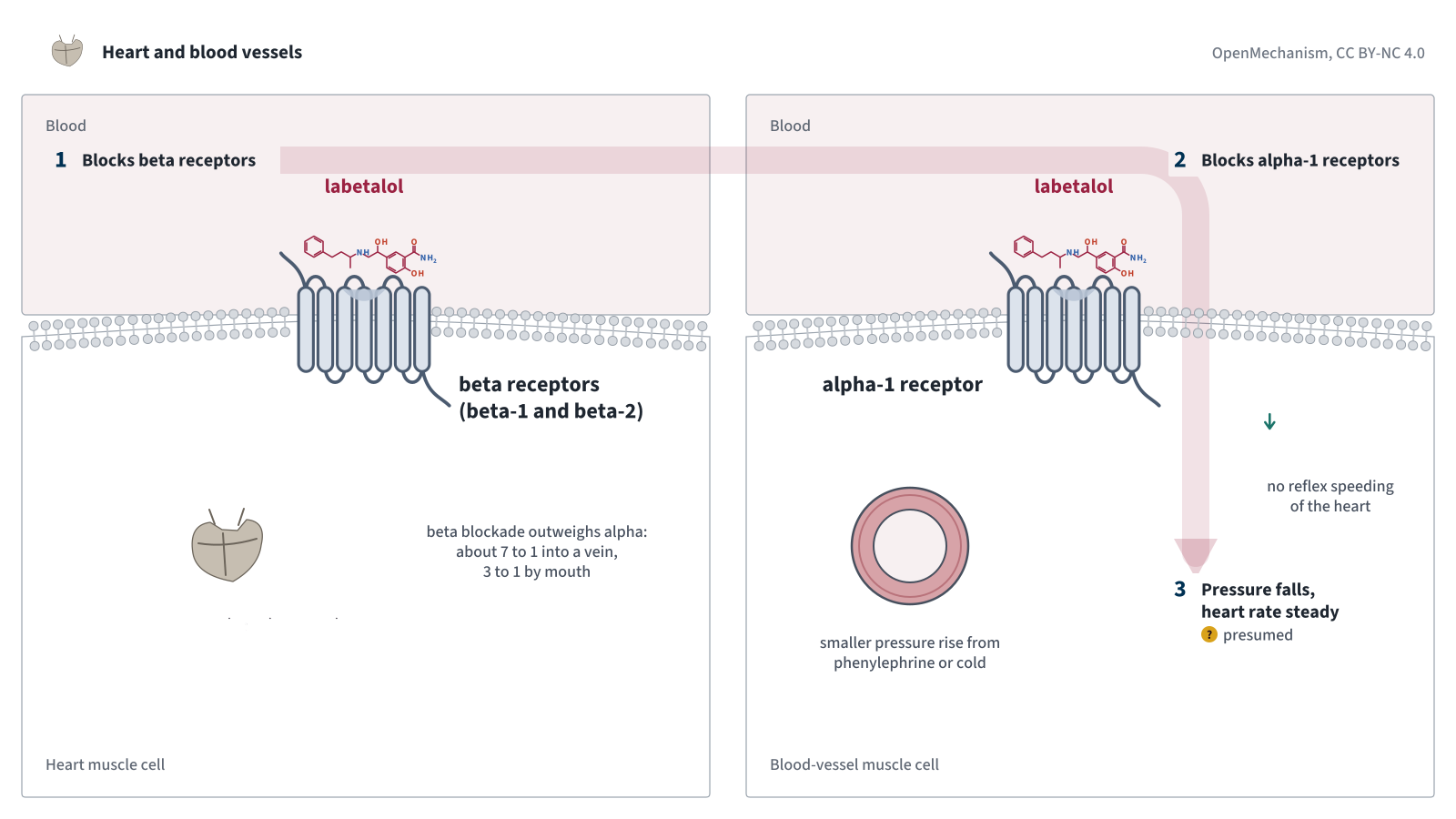
Step 3: presumed
The labetalol injection label says: Labetalol produces dose-related falls in blood pressure without reflex tachycardia and without significant reduction in heart rate, presumably through a mixture of its alpha-blocking and beta-blocking effects.
Clinical study: In a physiology study in healthy volunteers given labetalol into a vein, which measured its blockade of alpha and beta receptors against phenylephrine and isoprenaline; it tests the step itself: The ratio of relative potency alpha: beta adrenoceptor antagonism after intravenous labetalol was approximately 1:7, whereas in the same subjects after oral labetalol the ratio was approximately 1:3 as previously reported. … Labetalol produced adrenoceptor blockade at both alpha and beta sites in man sufficient to explain its therapeutic antihypertensive effect.
Richards DA et al., Br Heart J 1977 (PMID 12778)
This study was picked with a literature search and is not yet checked by our reviewer.
Key terms in this drawing
- alpha-1 receptor
- Alpha-1 adrenergic receptor. Alpha-1 adrenergic receptors come in at least three subtypes, A, B and D; alpha-1A may have a main role in prostate obstruction, alpha-1B in tightening arteries.
How it works
Blocks beta receptors. Labetalol blocks beta receptors of both types (nonselective, competitive blockade). In people this was shown by a small fall in the resting heart rate and by a blunted speeding of the heart with isoproterenol or exercise.1
Blocks alpha-1 receptors. The same molecule also blocks alpha-1 receptors (selective, competitive blockade): in people it blunted the rise in blood pressure caused by phenylephrine or by putting a hand in ice-cold water (the cold-pressor test). In people, the ratio of alpha to beta blockade has been estimated at about 1 to 7 when it is given into a vein and about 1 to 3 by mouth.1
Pressure falls, heart rate steady. Labetalol lowers blood pressure in step with the dose, without a reflex speeding of the heart and without a significant fall in heart rate, presumably through the mix of its alpha- and beta-blocking effects. Its effect on the heart's output varies between studies, and the total resistance of the blood vessels falls a little.1
For teachers: download this drawing.
See also
Condition pages: high blood pressure.
Other beta blockers: atenolol, carvedilol, esmolol, metoprolol, nebivolol, propranolol, sotalol and timolol.
Body system: heart, vessels & cholesterol.
Sources
- 1Labetalol hydrochloride injection (Hospira): FDA labelClinical Pharmacology, including Pharmacodynamics
- 2ChEMBL CHEMBL429Target and action classification: Adrenergic receptor antagonist
- 3Pharmacological basis for antihypertensive effects of intravenous labetalolRichards DA et al. Br Heart J 1977 (abstract)
Spotted a mistake? Report an error (hello@openmechanism.com). Since launch, every published error we fix is listed on the corrections page.
Notes and limits
- A schematic teaching drawing: not to scale, not exact structures, binding poses or a complete pathway, and not a guide to dosing, treatment or how a person will respond.
- The label says labetalol lowers blood pressure without reflex tachycardia presumably through a mixture of its alpha-blocking and beta-blocking effects.
All recorded limits are on the evidence page, and notes that apply to every page are on How to read a page. Version 1.0.0, not yet medically reviewed.
Cite this page
Tran D. Labetalol [Internet]. OpenMechanism; 2026 [updated 2026 Oct 16; cited 2026 Oct 16]. Available from: https://openmechanism.com/medicines/labetalol