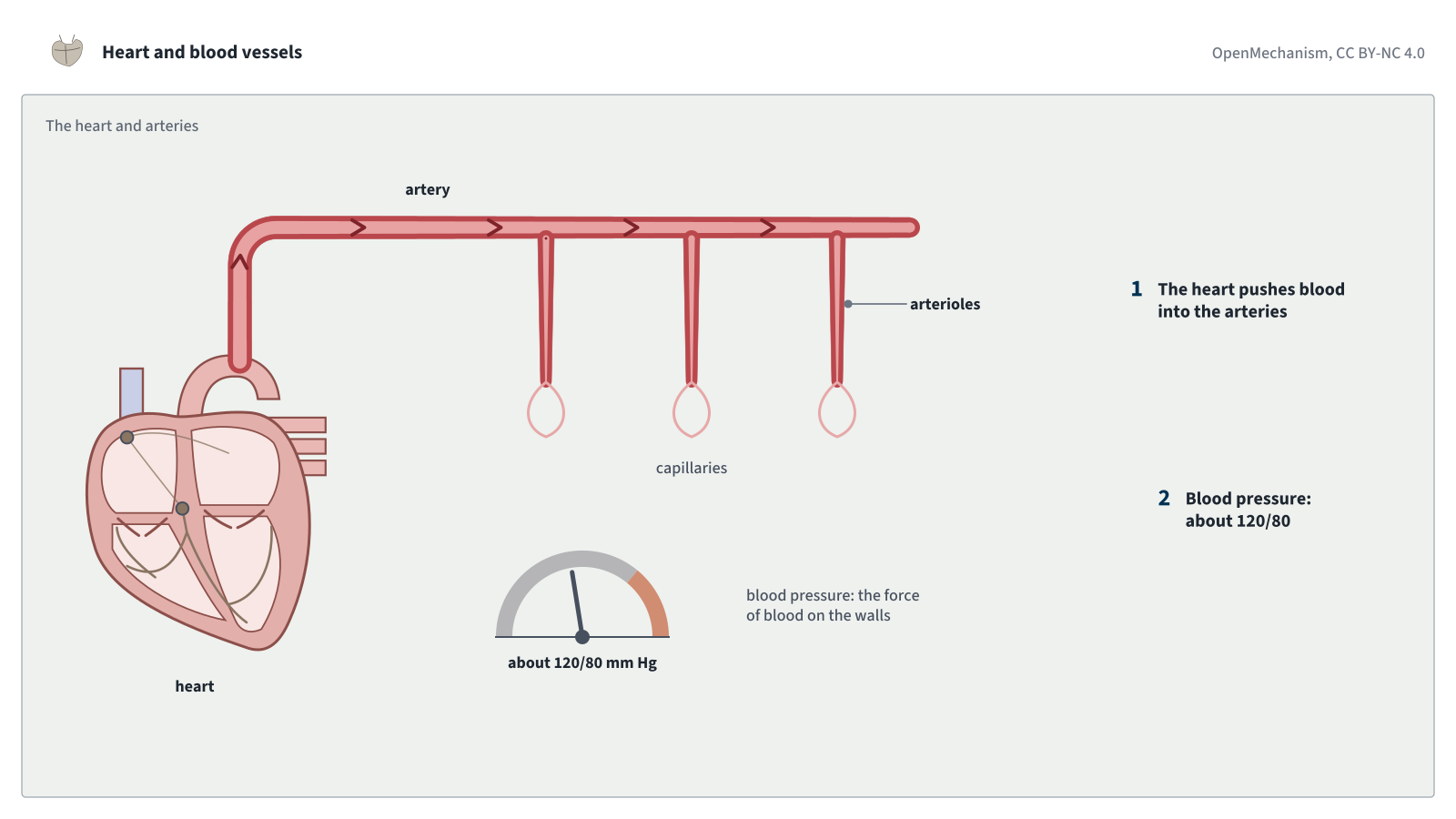
The heart pushes blood into the arteries. Each contraction of the heart's ventricles pushes blood into the large arteries; it flows from higher to lower pressure through smaller arteries, arterioles and capillaries.1
What the source says
“It is initiated by the contraction of the ventricles of the heart.”
“Ventricular contraction ejects blood into the major arteries, resulting in flow from regions of higher pressure to regions of lower pressure, as blood encounters smaller arteries and arterioles, then capillaries, then the venules and veins of the venous system.”
Blood pressure: about 120/80. Blood pressure is the force of the blood on the vessel walls; measured in an artery it is written as systolic over diastolic pressure, about 120/80 mm Hg in a normal adult.1
What the source says
“One form of hydrostatic pressure is blood pressure, the force exerted by blood upon the walls of the blood vessels or the chambers of the heart.”
“When systemic arterial blood pressure is measured, it is recorded as a ratio of two numbers (e.g., 120/80 is a normal adult blood pressure), expressed as systolic pressure over diastolic pressure.”
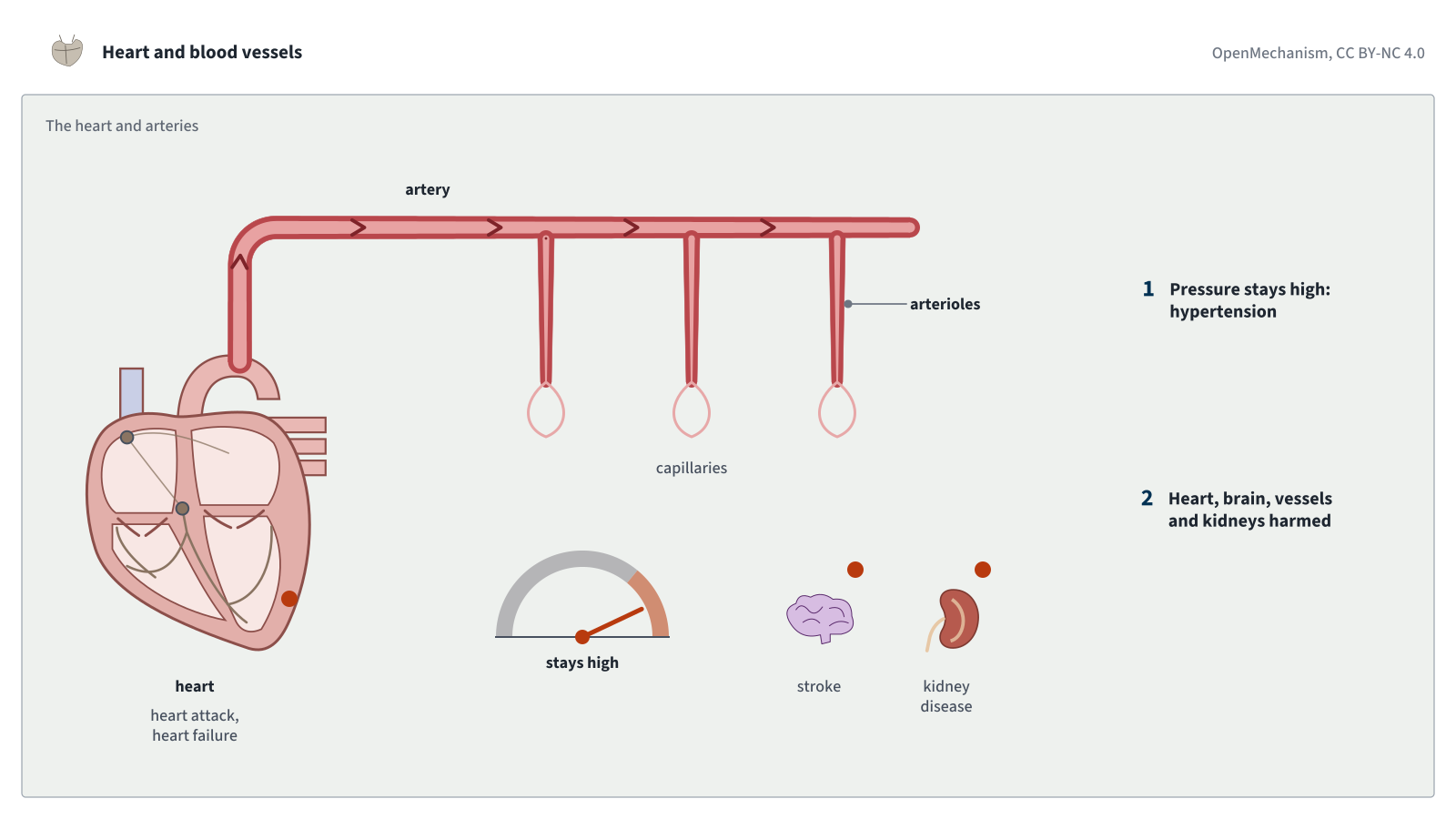
Heart, brain, vessels and kidneys harmed. It can lead to a heart attack or stroke, a ballooning of a weakened artery (aneurysm), blocked arteries in the limbs, chronic kidney disease or heart failure.2
“Hypertension may also lead to an aneurysm (ballooning of a blood vessel caused by a weakening of the wall), peripheral arterial disease (obstruction of vessels in peripheral regions of the body), chronic kidney disease, or heart failure.”
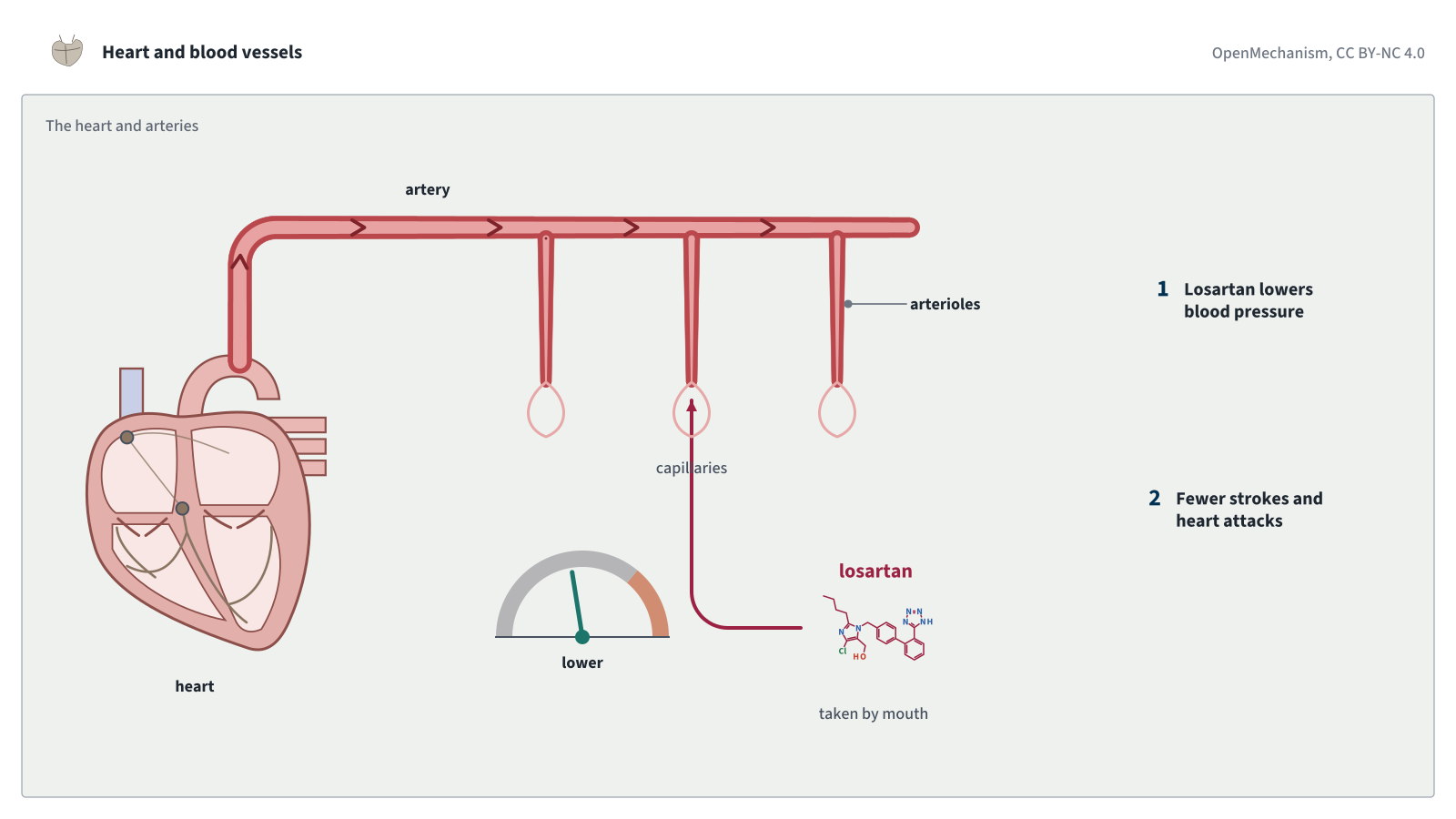
Fewer strokes and heart attacks. Lowering blood pressure lowers the risk of strokes and heart attacks; the benefit comes largely from the lower pressure itself, whichever medicine lowers it.4
What the source says
“Lowering blood pressure lowers the risk of fatal and nonfatal cardiovascular (CV) events, primarily strokes and myocardial infarction.”
“it can be concluded that it is blood pressure reduction, and not some other pharmacologic property of the drugs, that is largely responsible for those benefits.”
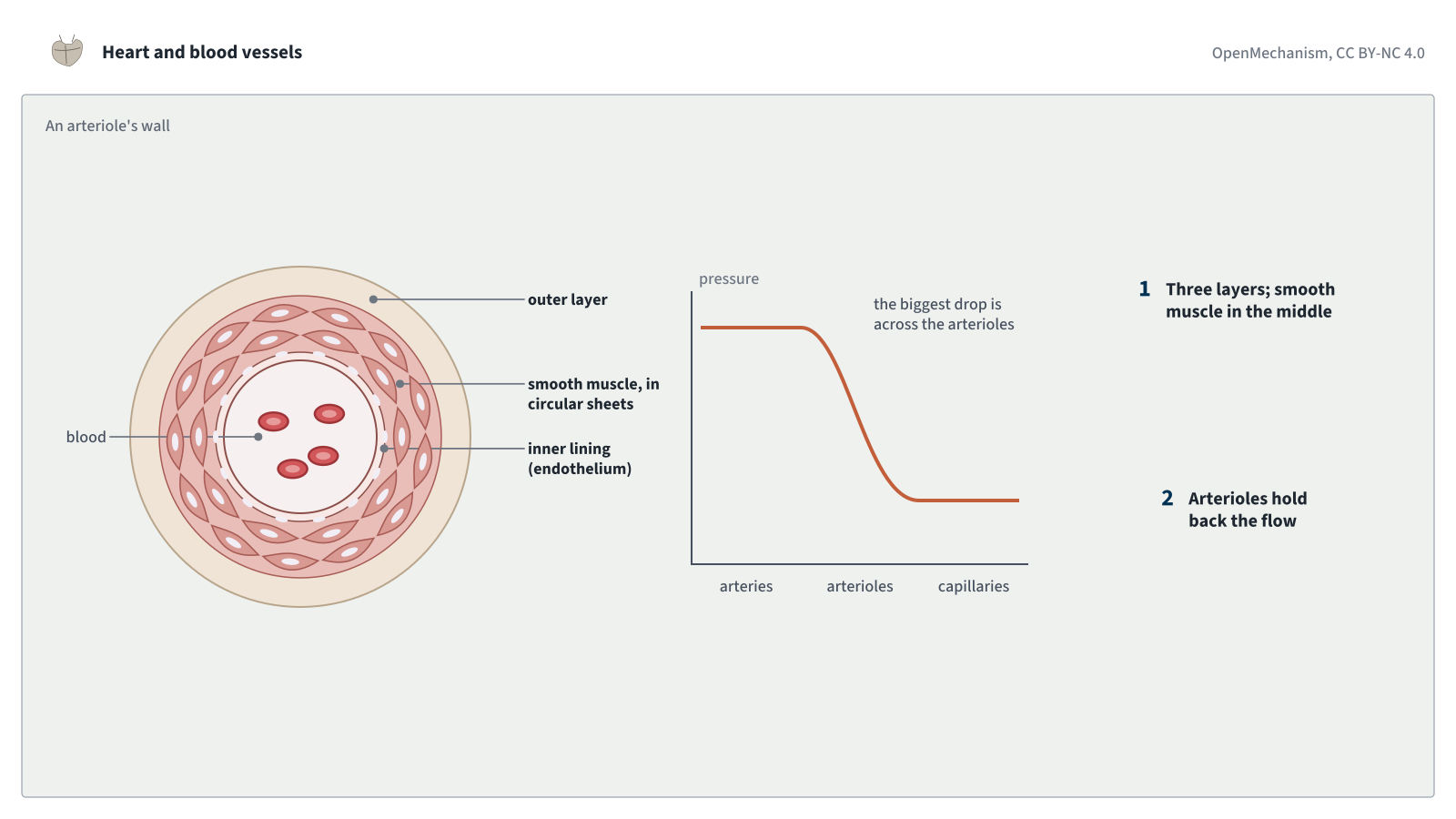
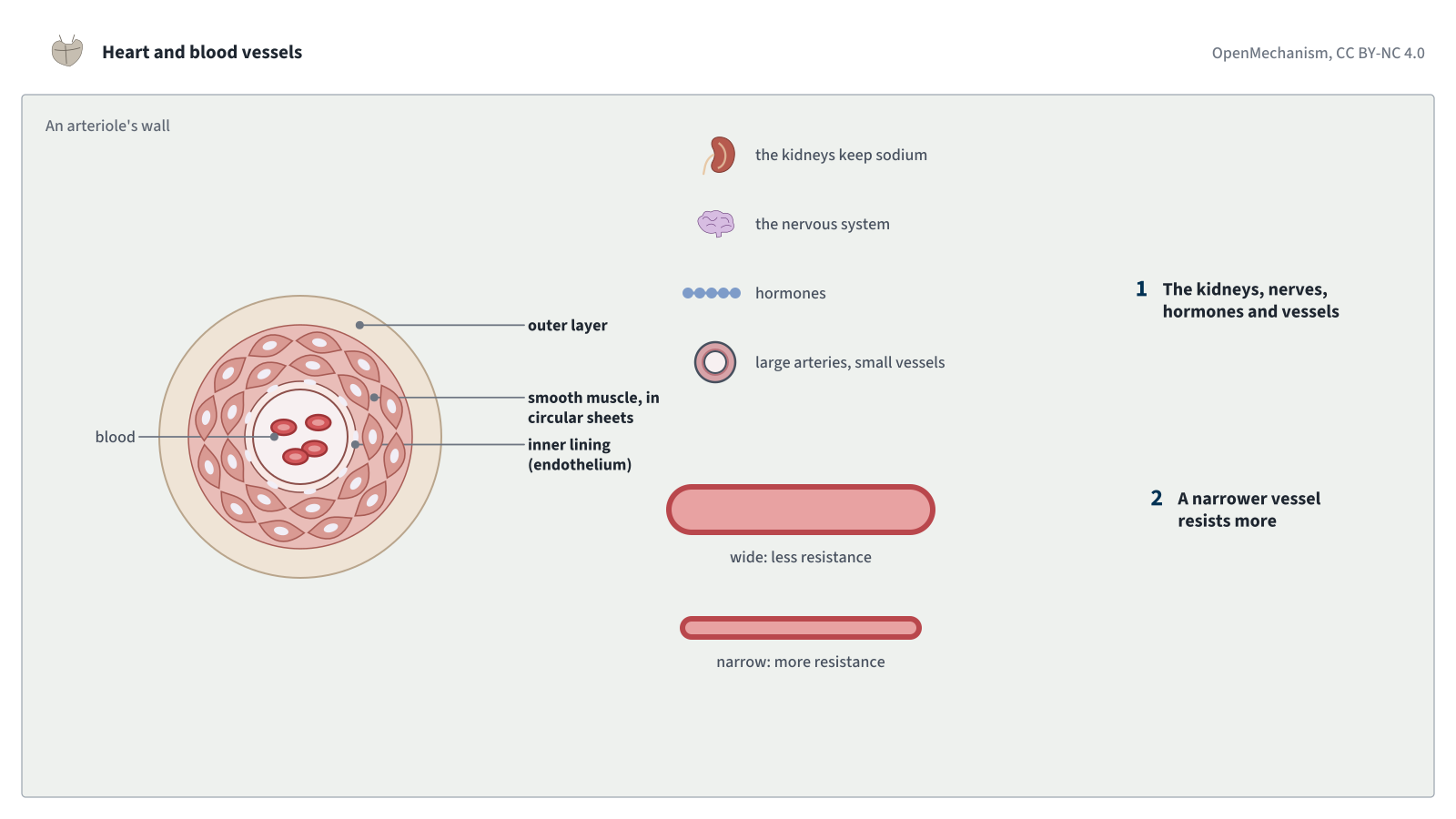
Three layers; smooth muscle in the middle. A vessel's wall has three layers: an inner lining (the endothelium), a middle layer of smooth muscle in circular sheets, and an outer layer.5
What the source says
“From the most interior layer to the outer, these tunics are the tunica intima, the tunica media, and the tunica externa”
“Lining the tunica intima is the specialized simple squamous epithelium called the endothelium, which is continuous throughout the entire vascular system, including the lining of the chambers of the heart.”
“The tunica media consists of layers of smooth muscle supported by connective tissue that is primarily made up of elastic fibers, most of which are arranged in circular sheets.”
Arterioles hold back the flow. Arterioles, the smallest arteries, resist the flow and so cause a large drop in pressure; their muscle is normally slightly contracted (vascular tone).5
What the source says
“With a lumen averaging 30 micrometers or less in diameter, arterioles are critical in slowing down—or resisting—blood flow and, thus, causing a substantial drop in blood pressure.”
“The muscle fibers in arterioles are normally slightly contracted, causing arterioles to maintain a consistent muscle tone—in this case referred to as vascular tone—in a similar manner to the muscular tone of skeletal muscle.”
The kidneys, nerves, hormones and vessels. In essential hypertension the kidneys cannot get rid of sodium at a normal blood pressure; the nervous system, hormones, the large arteries and the small vessels also play a part.3
What the source says
“The pathophysiology of essential hypertension depends on the primary or secondary inability of the kidney to excrete sodium at a normal blood pressure.”
A narrower vessel resists more. When a vessel narrows, more of the blood touches its wall and the resistance rises; a slight change in diameter makes a large change in resistance.1
What the source says
“A decreased diameter means more of the blood contacts the vessel wall, and resistance increases, subsequently decreasing flow.”
“The influence of lumen diameter on resistance is dramatic: A slight increase or decrease in diameter causes a huge decrease or increase in resistance.”
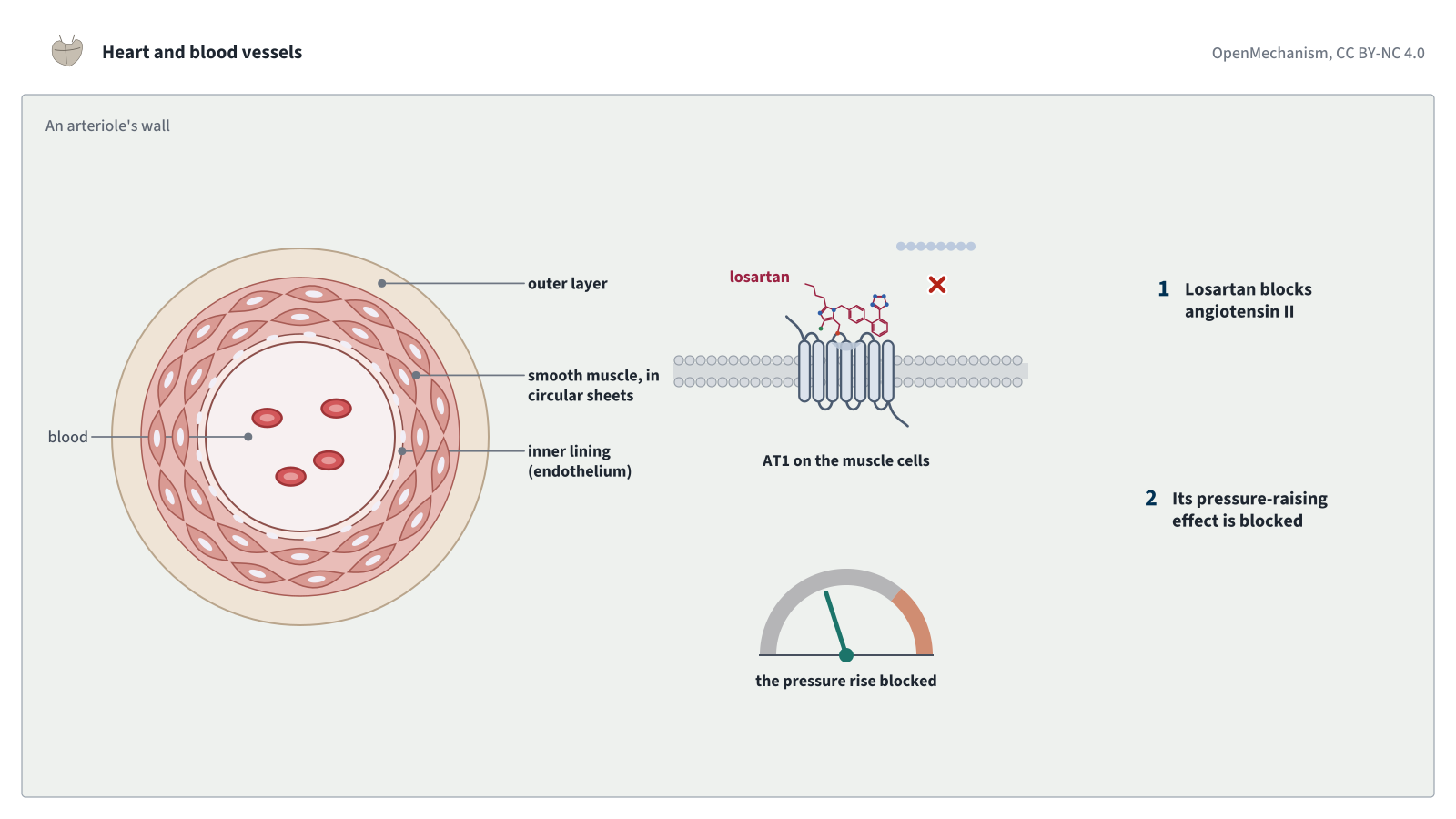
Losartan blocks angiotensin II. Losartan blocks from narrowing the vessels: it stops angiotensin II binding its receptor, , found in vascular smooth muscle.4
What the source says
“Losartan and its principal active metabolite block the vasoconstrictor and aldosterone-secreting effects of angiotensin II by selectively blocking the binding of angiotensin II to the AT 1 receptor found in many tissues, (e.g., vascular smooth muscle, adrenal gland).”
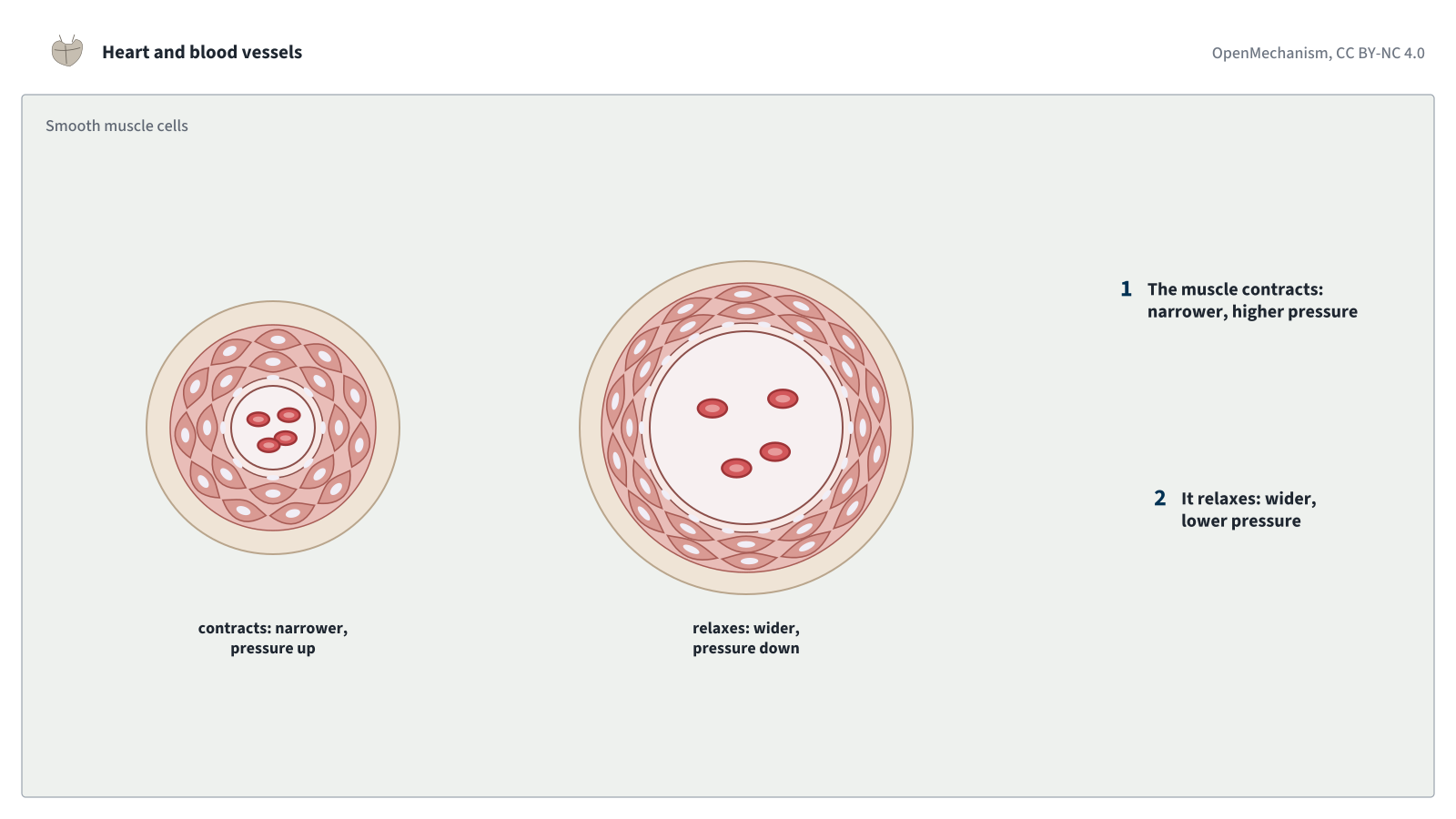
The muscle contracts: narrower, higher pressure. When the smooth muscle in an artery's wall contracts, the lumen narrows, blood flow falls and blood pressure rises (vasoconstriction).5
What the source says
“Specifically in arteries, vasoconstriction decreases blood flow as the smooth muscle in the walls of the tunica media contracts, making the lumen narrower and increasing blood pressure.”
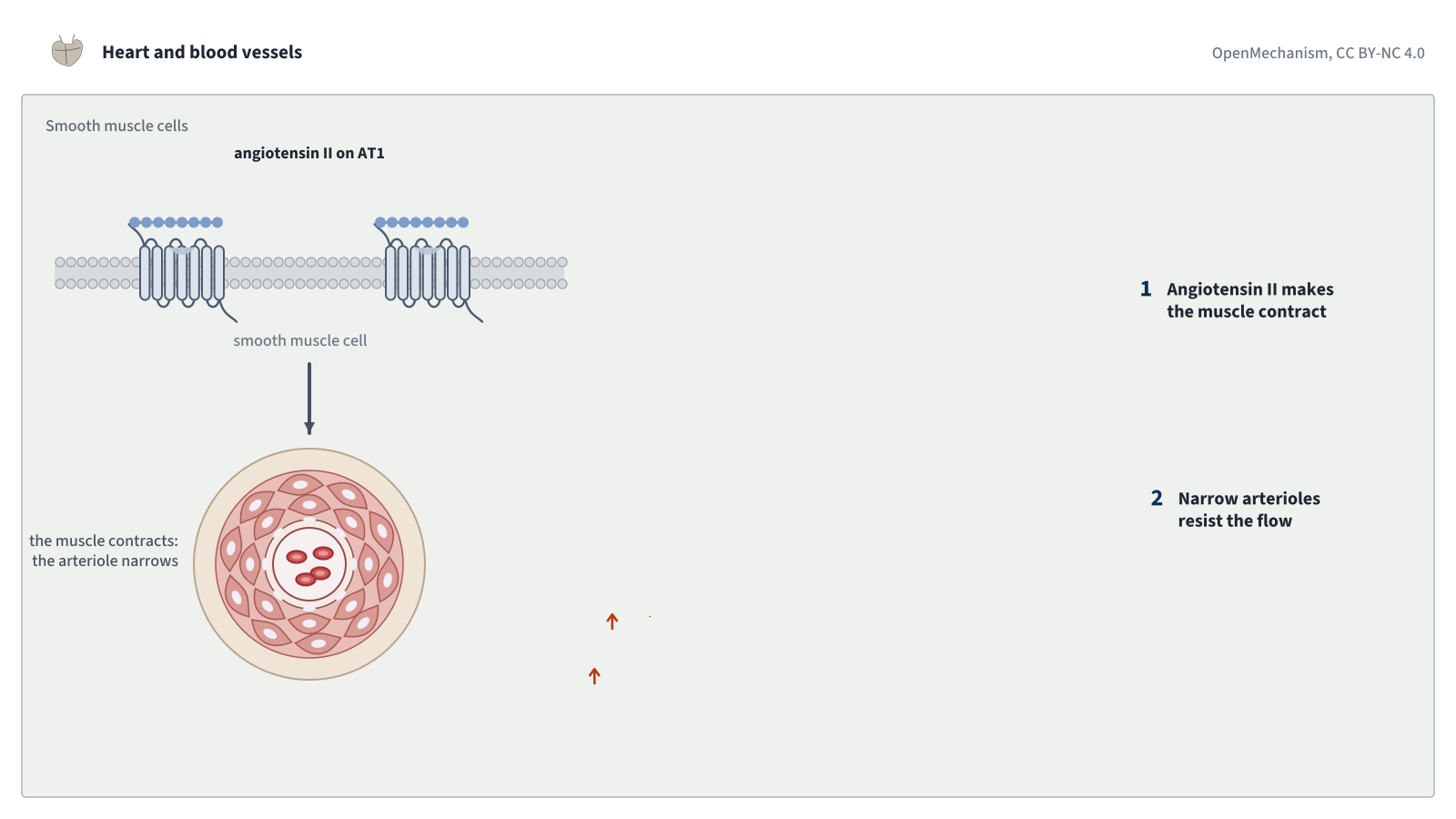
Angiotensin II makes the muscle contract. Angiotensin II is a powerful vasoconstrictor, the main hormone of the renin-angiotensin system acting on vessels, and an important part of high blood pressure.2,4
What the source says
“Angiotensin II is a powerful vasoconstrictor, greatly increasing blood pressure.”
“Angiotensin II [formed from angiotensin I in a reaction catalyzed by angiotensin converting enzyme (ACE, kininase II)] is a potent vasoconstrictor, the primary vasoactive hormone of the renin-angiotensin system, and an important component in the pathophysiology of hypertension.”
“Specifically in arteries, vasoconstriction decreases blood flow as the smooth muscle in the walls of the tunica media contracts, making the lumen narrower and increasing blood pressure.”
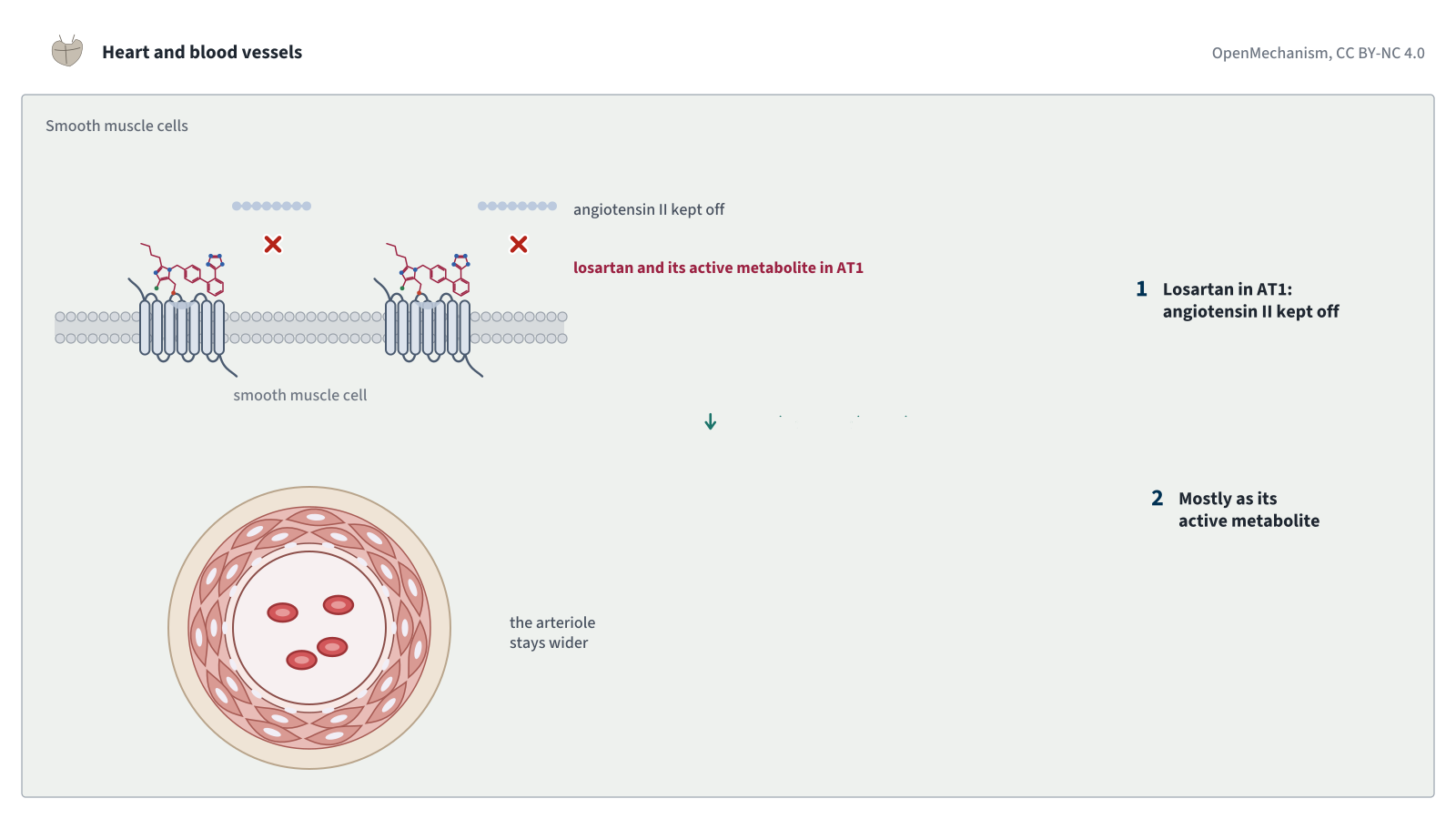
Losartan in AT1: angiotensin II kept off. Losartan sits in the AT1 receptor and competes with angiotensin II, which cannot bind; it does not act at all like angiotensin II there.4
What the source says
“Losartan and its principal active metabolite block the vasoconstrictor and aldosterone-secreting effects of angiotensin II by selectively blocking the binding of angiotensin II to the AT 1 receptor found in many tissues, (e.g., vascular smooth muscle, adrenal gland).”
“Neither losartan nor its principal active metabolite exhibits any partial agonist activity at the AT 1 receptor, and both have much greater affinity (about 1000-fold) for the AT 1 receptor than for the AT 2 receptor.”
Mostly as its active metabolite. In the body part of losartan becomes an active metabolite, 10 to 40 times more potent, which does most of the blocking.4
What the source says
“It is converted, in part, to an active carboxylic acid metabolite that is responsible for most of the angiotensin II receptor antagonism that follows losartan treatment.”
“The active metabolite is 10 to 40 times more potent by weight than losartan and appears to be a reversible, non-competitive inhibitor of the AT 1 receptor.”
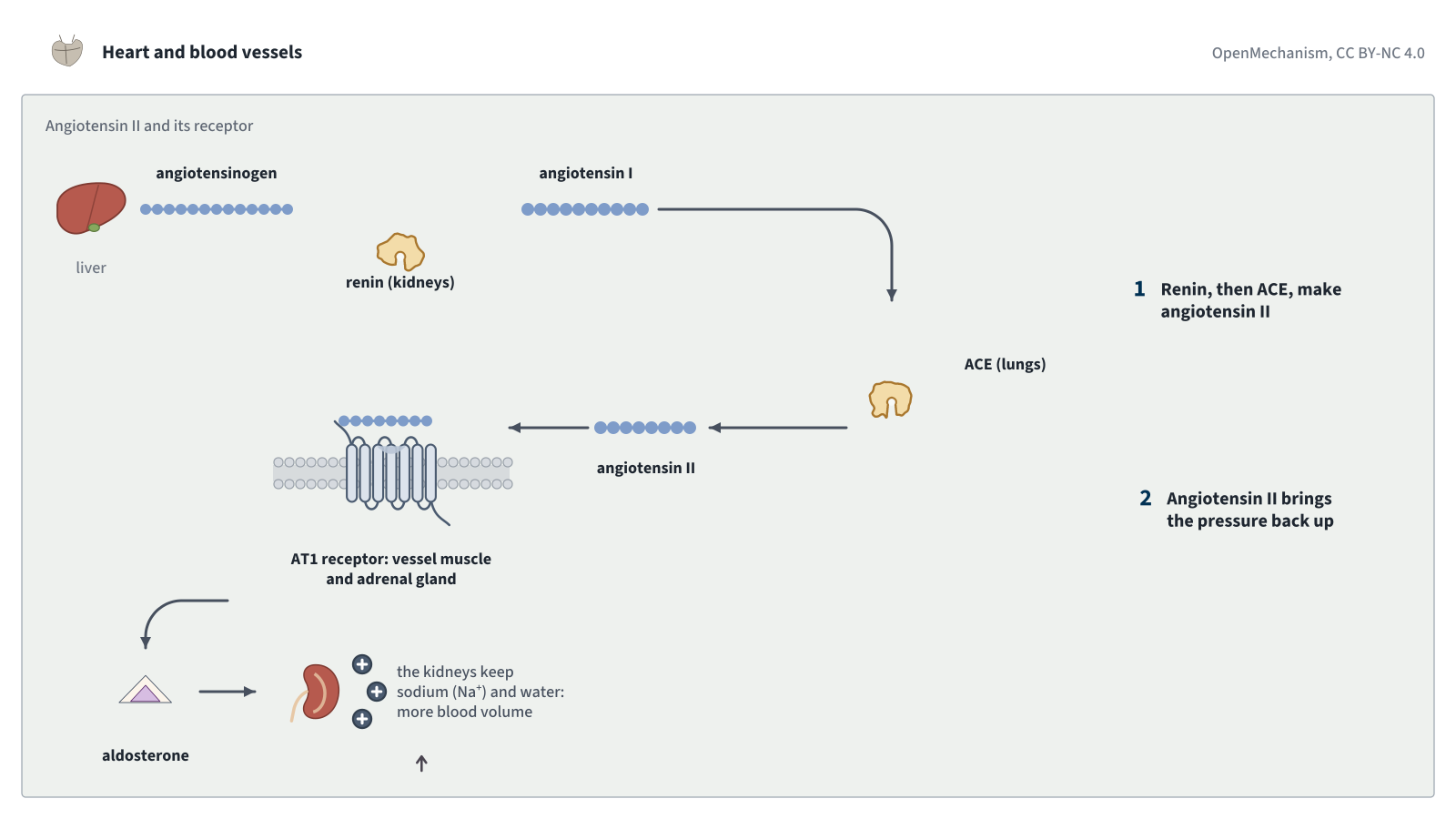
Renin, then ACE, make angiotensin II. When blood pressure falls, kidney cells release , which turns angiotensinogen from the liver into angiotensin I; the enzyme then converts it into angiotensin II.2
What the source says
“called juxtaglomerular (JG) cells, respond to decreased blood pressure by secreting renin into the blood.”
Angiotensin II brings the pressure back up. Angiotensin II narrows the vessels and makes the adrenal cortex release , so the kidneys keep sodium, and water with it; blood volume and pressure rise.2
What the source says
“Angiotensin II is a powerful vasoconstrictor, greatly increasing blood pressure.”
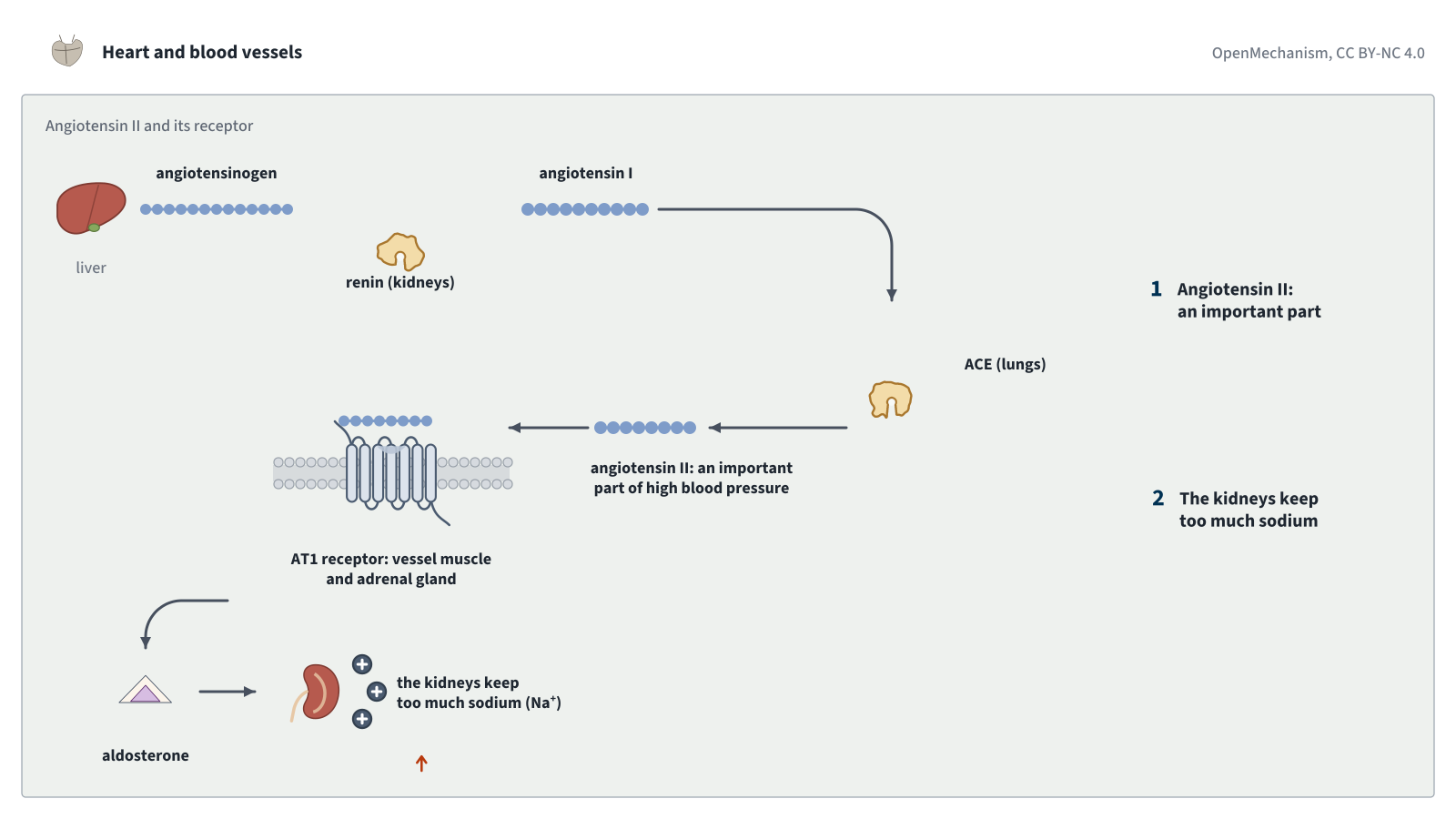
Angiotensin II: an important part. Angiotensin II, a potent vasoconstrictor that also makes the adrenal cortex release aldosterone, is an important part of high blood pressure.4
What the source says
“Angiotensin II [formed from angiotensin I in a reaction catalyzed by angiotensin converting enzyme (ACE, kininase II)] is a potent vasoconstrictor, the primary vasoactive hormone of the renin-angiotensin system, and an important component in the pathophysiology of hypertension.”
The kidneys keep too much sodium. In essential hypertension the kidneys cannot get rid of sodium at a normal blood pressure.3
What the source says
“The pathophysiology of essential hypertension depends on the primary or secondary inability of the kidney to excrete sodium at a normal blood pressure.”
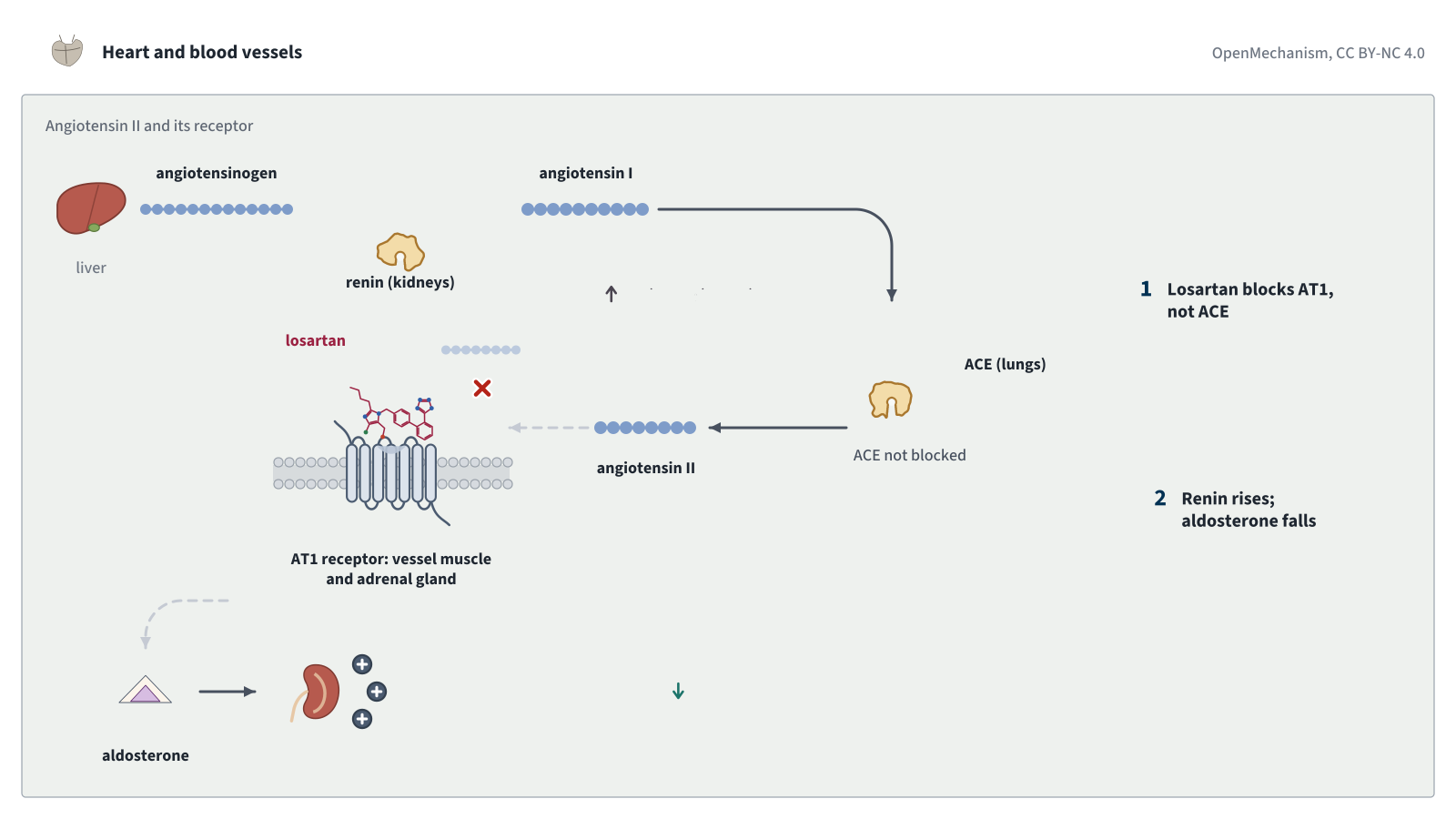
Losartan blocks AT1, not ACE. Losartan blocks the AT1 receptor; it does not block ACE, the enzyme that makes angiotensin II.4
What the source says
“Losartan and its principal active metabolite block the vasoconstrictor and aldosterone-secreting effects of angiotensin II by selectively blocking the binding of angiotensin II to the AT 1 receptor found in many tissues, (e.g., vascular smooth muscle, adrenal gland).”
“Neither losartan nor its active metabolite inhibits ACE (kininase II, the enzyme that converts angiotensin I to angiotensin II and degrades bradykinin), nor do they bind to or block other hormone receptors or ion channels known to be important in cardiovascular regulation.”
Renin rises; aldosterone falls. With angiotensin II's feedback removed, renin activity doubles or triples and angiotensin II levels rise; aldosterone levels fall.4
What the source says
“Removal of the negative feedback of angiotensin II causes a doubling to tripling in plasma renin activity and consequent rise in angiotensin II plasma concentration in hypertensive patients.”
Human renin with aliskirenPDB 2V0Z; Rahuel, J. et al. Chem.Biol. 2000;7:493-504. The renin outline in the drawings is traced from this structure. Saved copy
High blood pressure mostly comes from a mix of genes and environment, and many patients need more than one medicine to reach their blood pressure goal; losartan is one of several kinds.3,4
The drawings are schematic and not to scale; each shows only what the statements under it say.
Tran D. Blood pressure [Internet]. OpenMechanism; 2026 [updated 2026 Nov 13; cited 2026 Nov 13]. Available from: https://openmechanism.com/body/scales/blood-pressure