Nebivolol
Nebivolol blocks in most people at lower doses (beta-2 receptors too in poor metabolizers and at higher doses). Its breakdown products, made by several routes including the enzyme , also block beta receptors. It lowers blood pressure, but how is not definitively established: a slower, less forceful heartbeat, less sympathetic outflow from the brain, less and wider blood vessels are possible factors.
- Acts on
- Beta-1 adrenergic receptors (preferentially, in most people at lower doses)
- Where
- Heart and circulation
- Medicine type
- Small molecule
- Used for
- Heart & circulation
- Drug class
- Beta blockers
Also called Bystolic.
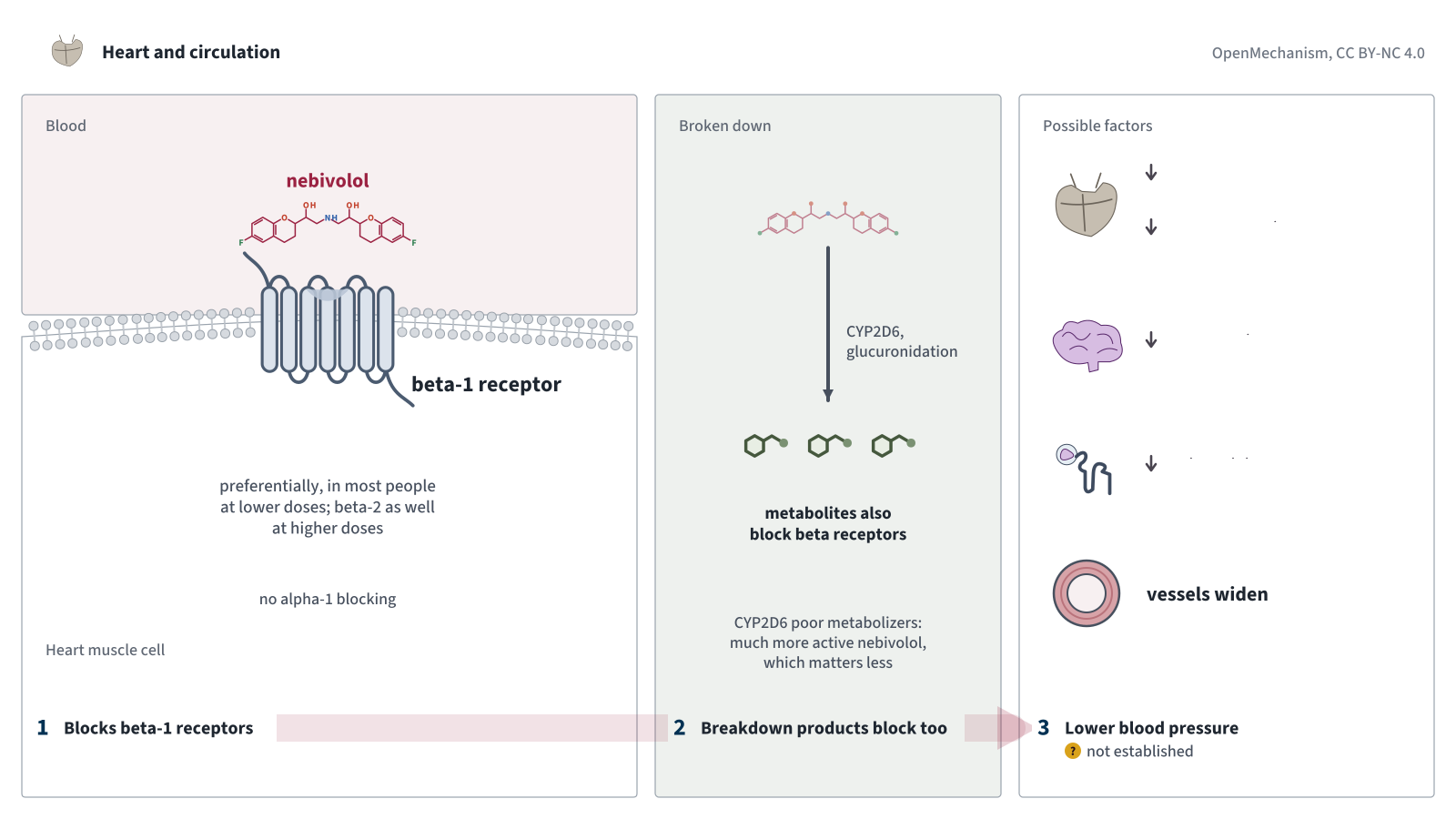
Step 3: not established
The Bystolic (nebivolol) label says: The mechanism of action of the antihypertensive response of BYSTOLIC has not been definitively established. … (5) vasodilation and decreased peripheral vascular resistance
Clinical study: In a study in 8 people, nebivolol infused into an artery of the arm increased forearm blood flow, and blocking the enzyme that makes nitric oxide weakened the effect: We conclude that nebivolol vasodilates human forearm vasculature via the L-arginine/nitric oxide pathway.
Cockcroft JR et al., J Pharmacol Exp Ther 1995 (PMID 7562470)
This study was picked with a literature search and is not yet checked by our reviewer.
Key terms in this drawing
- beta-1 receptor
- Beta-1 adrenergic receptor. A receptor, mainly in the heart, through which catecholamines make the heart beat faster and harder.
- CYP2D6
- Cytochrome P450 2D6. A liver enzyme that breaks down several medicines; for tramadol it makes the active metabolite M1.
- renin
- Renin. An enzyme that cuts angiotensinogen to make angiotensin I.
How it works
Blocks beta-1 receptors. Nebivolol is a beta-adrenergic receptor blocker. In extensive metabolizers (most people) and at lower doses it is preferentially beta-1 selective; in poor metabolizers and at higher doses it blocks both beta-1 and beta-2 receptors. At clinically relevant doses it does not block .1
Breakdown products block too. Nebivolol is broken down by several routes, including glucuronidation and hydroxylation by CYP2D6. In CYP2D6 poor metabolizers, exposure to the active d-isomer is substantially higher, but this matters less than usual, because the metabolites, including the hydroxyl metabolite and the glucuronides, also contribute to beta blocking.1
Lower blood pressure. How nebivolol lowers blood pressure has not been definitively established. Possible factors include a slower heart rate, weaker contraction of the heart muscle, less tonic sympathetic outflow from the brain's vasomotor centers, suppressed renin activity, and widening of blood vessels with lower peripheral resistance.1
For teachers: download this drawing.
See also
Condition pages: high blood pressure.
Other beta blockers: atenolol, carvedilol, esmolol, labetalol, metoprolol, propranolol, sotalol and timolol.
Body system: heart, vessels & cholesterol.
Sources
- 1Bystolic (nebivolol) tablets: FDA label12 Clinical Pharmacology; 12.1 Mechanism of Action; 12.3 Pharmacokinetics
- 2ChEMBL CHEMBL434394Target and action classification: Beta-1 adrenergic receptor antagonist; Beta-2 adrenergic receptor antagonist
- 3Nebivolol vasodilates human forearm vasculature: evidence for an L-arginine/NO-dependent mechanismCockcroft JR et al. J Pharmacol Exp Ther 1995 (abstract)
Spotted a mistake? Report an error (hello@openmechanism.com). Since launch, every published error we fix is listed on the corrections page.
Notes and limits
- A schematic teaching drawing: not to scale, not exact structures, binding poses or a complete pathway, and not a guide to dosing, treatment or how a person will respond.
- The label says the mechanism of the antihypertensive response has not been definitively established, and lists five possible factors.
All recorded limits are on the evidence page, and notes that apply to every page are on How to read a page. Version 1.0.0, not yet medically reviewed.
Cite this page
Tran D. Nebivolol [Internet]. OpenMechanism; 2026 [updated 2026 Oct 11; cited 2026 Oct 11]. Available from: https://openmechanism.com/medicines/nebivolol