Nicardipine
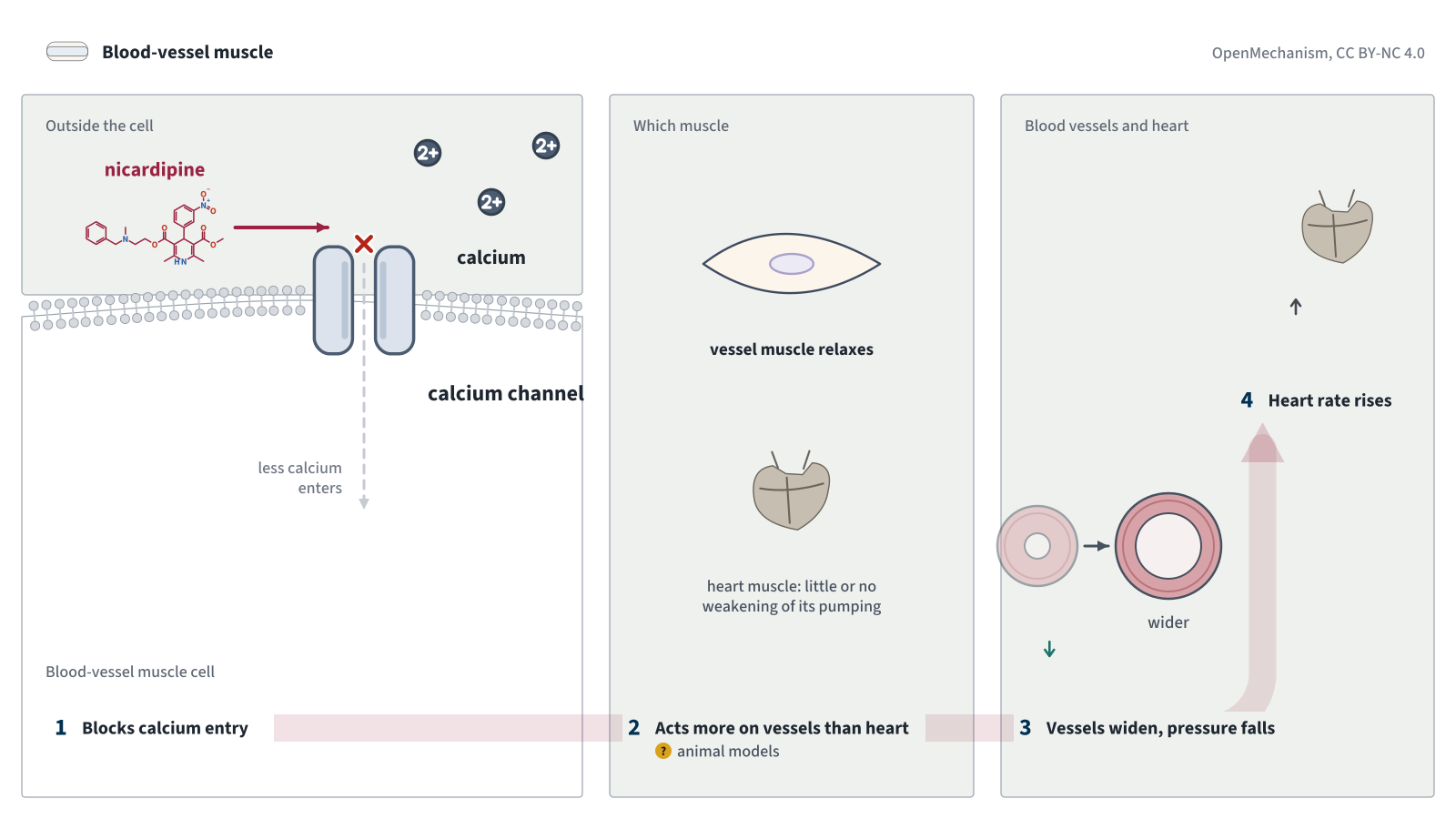
Nicardipine holds back the flow of calcium into muscle cells, acting more on blood-vessel muscle than on heart muscle (shown in animal models). Blood vessels widen and blood pressure falls, and the heart rate rises in response.
- Acts on
- Calcium channels in the muscle of blood vessels and, less, of the heart
- Where
- Blood-vessel muscle
- Medicine type
- Small molecule
- Used for
- Heart & circulation
- Drug class
- Calcium channel blockers
Also called Cardene I.V..
Step 2: animal models
The Cardene I.V. label says: The effects of nicardipine are more selective to vascular smooth muscle than cardiac muscle. … In animal models, nicardipine produced relaxation of coronary vascular smooth muscle at drug levels which cause little or no negative inotropic effect.
Clinical study: In a heart catheter study in 15 patients given nicardipine into a vein, which measured blood flow and pressures in the heart and the body; it tests the step in people: Nicardipine increased both heart rate from 69 +/- 3 to 81 +/- 3 beats/min and cardiac output from 7.3 +/- 0.5 to 9.9 +/- 0.5 liters/min (both p less than 0.001) as systemic vascular resistance decreased from 1,183 +/- 70 to 733 +/- 33 dynes s cm-5 (p less than 0.001). … Left ventricular end-diastolic pressure remained constant, at 14 +/- 1 vs 14 +/- 1 mm Hg as stroke volume increased from 108 +/- 6 to 123 +/- 6 ml/m2 (p less than 0.001).
Lambert CR et al., Am J Cardiol 1985 (PMID 3976506)
This study was picked with a literature search and is not yet checked by our reviewer.
How it works
Blocks calcium entry. Nicardipine is a calcium channel blocker: it holds back the flow of calcium ions into heart muscle and smooth muscle cells, without changing calcium levels in the blood. These muscles need calcium to flow in from outside the cell, through specific ion channels, to contract.1
Acts more on vessels than heart. Its effects are more selective for the smooth muscle of blood vessels than for heart muscle: in animal models it relaxed the muscle of the heart's own arteries at levels that caused little or no weakening of the heart's pumping.1
Vessels widen, pressure falls. Given into a vein, nicardipine markedly lowers the resistance of the body's blood vessels. The widening and the fall in blood pressure were greater in people with high blood pressure than in volunteers with normal blood pressure.1
Heart rate rises. The heart rate rises, a normal response to widened vessels and lower blood pressure. In placebo-controlled trials it rose by about 7 to 8 beats a minute on average; in some people the rise may be pronounced.1
For teachers: download this drawing.
See also
Condition pages: high blood pressure.
Other calcium channel blockers: amlodipine, diltiazem, nifedipine and verapamil.
Body system: heart, vessels & cholesterol.
Sources
- 1Cardene I.V. (nicardipine hydrochloride): FDA label11 Description; 12.1 Mechanism of Action; 12.2 Pharmacodynamics
- 2ChEMBL CHEMBL1484Target and action classification: Voltage-gated L-type calcium channel blocker
- 3Coronary and systemic hemodynamic effects of nicardipineLambert CR et al. Am J Cardiol 1985 (abstract)
Spotted a mistake? Report an error (hello@openmechanism.com). Since launch, every published error we fix is listed on the corrections page.
Notes and limits
- A schematic teaching drawing: not to scale, not exact structures, binding poses or a complete pathway, and not a guide to dosing, treatment or how a person will respond.
- The label's evidence for this selectivity comes from animal models.
All recorded limits are on the evidence page, and notes that apply to every page are on How to read a page. Version 1.0.0, not yet medically reviewed.
Cite this page
Tran D. Nicardipine [Internet]. OpenMechanism; 2026 [updated 2026 Oct 16; cited 2026 Oct 16]. Available from: https://openmechanism.com/medicines/nicardipine