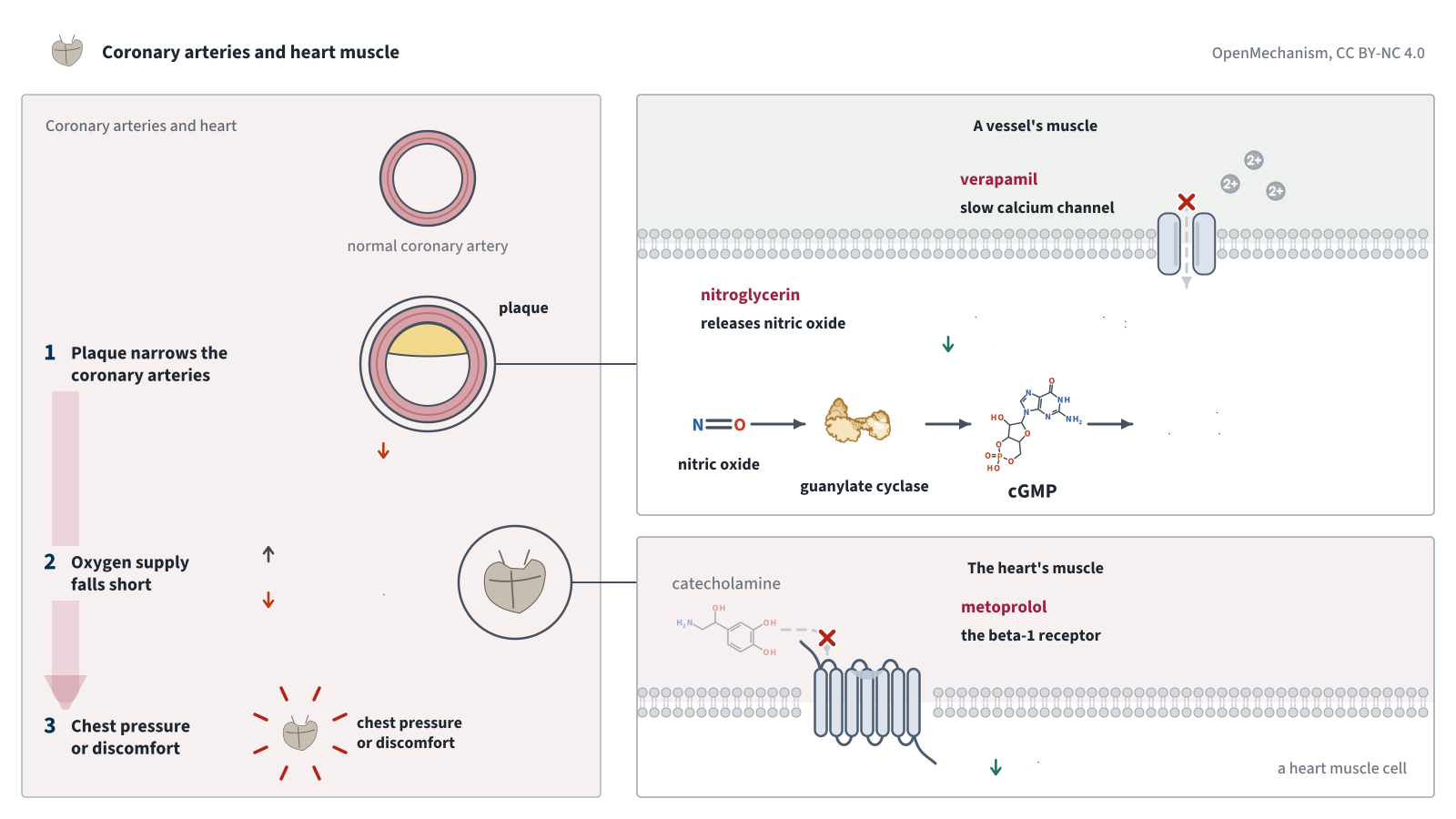
In stable angina, atherosclerotic plaques narrow the coronary arteries. When the heart works harder and needs more oxygen, the narrowed arteries cannot supply enough, the heart muscle becomes ischemic and there is chest pressure or discomfort. Medicines widen the vessels, lower the heart's work, or both.
What goes wrong in angina, and where medicines act. Schematic, not to scale. Guanylate cyclase outline from the structure activated by nitric oxide. License CC BY-NC 4.0.
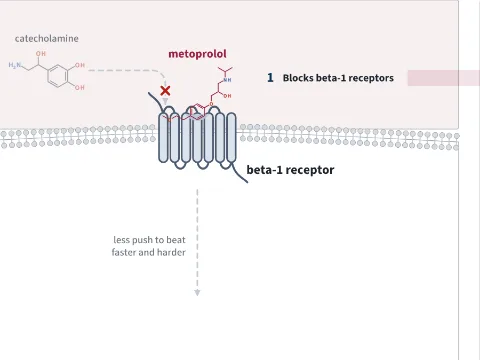
Beta-1 adrenergic receptor. A receptor, mainly in the heart, through which catecholamines make the heart beat faster and harder.
cGMP
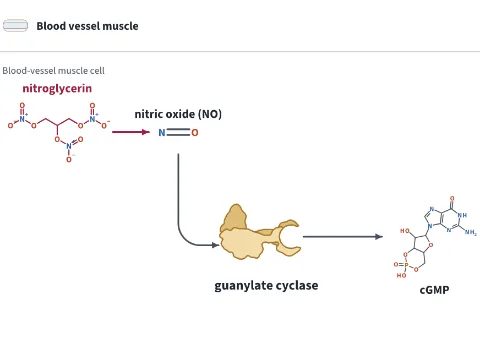
Cyclic guanosine monophosphate. A molecule that rises in smooth muscle when nitric oxide activates guanylate cyclase; the rise leads the vessels to widen.
NO
Nitric oxide. A signal molecule released by nerve endings and the cells lining blood vessels; it makes smooth muscle cells produce cGMP.
What goes wrong
Plaque narrows the coronary arteries. Fixed, obstructive atherosclerotic plaques reduce blood flow through the coronary arteries.1
What the source says
“coronary blood flow is reduced by fixed, atherosclerotic, obstructive lesions”
Nitroglycerin releases , which activates guanylate cyclase to raise in smooth muscle and widens the vessels, mainly the veins: less blood returns to the heart, and the heart's oxygen demand falls. As a tablet under the tongue, it is used for the acute relief or acute prevention of angina attacks due to coronary artery disease.3
What the source says
“NITROSTAT is indicated for the acute relief of an attack or acute prophylaxis of angina pectoris due to coronary artery disease.”
“Nitroglycerin forms free radical nitric oxide (NO) which activates guanylate cyclase, resulting in an increase of guanosine 3'5' monophosphate (cyclic GMP) in smooth muscle and other tissues.”
“Dilation of postcapillary vessels, including large veins, promotes peripheral pooling of blood, decreases venous return to the heart, and reduces left ventricular end-diastolic pressure (preload).”
“Myocardial oxygen consumption or demand (as measured by the pressure-rate product, tension-time index, and stroke-work index) is decreased and a more favorable supply-demand ratio can be achieved.”
Metoprolol, a beta-1 blocker, blocks catecholamines from making the heart beat faster and harder and from raising blood pressure, so the heart needs less oxygen at any level of effort; it is used long term to reduce angina attacks and improve exercise tolerance.4
What the source says
“TOPROL-XL is indicated in the long-term treatment of angina pectoris, to reduce angina attacks and to improve exercise tolerance.”
“By blocking catecholamine-induced increases in heart rate, in velocity and extent of myocardial contraction, and in blood pressure, metoprolol reduces the oxygen requirements of the heart at any given level of effort, thus making it useful in the long-term management of angina pectoris.”
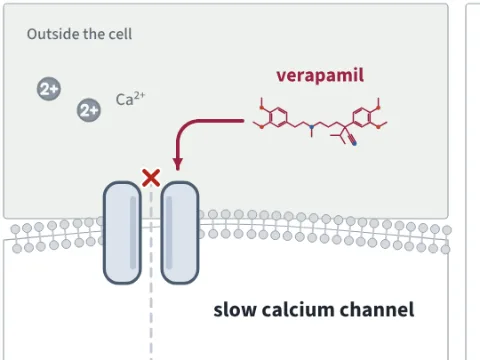
Verapamil, which blocks slow calcium channels, relaxes and prevents spasm of the coronary arteries, raising oxygen delivery to the heart muscle in people with coronary artery spasm; this makes it effective in angina at rest (vasospastic and unstable angina). By widening small arteries in the body, it also lowers the resistance the heart works against and so the heart's oxygen needs, which probably accounts for its effect in chronic stable angina. The label says how it relieves angina remains to be fully determined.5
What the source says
“a calcium ion influx inhibitor (slow-channel blocker or calcium ion antagonist)”
“The precise mechanism of action of verapamil hydrochloride as an antianginal agent remains to be fully determined, but includes the following two mechanisms:”
“Verapamil hydrochloride dilates the main coronary arteries and coronary arterioles, both in normal and ischemic regions, and is a potent inhibitor of coronary artery spasm, whether spontaneous or ergonovine-induced.”
“This property increases myocardial oxygen delivery in patients with coronary artery spasm and is responsible for the effectiveness of verapamil hydrochloride in vasospastic (Prinzmetal's or variant) as well as unstable angina at rest.”
“Verapamil hydrochloride regularly reduces the total peripheral resistance (afterload) against which the heart works both at rest and at a given level of exercise by dilating peripheral arterioles.”
“This unloading of the heart reduces myocardial energy consumption and oxygen requirements and probably accounts for the effectiveness of verapamil hydrochloride in chronic stable effort angina.”
Also used for it: amlodipine (for chronic stable angina and vasospastic angina: “NORVASC is indicated for the symptomatic treatment of chronic stable angina. … NORVASC is indicated for the treatment of confirmed or suspected vasospastic angina.”6); prasugrel (for lowering clot-related heart events in unstable angina treated with PCI, a procedure to open the artery: “Effient is a P2Y 12 platelet inhibitor indicated for the reduction of thrombotic cardiovascular events (including stent thrombosis) in patients with acute coronary syndrome who are to be managed with percutaneous coronary intervention (PCI) as follows: Patients with unstable angina or non-ST-elevation myocardial infarction (NSTEMI)”7); enoxaparin (for preventing ischemic complications of unstable angina, given with aspirin: “Lovenox is indicated for the prophylaxis of ischemic complications of unstable angina and non–Q-wave myocardial infarction, when concurrently administered with aspirin.”8); and eptifibatide (for lowering the rate of death or a heart attack in unstable angina: “Eptifibatide injection is indicated to decrease the rate of a combined endpoint of death or new myocardial infarction (MI) in patients with ACS (unstable angina [UA]/non-ST-elevation myocardial infarction [NSTEMI]), including patients who are to be managed medically and those undergoing percutaneous coronary intervention (PCI).”9).
A 2021 review reports that in randomized trials in stable angina, even with moderate to severe ischemia, unblocking the arteries (largely by PCI, a procedure to open the artery) did not lower deaths or heart attacks compared with optimal medical therapy alone, though it helps the angina.2
Claude Opus 5.5 (AI source check), 29 October 2026: 35 statements compared with their sources, 8 flagged for the reviewer. An automated check, not a medical review.
Conflict of interest
Atorvastatin: Pfizer, the reviewer's former employer, used to market this medicine as Lipitor. The label this site cites is from Viatris. Details
Next review due
29 April 2028
Cite this page
Tran D. Angina [Internet]. OpenMechanism; 2026 [updated 2026 Oct 29; cited 2026 Oct 29]. Available from: https://openmechanism.com/conditions/angina