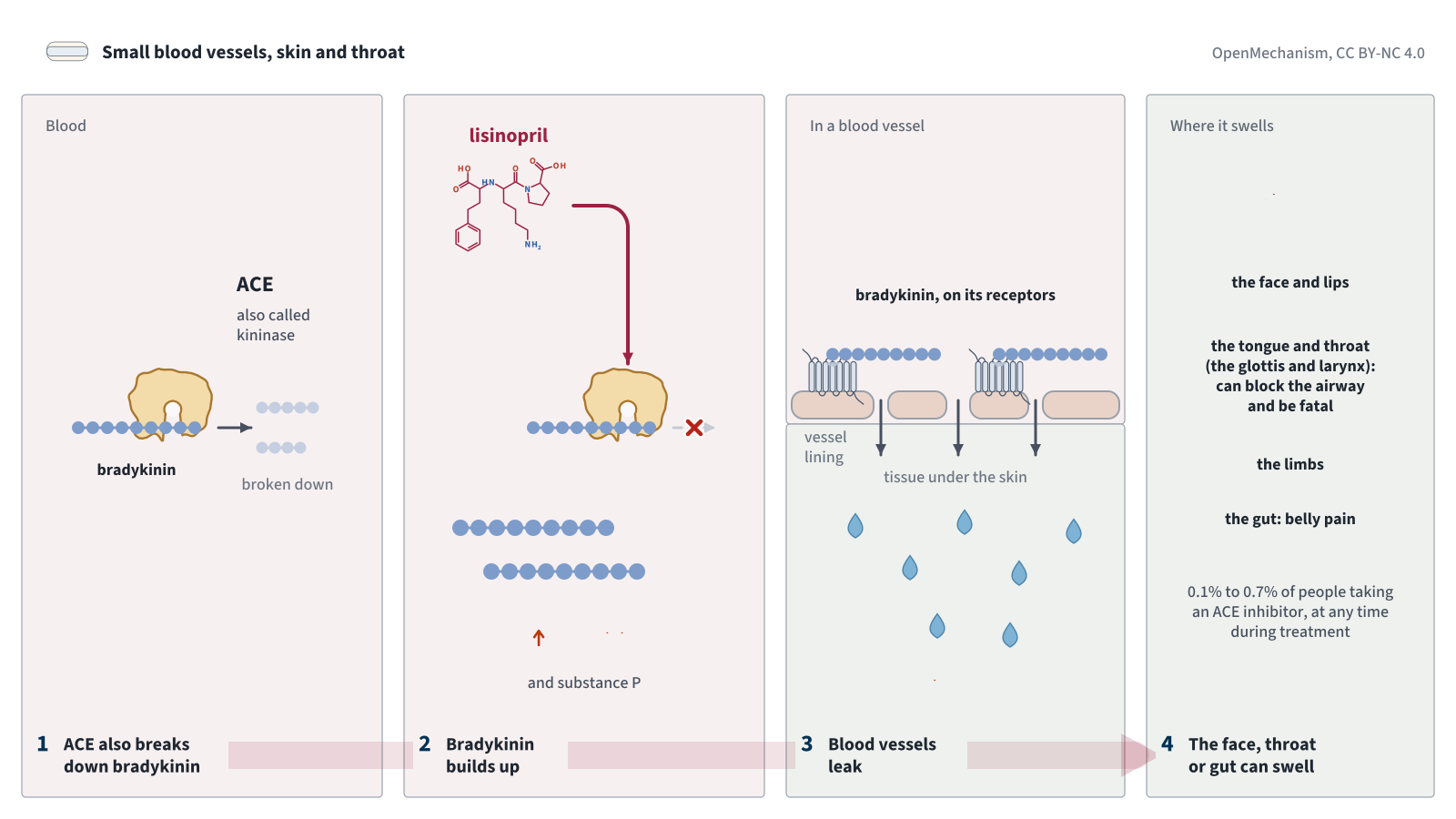
ACE, the enzyme that ACE inhibitors block, also breaks down bradykinin. With ACE blocked, bradykinin is broken down less, and through its receptors it makes blood vessels leak: fluid gathers under the skin and under the lining of the mouth, throat and gut, a swelling called angioedema. It happens in 0.1% to 0.7% of people taking an ACE inhibitor, at any time during treatment, and swelling of the tongue or throat can block the airway and be fatal.
ACE also breaks down bradykinin. , the enzyme that turns angiotensin I into , is the same enzyme as kininase, which breaks down bradykinin, a peptide that strongly lowers blood pressure.1
What the source says
“ACE is a peptidyl dipeptidase that catalyzes the conversion of angiotensin I to the vasoconstrictor substance, angiotensin II.”
Bradykinin builds up. ACE inhibitors such as lisinopril block ACE, so bradykinin and substance P are broken down less. In a patient taking captopril, bradykinin in the blood was very high during an attack of angioedema and normal after the medicine was stopped.1,2,3
What the source says
“Lisinopril inhibits angiotensin-converting enzyme (ACE) in human subjects and animals.”
“The pathophysiology of ACE-I-induced angioedema involves inhibition of bradykinin and substance P degradation by ACE (kininase II) leading to vasodilator and plasma extravasation.”
“In the patient receiving the ACE-inhibitor captopril, bradykinin concentration was very high at 47 fmol/mL during an acute attack of angio-oedema, but normal at 3.2 fmol/mL in remission after withdrawal of the drug.”
Blood vessels leak. Through its receptors, bradykinin makes blood vessels more leaky, and plasma escapes into the tissue under the skin and under the lining of the mouth, throat and gut. This kind of angioedema comes without hives (urticaria).2,4,5
What the source says
“Bradykinin (BK) metabolism and its receptors play a central role in drug-induced angioedema (AE) without urticaria through increased vascular permeability.”
“a paroxysmal, localized, self-limiting, and potentially fatal swelling of the subcutaneous and/or submucosal tissue, due to a temporary increase in vascular permeability”
The face, throat or gut can swell. Angioedema of the face, lips, tongue, throat (the glottis and larynx) or limbs has occurred at any time during treatment, sometimes fatally; swelling of the tongue or throat is likely to block the airway, and swelling of the gut has caused belly pain. It occurs in 0.1% to 0.7% of people taking an ACE inhibitor, more often in Black patients.1,2
What the source says
“Angioedema of the face, extremities, lips, tongue, glottis and/or larynx, including some fatal reactions, have occurred in patients treated with angiotensin converting enzyme inhibitors, including Zestril, at any time during treatment.”
“Patients with involvement of the tongue, glottis or larynx are likely to experience airway obstruction, especially those with a history of airway surgery.”
The labels' advice on stopping the medicine and on treatment is left out: this page explains the mechanism, not what to do.
Neprilysin inhibitors such as sacubitril also slow bradykinin's breakdown, and the Entresto label rules out taking it with an ACE inhibitor because of the increased risk of angioedema; mTOR inhibitors such as sirolimus may raise it too.1,4,6
Other medicines may also lead to bradykinin-related angioedema: a review says DPP-4 inhibitors, used for diabetes, slow bradykinin's breakdown, and names angiotensin receptor blockers, clot-dissolving medicines and statins.4
How medicines bring on bradykinin-related angioedema is not fully explained, and the bradykinin measurement on this page comes from a single patient taking captopril.3,5
A 2018 review of ACE inhibitor angioedema adds that angioedema is also more frequent in smokers, women, older people and people with a history of drug rash, seasonal allergies or immunosuppressive treatment.2
Claude Opus 5.5 (AI source check), 28 October 2026: 30 statements compared with their sources, 6 flagged for the reviewer. An automated check, not a medical review.
Next review due
28 April 2028
Cite this page
Tran D. Why ACE inhibitors can cause angioedema [Internet]. OpenMechanism; 2026 [updated 2026 Oct 28; cited 2026 Oct 28]. Available from: https://openmechanism.com/explained/ace-inhibitor-angioedema