Medically reviewed by Daniel Tran, PharmD, on 12 November 2026.
Why ACE inhibitors and ARBs can harm a fetus
Taken in the second and third trimesters, medicines that act on the renin-angiotensin system, such as lisinopril and losartan, lower the fetus's kidney function, and its blood pressure can fall. The fetus keeps the amniotic fluid around it moving by swallowing it and producing urine; with little urine made, the fluid runs low (oligohydramnios). That can leave the lungs underdeveloped and deform the skeleton and leave the skull underdeveloped, and the baby may be born with kidney failure or low blood pressure, or die.
- Kind
- Side effect
- Medicines
- Lisinopril, Losartan
- Sources
- 5
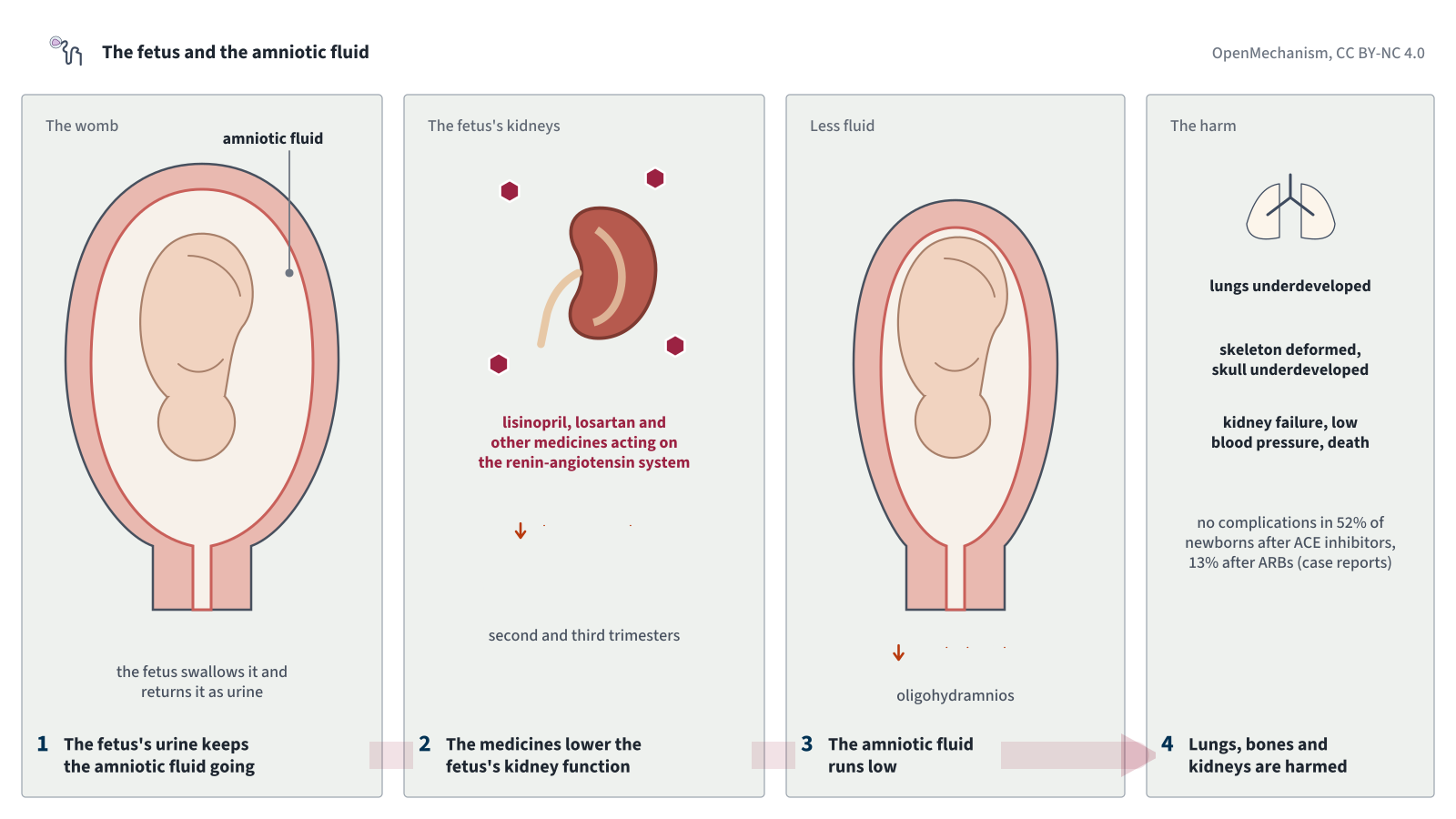
For teachers: download this drawing.
Step by step
The fetus's urine keeps the amniotic fluid going. The fetus circulates the amniotic fluid around it by swallowing it and producing urine.1
What the source says
“Pathways of AF recirculation include the fetal lungs, swallowing, absorption through the fetal gastrointestinal tract, excretion through fetal urine production, and movement.”
Source 1The medicines lower the fetus's kidney function. In the second and third trimesters, medicines that act on the renin-angiotensin system, such as the angiotensin-converting enzyme () inhibitor lisinopril and the angiotensin receptor blocker (ARB) losartan, reduce the fetus's kidney function, and the fetus's blood pressure can fall.2,3,4
What the source says
“Use of drugs that act on the renin-angiotensin system during the second and third trimesters of pregnancy reduces fetal renal function and increases fetal and neonatal morbidity and death.”
Source 2“COZAAR can cause fetal harm when administered to a pregnant woman.”
Source 3“ACE inhibitor fetopathy is characterized by fetal hypotension, anuria-oligohydramnios, growth restriction, pulmonary hypoplasia, renal tubular dysplasia, and hypocalvaria.”
Source 4The amniotic fluid runs low. With the kidneys making little or no urine (anuria), the amniotic fluid can run low (oligohydramnios), and this may not show until the fetus has already been harmed for good.2,3
What the source says
“reduced fetal renal function leading to anuria and renal failure”
Source 3“Resulting oligohydramnios can be associated with fetal lung hypoplasia and skeletal deformations.”
Source 2“Patients and physicians should be aware, however, that oligohydramnios may not appear until after the fetus has sustained irreversible injury.”
Source 3Lungs, bones and kidneys are harmed. Too little fluid can leave the lungs underdeveloped (lung hypoplasia) and deform the skeleton and leave the skull underdeveloped (skull hypoplasia); the baby may be born with kidney failure or low blood pressure, or die. Overall, in a 2012 review of published case reports and case series (118 cases exposed to ACE inhibitors, 68 to ARBs), 52% of the newborns exposed to ACE inhibitors and 13% of those exposed to ARBs had no complications.3,5
What the source says
“Oligohydramnios in pregnant women who use drugs affecting the renin-angiotensin system in the second and third trimesters of pregnancy can result in the following: reduced fetal renal function leading to anuria and renal failure, fetal lung hypoplasia, skeletal deformations, including skull hypoplasia, hypotension, and death.”
Source 3“Potential neonatal adverse effects include skull hypoplasia, anuria, hypotension, renal failure, and death.”
Source 3“Overall, 52% of the newborns exposed to ACE-Is and 13% of the newborns exposed to ARBs did not exhibit any complications (P<0.0001).”
Source 5
See also
Medicine pages: lisinopril and losartan.
Related medicines: enalapril, captopril, benazepril, valsartan, irbesartan and olmesartan.
Other side effects (heart & circulation): why ACE inhibitors can cause a dry cough, why ACE inhibitors can cause angioedema, why amiodarone can upset the thyroid, why amlodipine can cause swelling, why beta-blockers can tighten the airways, why diuretics can lower potassium, why spironolactone can cause breast growth, why statins can cause muscle problems, why stopping clonidine suddenly can raise blood pressure and all 65 side effects.
Interactions: ACE inhibitors with ARBs or aliskiren; and ACE inhibitors and spironolactone.
Conditions: high blood pressure; and preeclampsia and eclampsia.
Sources
- 1Assessment of amniotic fluid volume in pregnancyJha P et al. Radiographics 2023 (abstract). Saved copy
- 2Zestril (lisinopril) tablets: FDA label5.1 Fetal Toxicity. Saved copy
- 3Cozaar (losartan potassium) tablets: FDA label5.1 Fetal Toxicity; 8.1 Pregnancy. Saved copy
- 4Angiotensin-converting enzyme inhibitor fetopathyPryde PG et al. J Am Soc Nephrol 1993 (abstract). Saved copy
- 5Pregnancy outcome following exposure to angiotensin-converting enzyme inhibitors or angiotensin receptor antagonists: a systematic reviewBullo M et al. Hypertension 2012 (abstract). Saved copy
Notes and limits
- The labels' advice on stopping these medicines when pregnancy is found, on testing the fetus and on watching and treating exposed newborns is left out: this page explains the mechanism, not what to do.
- The labels say these medicines can cause fetal harm, and they tie the kidney harm to the second and third trimesters; most studies of fetal abnormalities after first-trimester use have not told these medicines apart from other blood pressure medicines.3
- High blood pressure in pregnancy carries its own risks, for the mother (preeclampsia, premature delivery) and for the fetus (poor growth and death in the womb).3
- The review's figures come from published case reports and case series, not from a count of every exposed pregnancy.5
Notes that apply to every page are on How to read a page.
Spotted a mistake? Report an error (hello@openmechanism.com). Since launch, every published error we fix is listed on the corrections page.
Medical review
Earlier reviews (1)
Cite this page
Tran D. Why ACE inhibitors and ARBs can harm a fetus [Internet]. OpenMechanism; 2026 [updated 2026 Nov 12; cited 2026 Nov 12]. Available from: https://openmechanism.com/explained/ace-inhibitors-and-arbs-in-pregnancy