Preeclampsia and eclampsia
Preeclampsia affects 2 to 8% of pregnancies. A placenta that develops abnormally releases factors that harm the mother's blood vessels, raising her blood pressure and affecting her organs; in eclampsia, seizures follow. Magnesium sulfate prevents and controls the seizures. Delivery is the only cure, and oxytocin can start labor near term when delivery is best.
- Where
- Placenta, blood vessels and brain
- Medicines
- 2 medicines
Mechanisms unclear
The Euser 2009 review says: Though the specific mechanisms of action remain unclear, the effect of magnesium sulfate in the prevention of eclampsia is likely multi-factorial.
Clinical study: In a randomized trial of magnesium sulfate against placebo in 10,141 women with pre-eclampsia in 33 countries (the Magpie Trial); the trial measured eclampsia, not how magnesium works: Women were randomised in 33 countries to either magnesium sulphate (n=5071) or placebo (n=5070). … Women allocated magnesium sulphate had a 58% lower risk of eclampsia (95% CI 40-71) than those allocated placebo (40, 0.8%, vs 96, 1.9%; 11 fewer women with eclampsia per 1000 women). … 1201 of 4999 (24%) women given magnesium sulphate reported side-effects versus 228 of 4993 (5%) given placebo.
Altman D et al., Lancet 2002 (PMID 12057549)
This study was picked with a literature search and is not yet checked by our reviewer.
For teachers: download this drawing.
What goes wrong
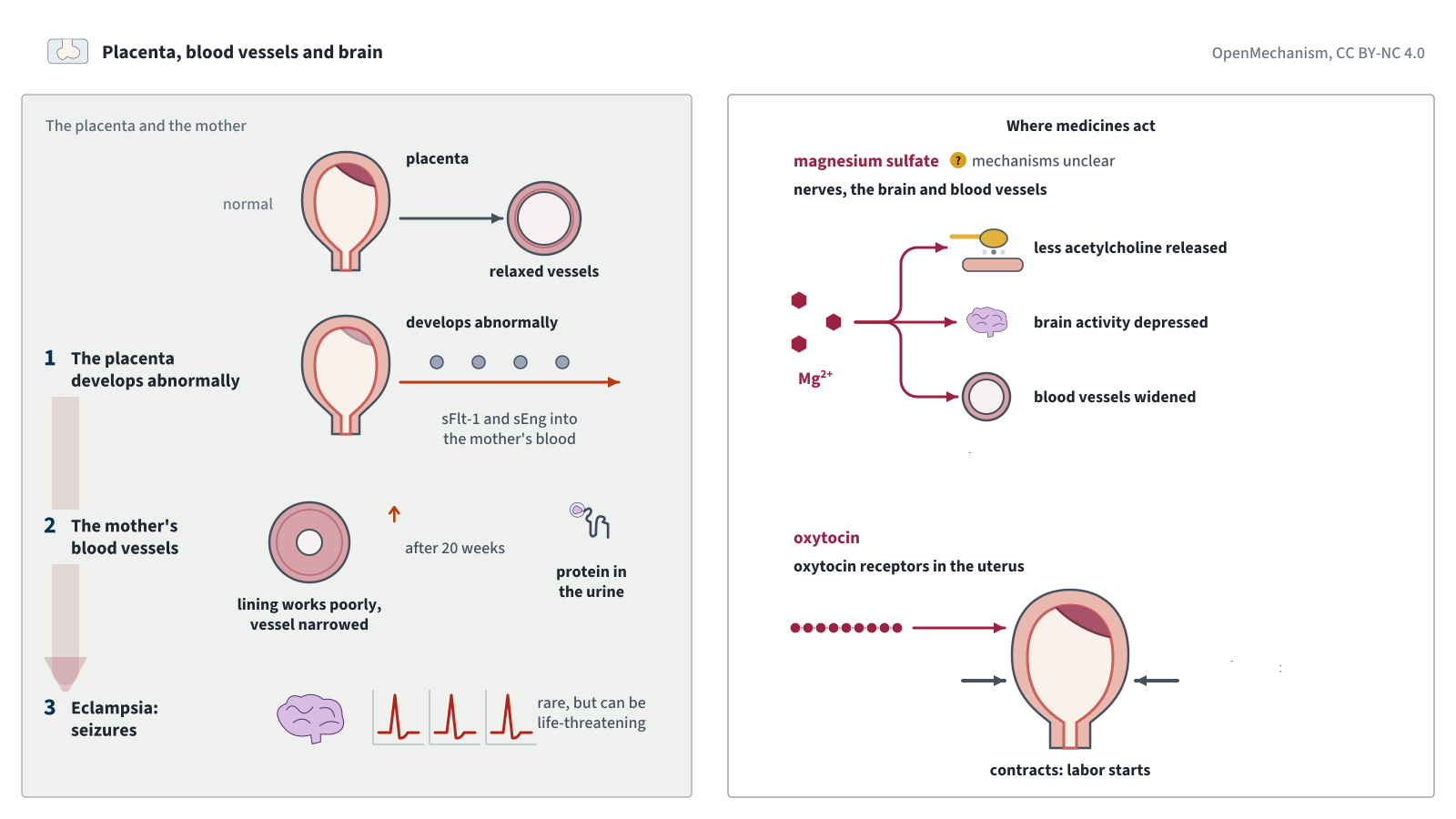
The placenta develops abnormally. Preeclampsia is found only when a placenta is or was recently present. It begins with a placenta that develops abnormally (abnormal placentation), which releases factors into the mother's blood, chiefly soluble fms-like tyrosine kinase-1 (sFlt-1) and soluble endoglin (sEng).1,2
What the source says
“Pre-eclampsia is found only when a placenta is or was recently present and is classified as preterm (delivery <37 weeks of gestation), term (delivery ≥37 weeks of gestation) and postpartum pre-eclampsia.”
Source 1“The clinical syndrome begins with abnormal placentation with subsequent release of antiangiogenic markers, mediated primarily by soluble fms-like tyrosine kinase-1 (sFlt-1) and soluble endoglin (sEng).”
Source 2“The maternal syndrome of pre-eclampsia is driven by a dysfunctional placenta, which releases factors into maternal blood causing systemic inflammation and widespread maternal endothelial dysfunction.”
Source 1The mother's blood vessels. These factors make the lining of the mother's blood vessels work poorly (endothelial dysfunction) and narrow the vessels. Preeclampsia is diagnosed by high blood pressure that starts suddenly after 20 weeks of pregnancy, with at least one other complication, such as protein in the urine, poorly working organs in the mother, or a poorly working uterus and placenta. It can progress to liver, kidney and brain disease if the baby and placenta are not delivered.1,2,3
What the source says
“High levels of sFlt-1 and sEng result in endothelial dysfunction, vasoconstriction, and immune dysregulation, which can negatively impact every maternal organ system and the fetus.”
Source 2“Pre-eclampsia is a complex multisystem disease, diagnosed by sudden-onset hypertension (>20 weeks of gestation) and at least one other associated complication, including proteinuria, maternal organ dysfunction or uteroplacental dysfunction.”
Source 1“The disease presents with new-onset hypertension and often proteinuria in the mother, which can progress to multi-organ dysfunction, including hepatic, renal and cerebral disease, if the fetus and placenta are not delivered.”
Source 3Eclampsia: seizures. Eclampsia is a seizure in a woman with preeclampsia; it is rare but can be life-threatening.4
What the source says
“Eclampsia, the occurrence of a seizure (fit) in association with pre-eclampsia, is rare but potentially life-threatening.”
Source 4
Where medicines act
Nerves, the brain and blood vessels
- A
Magnesium sulfate targets Nerves, the brain and blood vessels
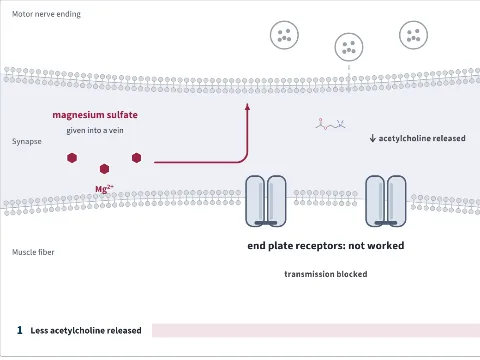
Blocks the signal from nerve to muscle, depresses the brain and widens blood vessels; exactly how it prevents eclampsia is unclear.5,6
Used forPreventing eclampsia: in preeclampsiaSeizures of eclampsia: to treat them and prevent their return
What the label says
“Magnesium Sulfate in 5% Dextrose Injection is indicated for: • Prevention of eclampsia in patients with preeclampsia • Treatment of seizures and prevention of recurrent seizures in patients with eclampsia”
Source 5“Magnesium prevents seizures in patients with preeclampsia and controls seizures in patients with eclampsia by blocking neuromuscular transmission and decreasing the amount of acetylcholine liberated at the end plate by the motor nerve impulse.”
Source 5“Magnesium has a depressant effect on the central nervous system”
Source 5“Magnesium acts peripherally to produce vasodilation.”
Source 5“Though the specific mechanisms of action remain unclear, the effect of magnesium sulfate in the prevention of eclampsia is likely multi-factorial.”
Source 6
The muscle of the uterus
- B
Oxytocin targets Oxytocin receptors in the uterus
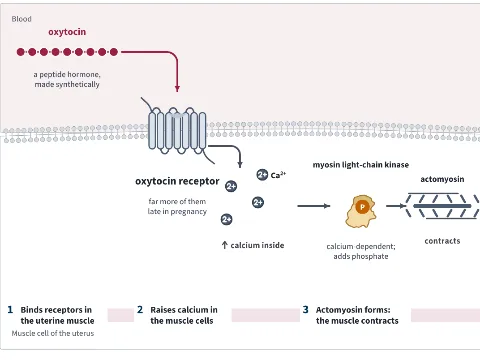
Makes the uterus contract, starting labor so that the baby and placenta can be delivered.7
Used forStarting labor for a medical reason: such as preeclampsia at or near term
What the label says
“It is indicated for (1) induction of labor in patients with a medical indication for the initiation of labor, such as Rh problems, maternal diabetes, preeclampsia at or near term, when delivery is in the best interests of mother and fetus”
Source 7“Oxytocin has specific receptors in the myometrium and the receptor concentration increases greatly during pregnancy, reaching a maximum in early labor at term.”
Source 7“Oxytocin promotes contractions by increasing the intracellular Ca 2+”
Source 7
See also
Body systems: bladder & reproductive organs; and heart, vessels & cholesterol.
Other conditions: high blood pressure, epilepsy, heavy bleeding after birth and myasthenia gravis.
Side effects: why ACE inhibitors and ARBs can harm a fetus.
Sources
- 1Pre-eclampsiaDimitriadis E et al. Nat Rev Dis Primers 2023 (abstract). Saved copy
- 2Preeclampsia: pathophysiology and clinical presentationsIves CW et al. J Am Coll Cardiol 2020 (abstract). Saved copy
- 3Pre-eclampsia: pathogenesis, novel diagnostics and therapiesPhipps EA et al. Nat Rev Nephrol 2019 (abstract). Saved copy
- 4Magnesium sulphate and other anticonvulsants for women with pre-eclampsiaDuley L et al. Cochrane Database Syst Rev 2010 (abstract). Saved copy
- 5Magnesium sulfate in 5% dextrose injection (Baxter): FDA label1 Indications and Usage; 12.1 Mechanism of Action. Saved copy
- 6Magnesium sulfate for the treatment of eclampsia: a brief reviewEuser AG, Cipolla MJ. Stroke 2009 (abstract). Saved copy
- 7Pitocin (oxytocin injection): FDA labelIndications and Usage; Clinical Pharmacology. Saved copy
- 8Magnesium sulfate in 5% dextrose injection (Baxter): FDA label5 Warnings and Precautions. Saved copy
- 9Do women with pre-eclampsia, and their babies, benefit from magnesium sulphate? The Magpie Trial: a randomised placebo-controlled trialAltman D et al. Lancet 2002 (abstract). Saved copy
Notes and limits
- Available treatments target the mother's high blood pressure and seizures; the only cure is delivering the placenta and baby, often early.1
- A 2020 review says low-dose aspirin is recommended to prevent preeclampsia in people at high risk. A 2023 review says preterm preeclampsia is prevented with daily low-dose aspirin started before 16 weeks of pregnancy, and that term and postpartum preeclampsia have no preventive treatments.1,2
- Women who have had preeclampsia have a shorter life expectancy, with higher risks of stroke, heart disease and diabetes; their babies have higher risks of preterm birth and of disease later in life.1
- Given for more than 5 to 7 days in pregnancy, magnesium sulfate can lower the developing baby's calcium and cause bone problems.8
- Magnesium sulfate can cause magnesium toxicity, including slowed breathing (respiratory depression); people with kidney problems are at greater risk, since magnesium leaves the body only through the kidneys.8
- In people with myasthenia gravis, magnesium sulfate can bring on a myasthenic crisis.8
Notes that apply to every page are on How to read a page.
Spotted a mistake? Report an error (hello@openmechanism.com). Since launch, every published error we fix is listed on the corrections page.
Cite this page
Tran D. Preeclampsia and eclampsia [Internet]. OpenMechanism; 2026 [updated 2026 Nov 18; cited 2026 Nov 18]. Available from: https://openmechanism.com/conditions/preeclampsia-and-eclampsia