Prazosin
Prazosin lowers peripheral resistance; how exactly is unknown, but animal studies suggest it blocks alpha-adrenoceptors, mainly at the arterioles. Unlike conventional alpha-blockers it usually does not speed up the heart, and in people it lowers blood pressure lying and standing without changing cardiac output or kidney blood flow.
- Acts on
- Postsynaptic alpha-adrenoceptors (as animal studies suggest)
- Where
- Arterioles
- Medicine type
- Small molecule
- Used for
- Heart & circulation
- Drug class
- Alpha-1 blockers
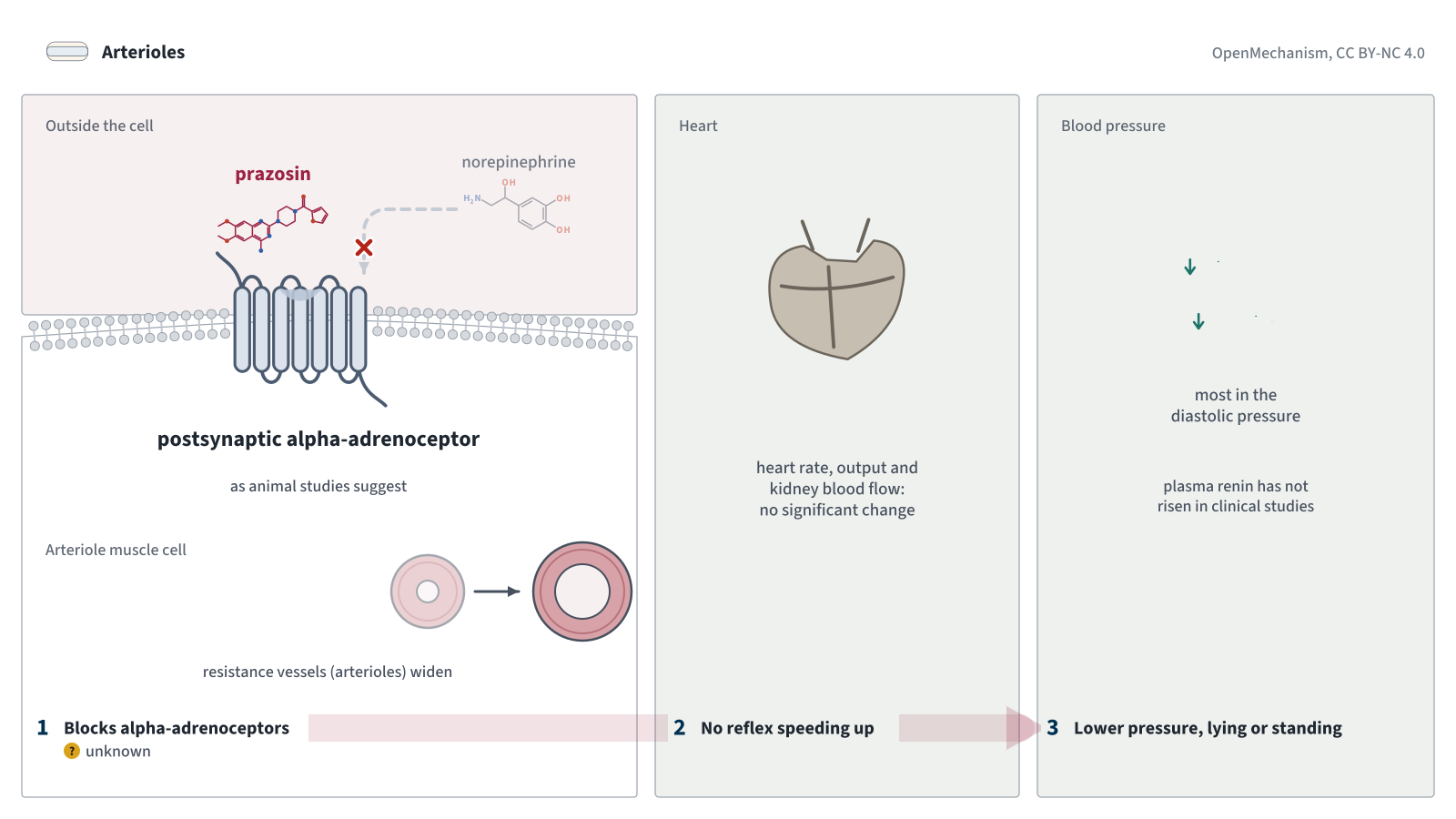
Step 1: unknown
The prazosin label says: The exact mechanism of the hypotensive action of prazosin is unknown. … Recent animal studies, however, have suggested that the vasodilator effect of prazosin is also related to blockade of postsynaptic alpha- adrenoceptors.
Source 1: Prazosin hydrochloride capsules: FDA label, Clinical Pharmacology
Clinical study: In a double-blind, placebo-controlled crossover trial in 12 patients with hypertension; the trial measured blood pressure, not how prazosin lowers it: Blood pressure was higher by 17/8 mm Hgin the lying posture and by 24/14 mm Hg in the standing posture during placebo than during prazosin treatment.
Bolli P et al., Clin Pharmacol Ther 1976 (PMID 7374)
This study was picked with a literature search and is not yet checked by our reviewer.
Key terms in this drawing
- renin
- Renin. An enzyme that cuts angiotensinogen to make angiotensin I.
How it works
Blocks alpha-adrenoceptors. The exact mechanism of prazosin's blood-pressure lowering is unknown; animal studies suggest its vasodilator effect relates to blockade of postsynaptic alpha-adrenoceptors, mainly at the resistance vessels (arterioles), lowering total peripheral resistance.1
No reflex speeding up. Unlike conventional alpha-blockers, its antihypertensive action usually comes without reflex tachycardia; in people it lowers blood pressure without a clinically significant change in cardiac output, heart rate, renal blood flow or glomerular filtration rate.1
Lower pressure, lying or standing. Blood pressure falls in both lying and standing positions, most in the diastolic pressure; in clinical studies plasma activity has not risen.1
For teachers: download this drawing.
See also
Condition pages: high blood pressure.
Other alpha-1 blockers: doxazosin and tamsulosin.
Body system: heart, vessels & cholesterol.
Sources
- 1Prazosin hydrochloride capsules: FDA labelClinical Pharmacology
- 2ChEMBL CHEMBL2Target and action classification: Adrenergic receptor alpha-1 antagonist
- 3Effects of prazosin in patients with hypertensionBolli P et al. Clin Pharmacol Ther 1976 (abstract)
Spotted a mistake? Report an error (hello@openmechanism.com). Since launch, every published error we fix is listed on the corrections page.
Notes and limits
- A schematic teaching drawing: not to scale, not exact structures, binding poses or a complete pathway, and not a guide to dosing, treatment or how a person will respond.
- The label says the exact mechanism of the hypotensive action of prazosin is unknown.
All recorded limits are on the evidence page, and notes that apply to every page are on How to read a page. Version 1.0.0, not yet medically reviewed.
Cite this page
Tran D. Prazosin [Internet]. OpenMechanism; 2026 [updated 2026 Oct 12; cited 2026 Oct 12]. Available from: https://openmechanism.com/medicines/prazosin