Carvedilol
Carvedilol blocks beta-1 and beta-2 receptors, slowing the heart, and also blocks , widening blood vessels. It lowers blood pressure, and in mild-to-severe chronic heart failure of ischemic or cardiomyopathic origin, usually added to diuretics, and digitalis, it helps people live longer and lowers the risk of a hospital stay; the label says how beta blockade lowers blood pressure, and the basis for the heart failure benefit, are not established.
- Acts on
- Beta-1 and beta-2 adrenergic receptors; alpha-1 adrenergic receptors
- Where
- Heart and blood vessels
- Medicine type
- Small molecule
- Used for
- Heart & circulation
- Drug class
- Beta blockers
Also called Coreg.
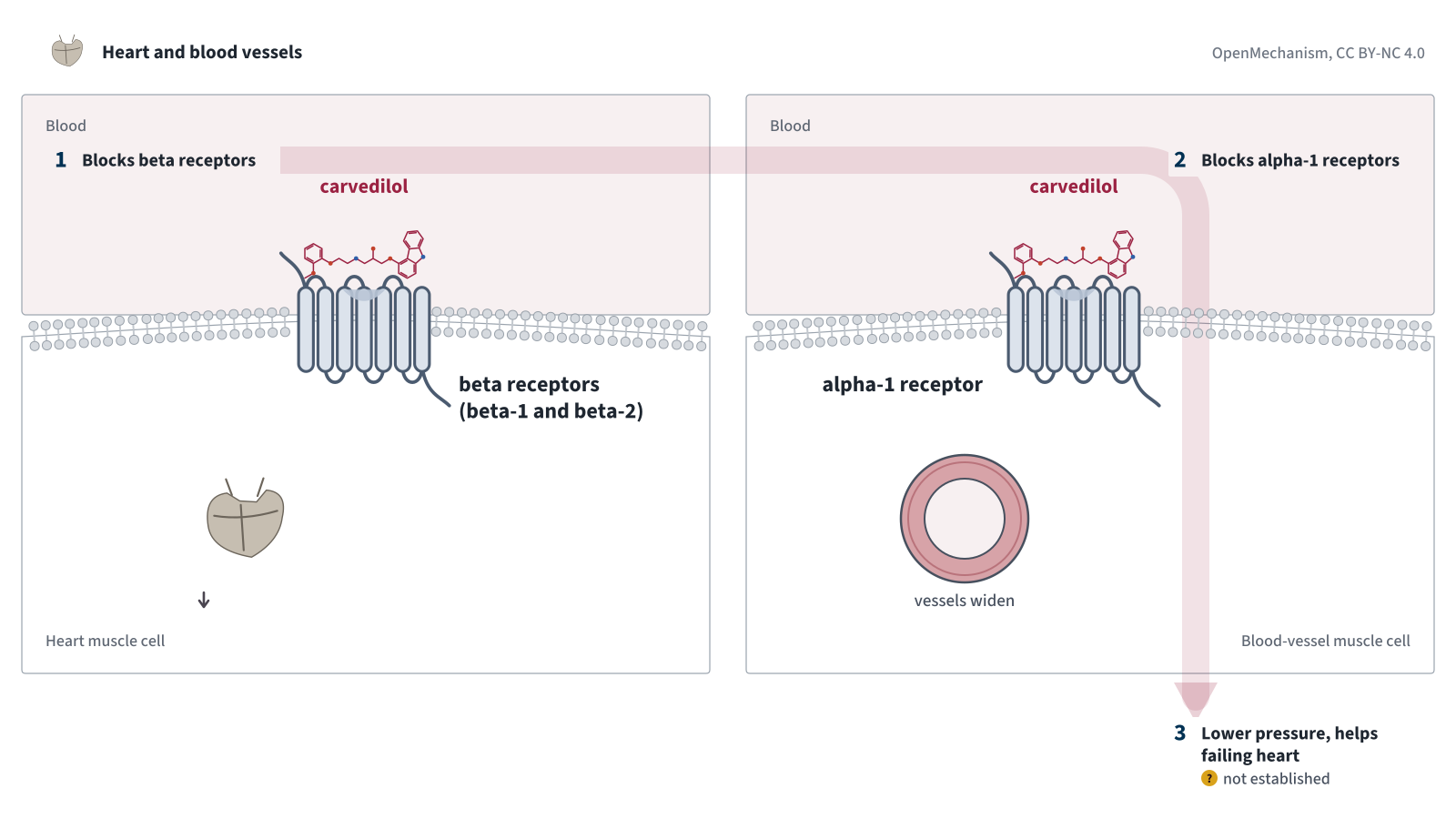
Step 3: not established
The carvedilol (Coreg) label says: The basis for the beneficial effects of COREG in heart failure is not established. … The mechanism by which β-blockade produces an antihypertensive effect has not been established.
Clinical study: In the U.S. Carvedilol Heart Failure Study (1996), a double-blind, placebo-controlled program, 1094 people with chronic heart failure and an ejection fraction of 0.35 or less were randomly assigned to carvedilol or placebo and followed for 6 months (12 months for mild heart failure); it was stopped early on its monitoring board's advice. It measured deaths and hospital stays, not how carvedilol works: The overall mortality rate was 7.8 percent in the placebo group and 3.2 percent in the carvedilol group … Carvedilol reduces the risk or death as well as the risk of hospitalization for cardiovascular causes in patients with heart failure who are receiving treatment with digoxin, diuretics, and an angiotensin-converting-enzyme inhibitor.
Packer M et al., N Engl J Med 1996 (PMID 8614419)
Key terms in this drawing
- alpha-1 receptor
- Alpha-1 adrenergic receptor. Alpha-1 adrenergic receptors come in at least three subtypes, A, B and D; alpha-1A may have a main role in prostate obstruction, alpha-1B in tightening arteries.
How it works
Blocks beta receptors. Carvedilol is a mixture of two mirror-image forms. The S form blocks beta-1 and beta-2 receptors (nonselective), and carvedilol has no stimulating activity of its own. In animal and human studies, this beta blockade lowered cardiac output in healthy people and blunted the speeding of the heart with exercise, isoproterenol or standing up.1
Blocks alpha-1 receptors. Both forms block alpha-1 receptors, with equal potency. In human and animal studies, carvedilol blunted the rise in blood pressure caused by phenylephrine, widened blood vessels and lowered the resistance of the body's blood vessels. These effects contribute to the fall in blood pressure.1
Lower pressure, helps failing heart. How beta blockade lowers blood pressure has not been established, and neither has the basis for carvedilol's benefit in heart failure. In trials in heart failure it lowered blood pressure and heart rate, and the pumping fraction of the left ventricle (ejection fraction) rose.1
For teachers: download this drawing.
See also
Condition pages: heart attack, heart failure and high blood pressure.
Other beta blockers: atenolol, esmolol, labetalol, metoprolol, nebivolol, propranolol, sotalol and timolol.
Body system: heart, vessels & cholesterol.
Sources
- 1Coreg (carvedilol) tablets: FDA label1 Indications and Usage; 12.1 Mechanism of Action; 12.2 Pharmacodynamics
- 2ChEMBL CHEMBL723Target and action classification: Adrenergic receptor alpha-1 antagonist; Adrenergic receptor beta antagonist
- 3The effect of carvedilol on morbidity and mortality in patients with chronic heart failure. U.S. Carvedilol Heart Failure Study GroupPacker M et al. N Engl J Med 1996 (abstract)
Spotted a mistake? Report an error (hello@openmechanism.com). Since launch, every published error we fix is listed on the corrections page.
Notes and limits
- A schematic teaching drawing: not to scale, not exact structures, binding poses or a complete pathway, and not a guide to dosing, treatment or how a person will respond.
- The steps are in the order that explains them; one step is said to cause the next only where the source says so.
- The label says the mechanism by which beta-blockade lowers blood pressure, and the basis for carvedilol's benefit in heart failure, are not established.
All recorded limits are on the evidence page, and notes that apply to every page are on How to read a page. Version 1.0.1, medically reviewed by Daniel Tran, PharmD, on 29 October 2026.
Cite this page
Tran D. Carvedilol [Internet]. OpenMechanism; 2026 [updated 2026 Oct 29; cited 2026 Oct 29]. Available from: https://openmechanism.com/medicines/carvedilol