Amlodipine
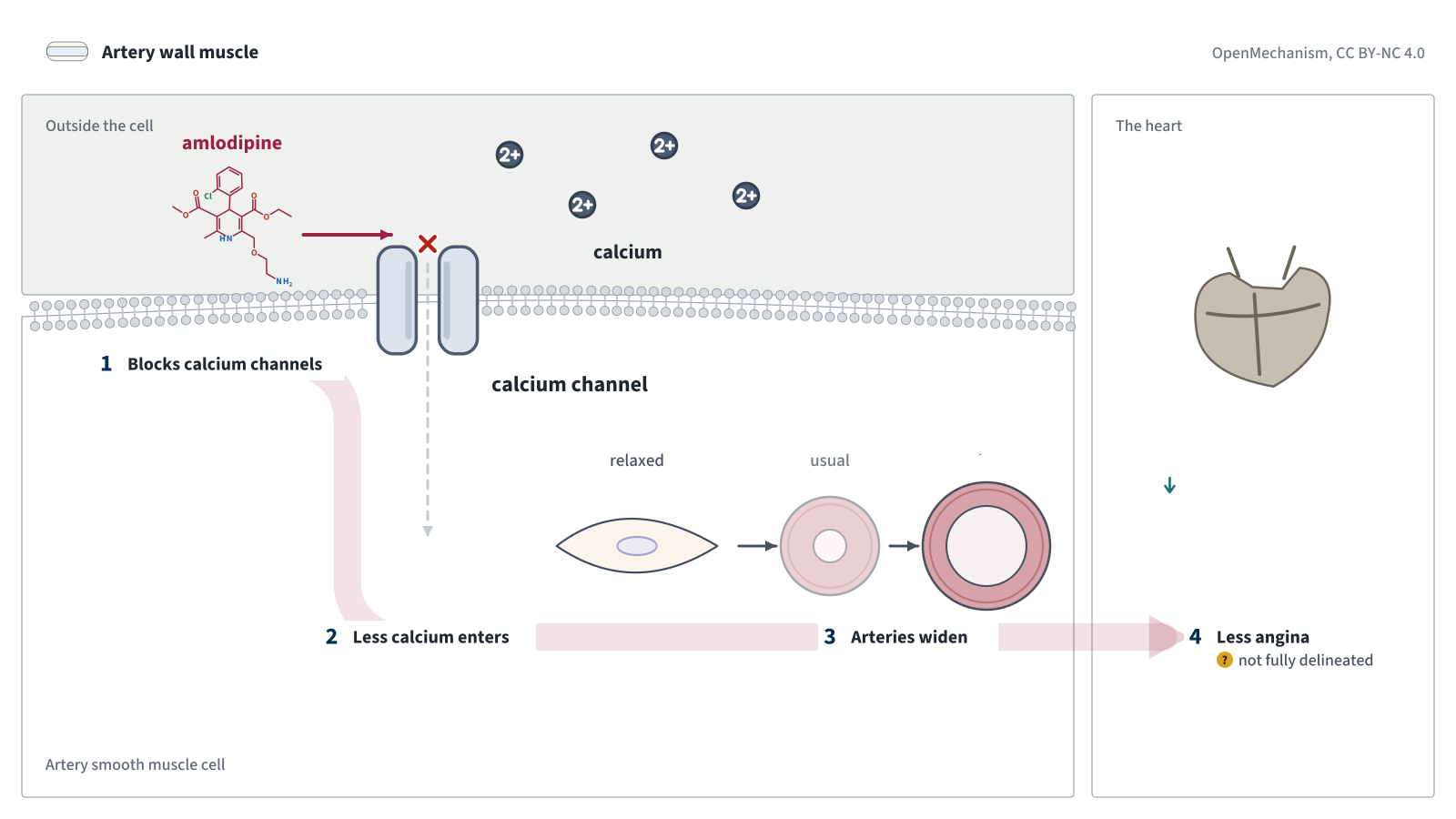
Amlodipine blocks calcium channels, so less calcium flows into the muscle cells of blood vessels and, less so, the heart. The muscle of the arteries relaxes, the arteries widen and blood pressure falls, without a significant change in heart rate over long-term use. In angina brought on by exertion it lowers the heart's oxygen demand; in vasospastic angina it blocks coronary spasm (shown in animal models and human vessels in the laboratory). The label says these mechanisms are not fully worked out.
- Acts on
- L-type (slow) calcium channels (calcium ion influx)
- Where
- Artery wall muscle
- Medicine type
- Small molecule
- Used for
- Heart & circulation
- Drug class
- Calcium channel blockers
Also called Norvasc.
Step 4: not fully delineated
The Norvasc (amlodipine) label says: The precise mechanisms by which amlodipine relieves angina have not been fully delineated, but are thought to include the following:
Clinical study: In a 1993 randomized, double-blind, placebo-controlled trial in 52 people with vasospastic angina, 24 of whom took amlodipine 10 mg once a day for 4 weeks while 28 took a placebo; the trial measured anginal episodes, not how amlodipine relieves angina: The rate of anginal episodes decreased significantly (p = 0.009) with amlodipine treatment compared with placebo and the intake of nitroglycerin tablets showed a similar trend. Peripheral edema was the only adverse event seen more frequently in amlodipine-treated patients.
Chahine RA et al., J Am Coll Cardiol 1993 (PMID 8166777)
How it works
Blocks calcium channels. Amlodipine is a dihydropyridine calcium (a calcium channel blocker). It inhibits the flow of calcium ions into the muscle cells of blood vessels and the heart. Experimental data suggest it binds both dihydropyridine and nondihydropyridine binding sites; it binds and lets go gradually, so its effect comes on gradually.1
Less calcium enters. The contraction of heart muscle and blood-vessel muscle depends on calcium entering these cells through specific ion channels. Amlodipine reduces this entry selectively, with a greater effect on blood-vessel muscle cells than on heart muscle cells; it does not change the level of calcium in the blood. Weaker contraction of heart muscle can be detected in the laboratory, but studies in intact animals and people have not found it at treatment doses.1
Arteries widen. Amlodipine acts directly on the muscle of the arteries and widens them, lowering the resistance of the body's arteries and the blood pressure. In people with high blood pressure, the fall in blood pressure with long-term use comes without a significant change in heart rate or blood catecholamines.1
Less angina. How amlodipine relieves angina has not been fully delineated. In angina brought on by exertion, it lowers the resistance the heart pumps against and so the heart's oxygen demand at any level of exercise. In vasospastic angina, it blocks spasm of the coronary arteries: in animal models and in human coronary vessels in the laboratory it blocked their constriction and restored blood flow.1
For teachers: download this drawing.
See also
Condition pages: angina and high blood pressure.
Other calcium channel blockers: diltiazem, nicardipine, nifedipine and verapamil.
Explained: why amlodipine can cause swelling.
Body system: heart, vessels & cholesterol.
Sources
- 1Norvasc (amlodipine besylate) tablets: FDA label1 Indications and Usage; 12.1 Mechanism of Action; 12.2 Pharmacodynamics
- 2ChEMBL CHEMBL1491Target and action classification: Voltage-gated L-type calcium channel blocker
- 3Randomized placebo-controlled trial of amlodipine in vasospastic angina. Amlodipine Study 160 GroupChahine RA et al. J Am Coll Cardiol 1993 (abstract)
Spotted a mistake? Report an error (hello@openmechanism.com). Since launch, every published error we fix is listed on the corrections page.
Notes and limits
- A schematic teaching drawing: not to scale, not exact structures, binding poses or a complete pathway, and not a guide to dosing, treatment or how a person will respond.
- The label says the precise mechanisms by which amlodipine relieves angina have not been fully delineated, but are thought to include those shown.
All recorded limits are on the evidence page, and notes that apply to every page are on How to read a page. Version 1.0.1, medically reviewed by Daniel Tran, PharmD, on 29 October 2026.
Cite this page
Tran D. Amlodipine [Internet]. OpenMechanism; 2026 [updated 2026 Oct 29; cited 2026 Oct 29]. Available from: https://openmechanism.com/medicines/amlodipine