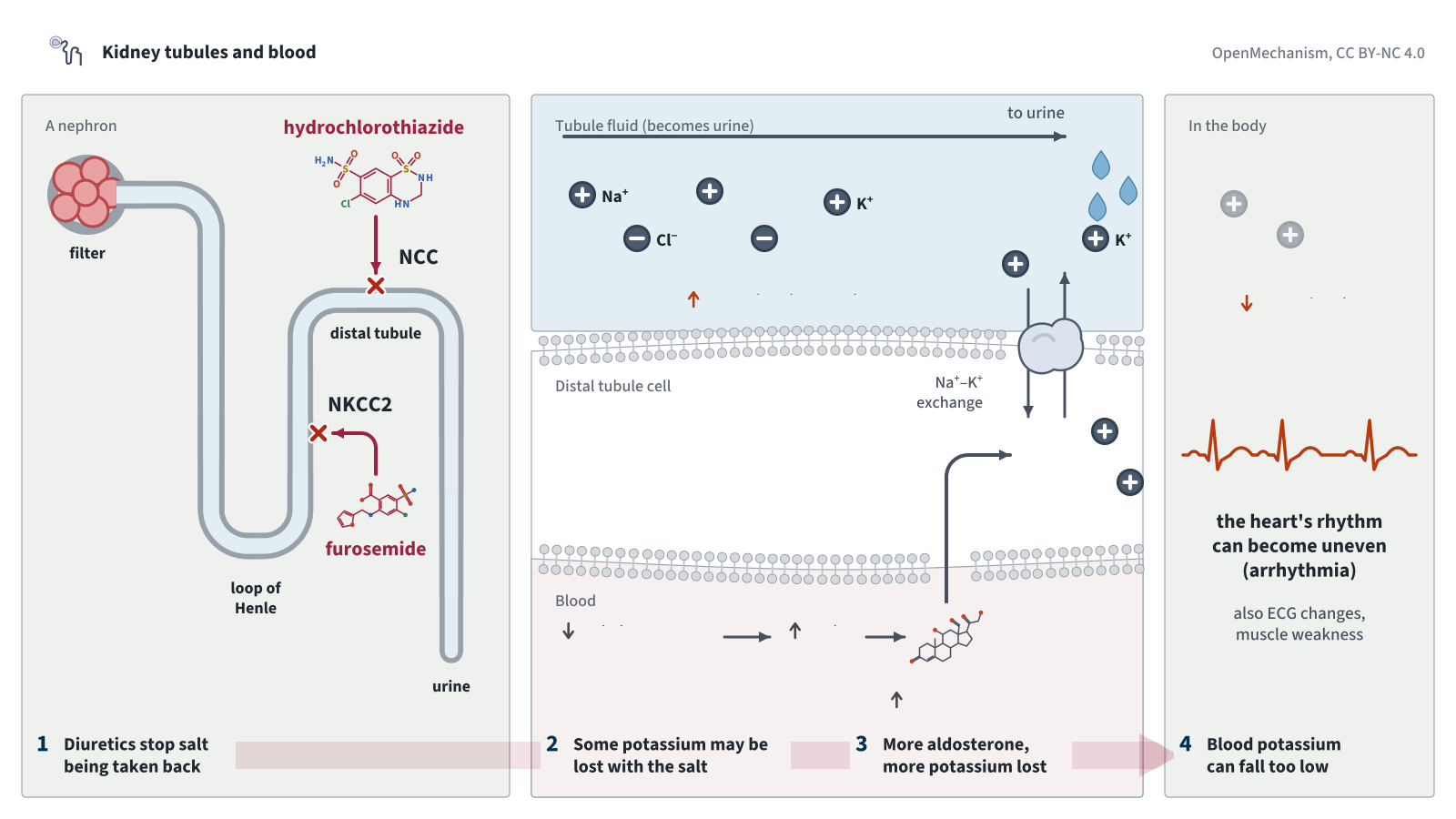
Loop diuretics such as furosemide and thiazides such as hydrochlorothiazide stop the kidney taking salt back, so more sodium and chloride pass into the urine. The hydrochlorothiazide labels say some potassium may go with them, and the Inzirqo (hydrochlorothiazide) label adds that the smaller blood volume raises aldosterone, which makes the kidney lose more potassium. Blood potassium can then fall too low (hypokalemia), which can upset the heart's rhythm.
Diuretics stop salt being taken back. Furosemide blocks , a carrier in the loop of Henle, and mainly stops the kidney taking sodium and chloride back from the fluid that becomes urine. Hydrochlorothiazide acts on the distal tubule, where its target, the sodium-chloride cotransporter (), has a major role in taking salt back.1,2,3,4
What the source says
“Furosemide is a widely used, potent natriuretic drug, which inhibits the Na(+)-K(+)-2Cl(-) cotransporter (NKCC)-2 in the ascending limb of the loop of Henle”
Some potassium may be lost with the salt. More sodium and chloride pass into the urine. The hydrochlorothiazide label says the extra sodium in the urine may come with some loss of potassium and bicarbonate.3
What the source says
“Hydrochlorothiazide increases excretion of sodium and chloride in approximately equivalent amounts.”
More aldosterone, more potassium lost. The Inzirqo (hydrochlorothiazide) label adds a second route: the fluid lost lowers the blood's volume, so and then rise, and more potassium is lost in the urine. Aldosterone makes the distal tubule take back sodium and pass potassium into the urine to leave the body.3,5,6
What the source says
“Indirectly, the diuretic action of hydrochlorothiazide reduces plasma volume, with consequent increases in plasma renin activity, increases in aldosterone secretion, increases in urinary potassium loss, and decreases in serum potassium.”
“Mineralocorticoids act on the distal tubules of the kidney to enhance the reabsorption of sodium ions from the tubular fluid into the plasma; they increase the urinary excretion of both potassium and hydrogen ions.”
Blood potassium can fall too low. Blood potassium can fall too low, called hypokalemia, with either medicine, especially when the urine flow is brisk or in liver cirrhosis (severe cirrhosis, for hydrochlorothiazide) and, with hydrochlorothiazide, after long treatment. Low potassium can cause heart rhythm problems (arrhythmias), and the Inzirqo label gives changes and muscle weakness as examples of its symptoms.2,3,7,8
What the source says
“Lower than normal levels of potassium in the circulating blood.”
“Hypokalemia may develop with LASIX, especially with brisk diuresis, inadequate oral electrolyte intake, when cirrhosis is present, or during concomitant use of corticosteroids, ACTH, licorice in large amounts, or prolonged use of laxatives.”
The labels' doses and management advice are left out: this page explains the mechanism, not what to do.
The furosemide label says potassium can fall but does not say how; on this page, potassium lost with the salt is from the hydrochlorothiazide labels, and the aldosterone route from the Inzirqo (hydrochlorothiazide) label.
The furosemide label names other things that make low potassium more likely, such as corticosteroids, large amounts of licorice, long use of laxatives and taking in too few electrolytes by mouth; with hydrochlorothiazide, low potassium depends on the dose.2,3
The Inzirqo label adds that low magnesium can bring low potassium that appears hard to treat even when potassium is replaced.3
Claude Opus 5.5 (AI source check), 30 October 2026: 35 statements compared with their sources, 11 flagged for the reviewer. An automated check, not a medical review.
Key terms
Definitions reworded since this review: ECG. Definitions are shared across pages, so a later rewording does not take the review line off (what a review covers).
The file of this review’s AI source check was later saved over by the check for the review of 12 November 2026, so its own date and counts are not shown. An automated check, not a medical review.
Next review due
29 April 2028
Cite this page
Tran D. Why diuretics can lower potassium [Internet]. OpenMechanism; 2026 [updated 2026 Nov 12; cited 2026 Nov 12]. Available from: https://openmechanism.com/explained/diuretics-and-low-potassium