Why beta-blockers can tighten the airways
Beta-2 receptors on the smooth muscle of the airways relax it when the body's own catecholamines reach them, and medicines such as albuterol widen the airways the same way. Propranolol blocks beta-2 receptors as well as the heart's beta-1 receptors, so in people prone to bronchospasm the airways can narrow and an asthma attack may follow; timolol eye drops can do the same. Metoprolol blocks mainly beta-1 receptors and narrows the airways less, but at higher levels it blocks beta-2 receptors too.
- Kind
- Side effect
- Medicines
- Propranolol, Metoprolol
- Sources
- 6
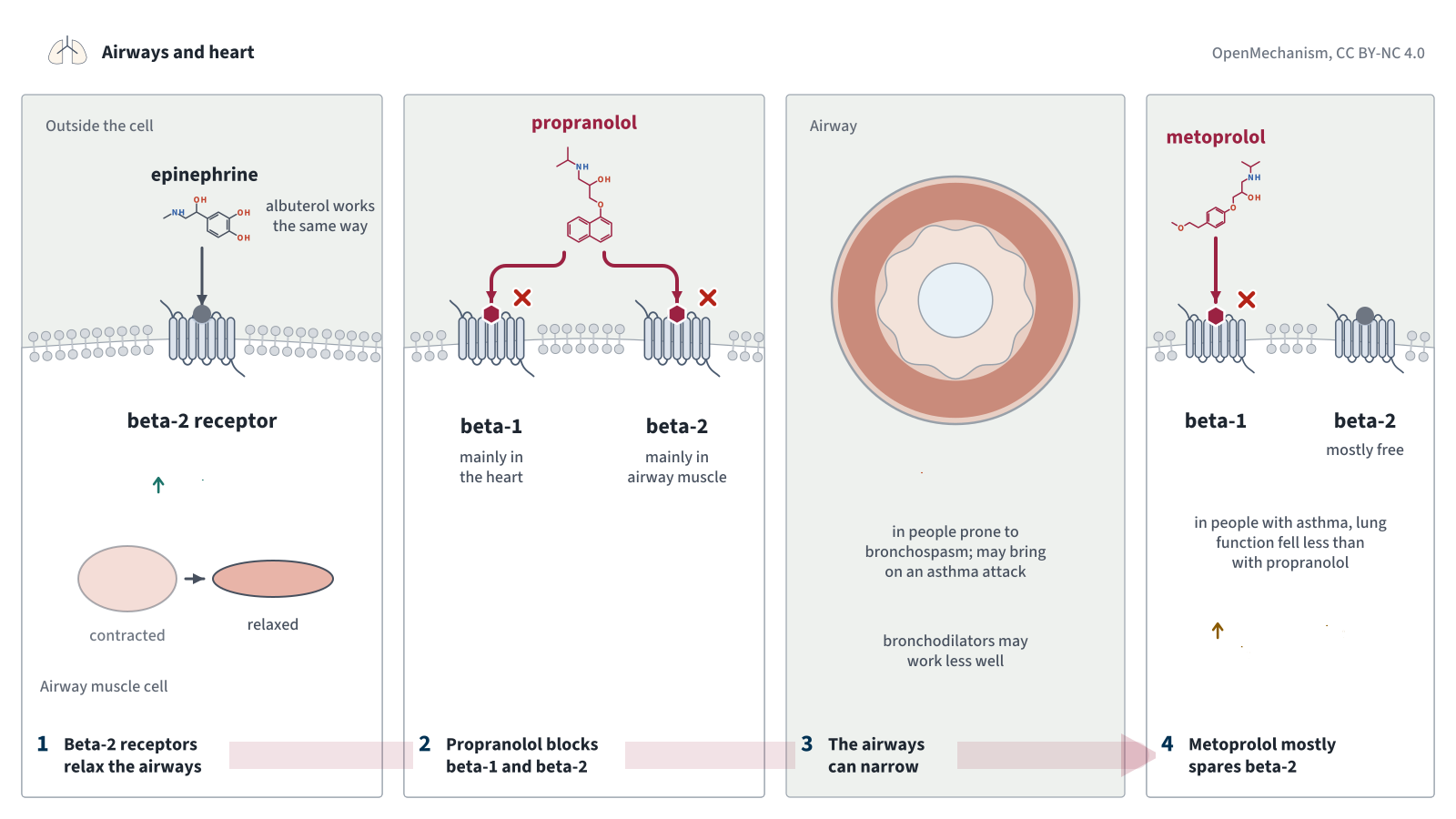
For teachers: download this drawing.
Step by step
Beta-2 receptors relax the airways. Beta-2 receptors are the main adrenergic receptors on the smooth muscle of the airways; are the main ones in the heart. Switching on a beta-2 receptor raises cyclic AMP in the muscle cell, and the muscle relaxes. The body's own catecholamines widen the airways this way, and so does albuterol.1,2
What the source says
“Although beta 2 -adrenoceptors are the predominant adrenergic receptors in bronchial smooth muscle and beta 1 -adrenoceptors are the predominant receptors in the heart”
Source 1“Activation of beta 2 -adrenergic receptors on airway smooth muscle leads to the activation of adenyl cyclase and to an increase in the intracellular concentration of cyclic-3′,5′-adenosine monophosphate (cyclic AMP).”
Source 1“This increase of cyclic AMP leads to the activation of protein kinase A, which inhibits the phosphorylation of myosin and lowers intracellular ionic calcium concentrations, resulting in relaxation.”
Source 1“bronchodilation produced by endogenous and exogenous catecholamine stimulation of beta-receptors”
Source 2“Albuterol relaxes the smooth muscles of all airways, from the trachea to the terminal bronchioles.”
Source 1Propranolol blocks beta-1 and beta-2. Propranolol is a nonselective beta-blocker: it blocks beta-2 receptors as well as beta-1 receptors. Timolol is nonselective too, and timolol eye drops are absorbed into the body.2,3,4,5
What the source says
“Propranolol is a nonselective beta-adrenergic receptor blocking agent possessing no other autonomic nervous system activity.”
Source 2“In normal subjects, metoprolol is unable to reverse the beta 2 -mediated vasodilating effects of epinephrine. This contrasts with the effect of nonselective beta-blockers, which completely reverse the vasodilating effects of epinephrine.”
Source 3“Timolol maleate is a beta 1 and beta 2 (non-selective) adrenergic receptor blocking agent”
Source 4“As with many topically applied ophthalmic drugs, this drug is absorbed systemically.”
Source 5The airways can narrow. Blocking beta-2 receptors takes away the widening that the body's own catecholamines give, so in people prone to bronchospasm the airways narrow and propranolol may bring on an asthma attack; the airway-tightening nerves (parasympathetic) are left unopposed. The blockade may also blunt bronchodilator medicines. With timolol, deaths from bronchospasm in people with asthma have been reported after eye drops as well as other forms.2,3,4,5
What the source says
“Beta 2 -adrenergic blockade results in passive bronchial constriction by interfering with endogenous adrenergic bronchodilator activity in patients subject to bronchospasm and may also interfere with exogenous bronchodilators in such patients.”
Source 3“Propranolol should be administered with caution in this setting since it may provoke a bronchial asthmatic attack by blocking bronchodilation produced by endogenous and exogenous catecholamine stimulation of beta-receptors.”
Source 2“Beta-adrenergic receptor blockade in the bronchi and bronchioles results in increased airway resistance from unopposed parasympathetic activity.”
Source 4“For example, severe respiratory reactions and cardiac reactions, including death due to bronchospasm in patients with asthma, and rarely death in association with cardiac failure, have been reported following systemic or ophthalmic administration of timolol maleate”
Source 5Metoprolol mostly spares beta-2. Metoprolol blocks mainly beta-1 receptors (it is cardioselective). In people with asthma it lowered lung function (FEV1 and FVC) significantly less than propranolol at doses that blocked beta-1 receptors equally. The preference is not absolute: at higher levels in the blood, above about 300 nmol/L, metoprolol blocks more beta-2 receptors, which lie mainly in the muscle of the airways and blood vessels.3
What the source says
“Metoprolol is a beta 1 -selective (cardioselective) adrenergic receptor blocking agent.”
Source 3“(2) In asthmatic patients, metoprolol reduces FEV 1 and FVC significantly less than a nonselective beta-blocker, propranolol, at equivalent beta 1 -receptor blocking doses.”
Source 3“This preferential effect is not absolute, however, and at higher plasma concentrations, metoprolol also inhibits beta 2 -adrenoreceptors, chiefly located in the bronchial and vascular musculature.”
Source 3“The relative beta 1 -selectivity of metoprolol diminishes and blockade of beta 2 -adrenoceptors increases at plasma concentration above 300 nmol/L.”
Source 3
See also
Medicine pages: propranolol and metoprolol.
Can raise or cause it: timolol (“Beta-adrenergic receptor blockade in the bronchi and bronchioles results in increased airway resistance from unopposed parasympathetic activity.”4); and atenolol (“This preferential effect is not absolute, however, and at higher doses, TENORMIN inhibits beta 2 -adrenoreceptors, chiefly located in the bronchial and vascular musculature.”6).
Related medicines: albuterol.
Other side effects (heart & circulation): why ACE inhibitors and ARBs can harm a fetus; why ACE inhibitors can cause a dry cough; why ACE inhibitors can cause angioedema; why amiodarone can upset the thyroid; why amlodipine can cause swelling; why diuretics can lower potassium; why spironolactone can cause breast growth; why statins can cause muscle problems; why stopping clonidine suddenly can raise blood pressure; and all 65 side effects.
Conditions: asthma, high blood pressure and glaucoma.
Interactions: why beta-blockers can hide low blood sugar and verapamil with beta-blockers.
Sources
- 1Ventolin HFA (albuterol sulfate): FDA label12.1 Mechanism of Action. Saved copy
- 2Propranolol hydrochloride tablets: FDA labelClinical Pharmacology; Warnings. Saved copy
- 3Toprol-XL (metoprolol succinate): FDA label5 Warnings and Precautions; 12.1 Mechanism of Action; 12.2 Pharmacodynamics. Saved copy
- 4Timoptic (timolol maleate ophthalmic solution): FDA labelClinical Pharmacology. Saved copy
- 5
- 6Tenormin (atenolol) tablets: FDA labelClinical Pharmacology. Saved copy
Notes and limits
- The labels' advice on who should avoid beta-blockers and on bronchodilators is left out: this page explains the mechanism, not what to do.
- Metoprolol's levels are several times higher in people whose CYP2D6 enzyme works poorly or who take medicines that block CYP2D6, which makes it less cardioselective.3
- Atenolol is cardioselective like metoprolol: in people with asthma, a dose that slowed the resting heart more than propranolol raised airway resistance much less.6
- Beta blockade also matters in severe allergic reactions: people taking beta-blockers who have had severe anaphylactic reactions may react more strongly to another exposure and may not respond to the usual doses of epinephrine.3
Notes that apply to every page are on How to read a page.
Spotted a mistake? Report an error (hello@openmechanism.com). Since launch, every published error we fix is listed on the corrections page.
Cite this page
Tran D. Why beta-blockers can tighten the airways [Internet]. OpenMechanism; 2026 [updated 2026 Oct 20; cited 2026 Oct 20]. Available from: https://openmechanism.com/explained/beta-blockers-and-the-airways