Captopril
Captopril blocks angiotensin-converting enzyme (), so less , a substance that strongly tightens blood vessels, is made. Lower angiotensin II reduces , which leads to some sodium and fluid loss. In people with high blood pressure, captopril also lowers the resistance in the arteries. Its blood-pressure lowering appears to come mainly from damping the renin-angiotensin-aldosterone system, though the full mechanism is not settled. ACE also breaks down bradykinin, a peptide that lowers blood pressure; the label says more bradykinin may also play a part, and a short-term study in 27 salt-depleted people found that it adds to captopril's fall in blood pressure.
- Acts on
- Angiotensin converting enzyme
- Where
- Blood and blood vessels
- Medicine type
- Small molecule
- Used for
- Heart & circulation
- Drug class
- ACE inhibitors
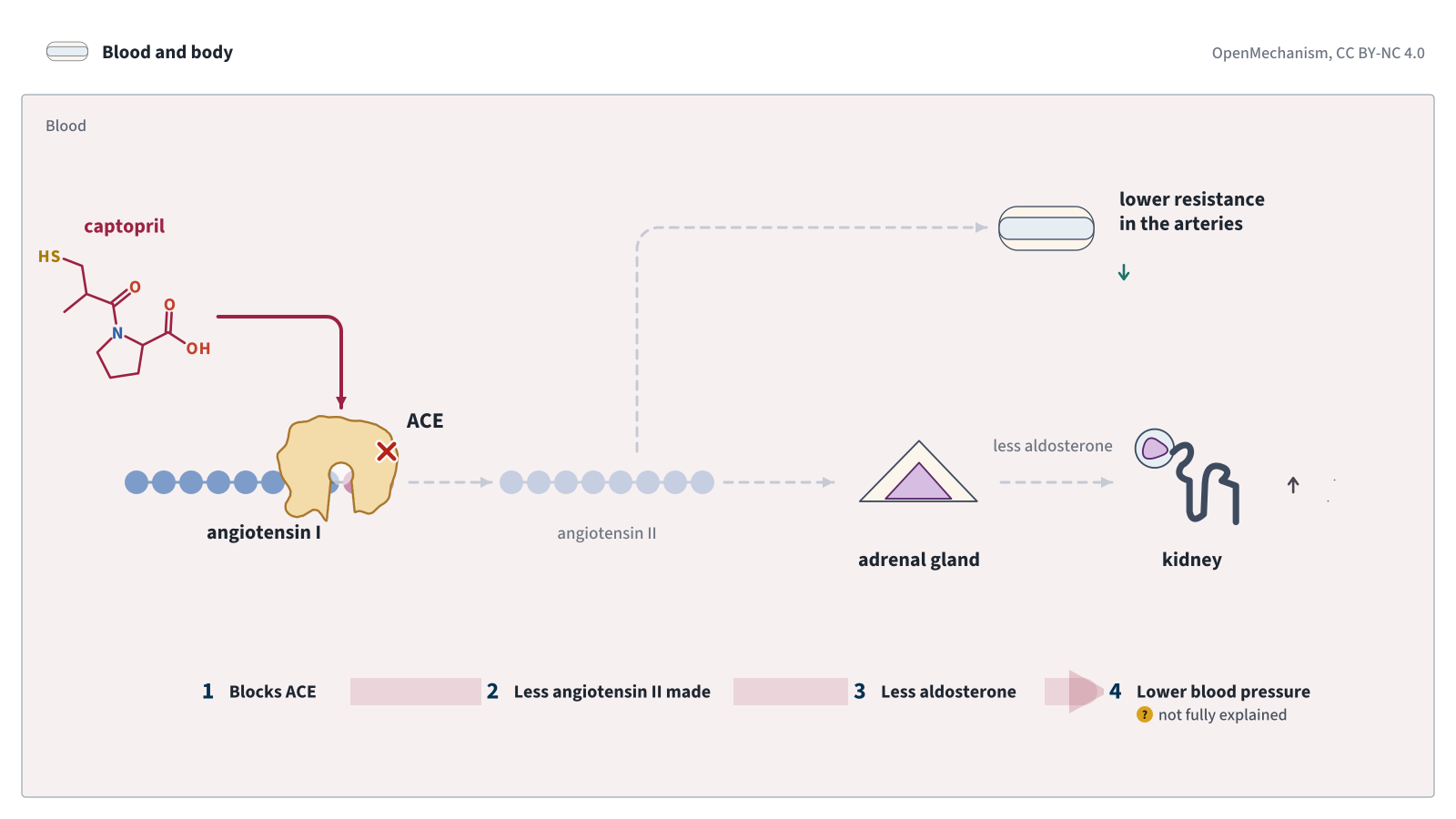
Step 4: not fully explained
The captopril label says: The mechanism of action of captopril tablets have not yet been fully elucidated. … Increased concentrations of bradykinin or prostaglandin E may also have a role in the therapeutic effect of captopril tablets.
Source 1: Captopril: FDA label, Clinical Pharmacology: Mechanism of Action
Clinical study: In a 1998 randomized, single-blind study of 27 people (20 with normal and 7 with high blood pressure), studied while salt-depleted (10 mmol of sodium a day) and given the drugs on four separate study days, a bradykinin-receptor blocker weakened captopril's effect on blood pressure: These data confirm that bradykinin contributes to the short-term effects of ACE inhibition on blood pressure in normotensive and hypertensive persons
Gainer JV et al., N Engl J Med 1998 (PMID 9791144)
Key terms in this drawing
- ACE
- Angiotensin-converting enzyme. The enzyme that makes angiotensin II from angiotensin I.
- aldosterone
- Aldosterone. Released by the adrenal glands, it helps the body keep sodium and fluid; angiotensin II stimulates its release.
- angiotensin II
- Angiotensin II. A hormone that strongly tightens blood vessels; ACE makes it from angiotensin I.
How it works
Blocks ACE. Captopril inhibits ACE, the enzyme that turns angiotensin I into angiotensin II, a substance that strongly tightens blood vessels.1
Less angiotensin II made. This prevents angiotensin I conversion into angiotensin II and lowers plasma angiotensin II.1
Less aldosterone. Lower angiotensin II decreases aldosterone secretion, contributing to sodium and fluid loss; small increases in blood potassium may occur.1
Lower blood pressure. In people with high blood pressure, captopril lowers the resistance in the arteries. The label says its blood-pressure lowering appears to come mainly from suppressing the renin-angiotensin-aldosterone system, but that the complete mechanism is not elucidated: ACE also breaks down bradykinin, a peptide that lowers blood pressure, and more bradykinin or prostaglandin E may also play a part. In a 1998 study of 27 salt-depleted people, blocking bradykinin's receptor weakened captopril's short-term fall in blood pressure.1,2
For teachers: download this drawing or build a slide deck.
See also
Condition pages: chronic kidney disease, heart attack, heart failure and high blood pressure.
Side effects: cough and high blood potassium.
Other ACE inhibitors: benazepril, enalapril and lisinopril.
Explained: why ACE inhibitors can cause angioedema; why ACE inhibitors can cause a dry cough; why ACE inhibitors and ARBs can harm a fetus; and ACE inhibitors and spironolactone.
Body system: heart, vessels & cholesterol.
Sources
- 1Captopril: FDA labelClinical Pharmacology: Mechanism of Action; Pharmacodynamics
- 2Effect of bradykinin-receptor blockade on the response to angiotensin-converting-enzyme inhibitor in normotensive and hypertensive subjectsGainer JV et al., N Engl J Med 1998 (abstract)
- 3ChEMBL CHEMBL1560Target and action classification: Angiotensin-converting enzyme inhibitor
Also used for the drawing
The ACE outline is traced from the crystal structure below.
- 4Human angiotensin-converting enzyme with lisinoprilPDB 1O86; Natesh, R. et al. Nature 2003; 421:551
Spotted a mistake? Report an error (hello@openmechanism.com). Since launch, every published error we fix is listed on the corrections page.
Notes and limits
- A schematic teaching drawing: not to scale, not exact structures, binding poses or a complete pathway, and not a guide to dosing, treatment or how a person will respond.
- Other medicines in the same family may not follow every step or share the same clinical endpoint.
- The steps are in the order that explains them; one step is said to cause the next only where the source says so.
- The label says the mechanism is not fully elucidated: more bradykinin or prostaglandin E may also play a part, and the blood-pressure effect lasts longer than measurable blocking of ACE in the blood; whether ACE in the vessel lining stays blocked longer than ACE in the blood is not known.
All recorded limits are on the evidence page, and notes that apply to every page are on How to read a page. Version 1.0.1, medically reviewed by Daniel Tran, PharmD, on 28 October 2026.
Cite this page
Tran D. Captopril [Internet]. OpenMechanism; 2026 [updated 2026 Oct 28; cited 2026 Oct 28]. Available from: https://openmechanism.com/medicines/captopril