Medically reviewed by Daniel Tran, PharmD, on 12 November 2026.
ACE inhibitors with ARBs or aliskiren
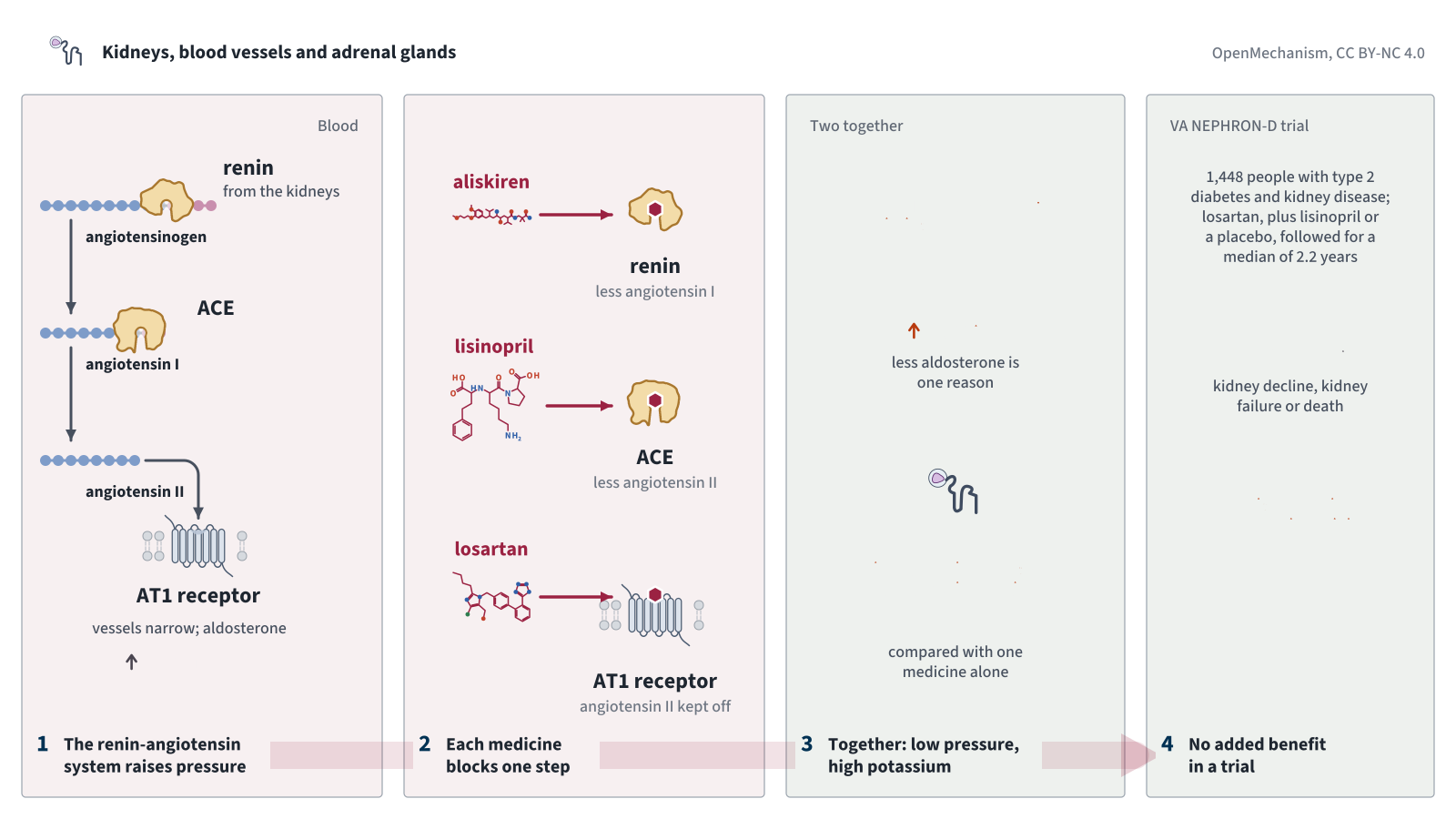
The renin-angiotensin system makes angiotensin II, which narrows blood vessels and makes the adrenal glands release aldosterone. Aliskiren, ACE (angiotensin-converting enzyme) inhibitors such as lisinopril and angiotensin receptor blockers (ARBs) such as losartan each block it at a different step. Blocking it twice is linked with more low blood pressure, high potassium and changes in kidney function; in a trial of people with diabetic kidney disease, adding lisinopril to losartan brought no added benefit.
- Kind
- Interaction
- Medicines
- Lisinopril, Losartan
- Sources
- 8
For teachers: download this drawing.
Step by step
The renin-angiotensin system raises blood pressure. When blood pressure falls, kidney cells release , which turns angiotensinogen into angiotensin I; the enzyme then makes , a powerful narrower of blood vessels that also makes the adrenal glands release .1,2,3
What the source says
“Juxtaglomerular cells are sensors that release renin to control blood pressure and fluid-electrolyte homeostasis.”
Source 1“the renin baroreceptor, whereby a decrease in arterial pressure leads to increased renin release”
Source 1“Ang II is a powerful vasoconstrictor”
Source 2“Angiotensin II also stimulates aldosterone secretion by the adrenal cortex.”
Source 3“Renin cleaves angiotensinogen to form the inactive decapeptide angiotensin I (Ang I).”
Source 2“ACE is a peptidyl dipeptidase that catalyzes the conversion of angiotensin I to the vasoconstrictor substance, angiotensin II.”
Source 3Each medicine blocks one step. Aliskiren blocks renin, lisinopril blocks ACE, and losartan and its active metabolite keep angiotensin II off its .2,3,4
What the source says
“Aliskiren is a direct renin inhibitor, decreasing plasma renin activity (PRA) and inhibiting the conversion of angiotensinogen to Ang I.”
Source 2“Lisinopril inhibits angiotensin-converting enzyme (ACE) in human subjects and animals.”
Source 3“Losartan and its principal active metabolite block the vasoconstrictor and aldosterone-secreting effects of angiotensin II by selectively blocking the binding of angiotensin II to the AT 1 receptor”
Source 4Together: low blood pressure, high potassium. Blocking the system twice is linked with more low blood pressure, fainting, high potassium and changes in kidney function, including acute kidney failure, than one medicine alone. Less aldosterone is one reason potassium can rise.3,5
What the source says
“Dual blockade of the RAS with angiotensin receptor blockers, ACE inhibitors, or aliskiren is associated with increased risks of hypotension, syncope, hyperkalemia, and changes in renal function (including acute renal failure) compared to monotherapy.”
Source 5“Inhibition of ACE results in decreased plasma angiotensin II which leads to decreased vasopressor activity and to decreased aldosterone secretion. The latter decrease may result in a small increase of serum potassium.”
Source 3No added benefit in a trial. In the VA NEPHRON-D trial, 1,448 people with type 2 diabetes and kidney disease took lisinopril or a placebo on top of losartan and were followed for a median of 2.2 years. The combination brought no added benefit for kidney decline, kidney failure or death, but more high potassium and acute kidney injury.5,6
What the source says
“The Veterans Affairs Nephropathy in Diabetes (VA NEPHRON-D) trial enrolled 1448 patients with type 2 diabetes, elevated urinary-albumin-to-creatinine ratio, and decreased estimated glomerular filtration rate (GFR 30 to 89.9 mL/min), randomized them to lisinopril or placebo on a background of losartan therapy and followed them for a median of 2.2 years.”
Source 5“The VA NEPHRON trial enrolled 1,448 patients with type 2 diabetes, elevated urinary-albumin-to-creatinine ratio, and decreased estimated glomerular filtration rate (GFR 30 mL/min to 89.9 mL/min), randomized them to lisinopril or placebo on a background of losartan therapy and followed them for a median of 2.2 years.”
Source 6“Patients receiving the combination of losartan and lisinopril did not obtain any additional benefit compared to monotherapy for the combined endpoint of decline in GFR, end state renal disease, or death, but experienced an increased incidence of hyperkalemia and acute kidney injury compared with the monotherapy group.”
Source 6
See also
Medicine pages: lisinopril and losartan.
Also part of this interaction: aliskiren (“Dual blockade of the RAS with angiotensin receptor blockers, ACE inhibitors, or aliskiren is associated with increased risks of hypotension, hyperkalemia, and changes in renal function (including acute renal failure) compared to monotherapy.”6).
Related medicines: valsartan, irbesartan and olmesartan.
Other interactions (heart & circulation): ACE inhibitors and spironolactone; amiodarone and warfarin; atorvastatin and medicines that block CYP3A4; digoxin and diuretics; digoxin and P-glycoprotein blockers; grapefruit juice and simvastatin; nitrates and PDE5 inhibitors such as sildenafil; simvastatin and clarithromycin; verapamil with beta-blockers; why beta-blockers can hide low blood sugar; and all 40 interactions.
Conditions: high blood pressure and chronic kidney disease.
Sources
- 1Renin cells, from vascular development to blood pressure sensingYamaguchi H et al. Hypertension 2023 (abstract). Saved copy
- 2Tekturna (aliskiren): FDA label12.1 Mechanism of Action. Saved copy
- 3Zestril (lisinopril): FDA label12.1 Mechanism of Action. Saved copy
- 4Cozaar (losartan): FDA label12.1 Mechanism of Action. Saved copy
- 5Cozaar (losartan): FDA label7.4 Dual Blockade of the Renin-Angiotensin System. Saved copy
- 6Zestril (lisinopril): FDA label7.4 Dual Blockade of the Renin-Angiotensin System. Saved copy
- 7Human renin with aliskirenPDB 2V0Z; Rahuel, J. et al. Chem.Biol. 2000;7:493-504. The renin outline in the drawing is traced from this structure. Saved copy
- 8Human angiotensin-converting enzyme with lisinoprilPDB 1O86; Natesh, R. et al. Nature 2003;421:551. The ACE outline in the drawing is traced from this structure. Saved copy
Notes and limits
- The labels' advice on avoiding the combination and on checking blood pressure, kidney function and electrolytes is left out: this page explains the mechanism, not what to do.
Notes that apply to every page are on How to read a page.
Spotted a mistake? Report an error (hello@openmechanism.com). Since launch, every published error we fix is listed on the corrections page.
Medical review
Earlier reviews (1)
Cite this page
Tran D. ACE inhibitors with ARBs or aliskiren [Internet]. OpenMechanism; 2026 [updated 2026 Nov 12; cited 2026 Nov 12]. Available from: https://openmechanism.com/explained/ace-inhibitors-with-arbs-or-aliskiren