Propranolol
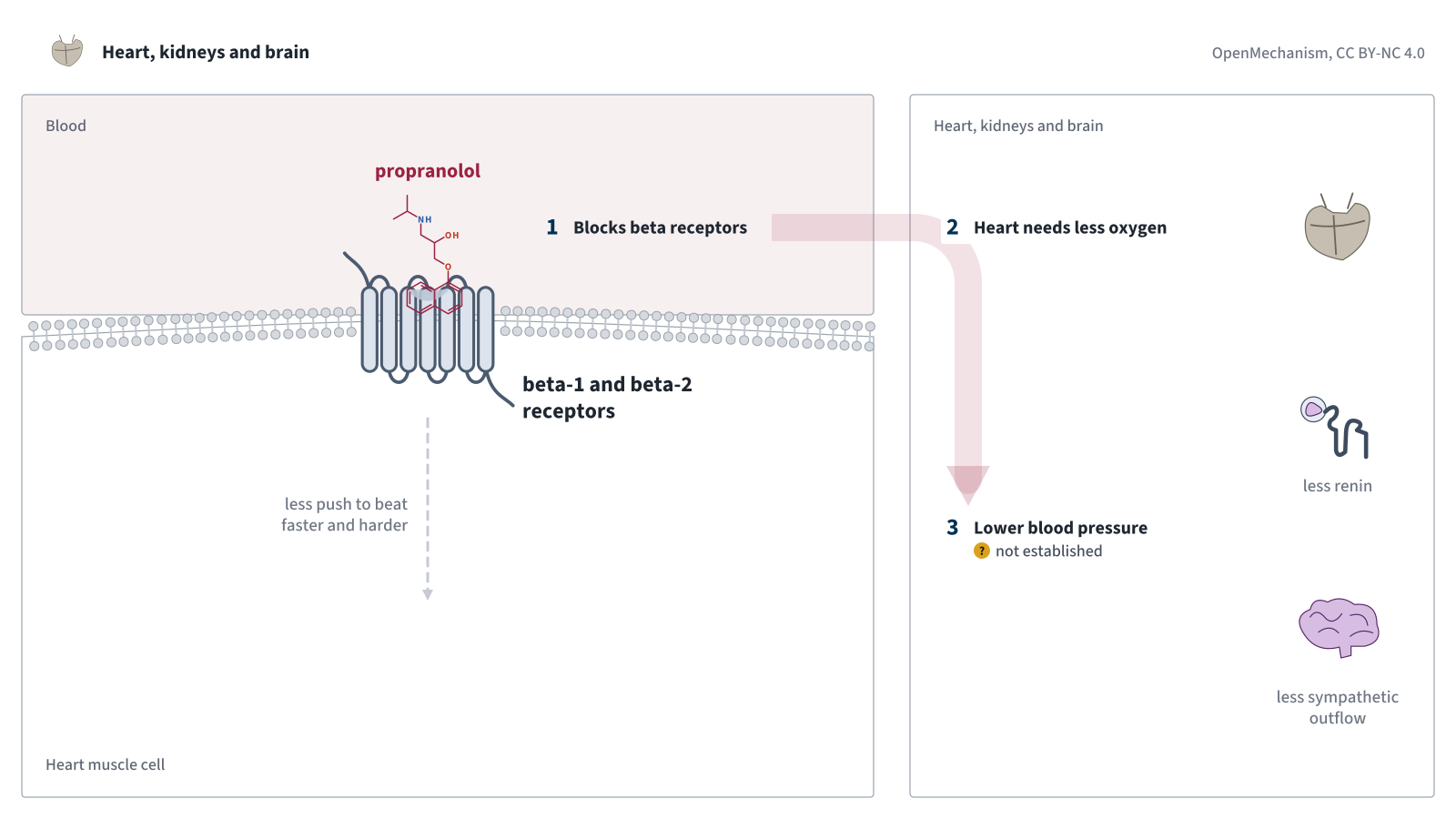
Propranolol blocks beta-1 and beta-2 receptors, so beta-receptor stimulation speeds the heart and strengthens its beat less. In angina, the heart usually needs less oxygen at any level of effort. It also lowers blood pressure; how is not established, though a lower cardiac output, less from the kidneys and less sympathetic outflow from the brain may contribute.
- Acts on
- Beta-1 and beta-2 adrenergic receptors (nonselective)
- Where
- Heart, kidneys and brain
- Medicine type
- Small molecule
- Used for
- Heart & circulation
- Drug class
- Beta blockers
Step 3: not established
The propranolol label says: The mechanism of the antihypertensive effect of propranolol has not been established. Factors that may contribute to the antihypertensive action include: (1) decreased cardiac output, (2) inhibition of renin release by the kidneys, and (3) diminution of tonic sympathetic nerve outflow from vasomotor centers in the brain.
Clinical study: In a 1983 study, people with a diastolic blood pressure of 95 to 114 mm Hg took propranolol (40 to 320 mg twice daily) or hydrochlorothiazide (25 to 100 mg twice daily) alone and were sorted by renin profile (high in 11 percent, 60 people): Hydrochlorothiazide administration resulted in a greater decrement in diastolic blood pressure (p less than 0.05) in the total group. Irrespective of renin activity, both hydrochlorothiazide and propranolol reduced diastolic blood pressure. … In comparing therapeutic response, patients with a low renin profile had a better response to hydrochlorothiazide, and propranolol was more effective in patients with a high renin profile.
The authors added: Although these results are consistent with a volume-vasoconstrictor analysis of hypertension, the results of therapy could not have been prejudged from renin profile or responsivity.
Freis ED et al., Am J Med 1983 (PMID 6344619)
Key terms in this drawing
- renin
- Renin. An enzyme that cuts angiotensinogen to make angiotensin I.
How it works
Blocks beta receptors. Propranolol is a nonselective beta blocker with no other action on the autonomic nervous system. It competes for beta receptors with the agents that stimulate them (beta ), so the speeding of the heart, the stronger heart contraction and the vessel widening they cause shrink in proportion. Its effect on abnormal heart rhythms appears to come mainly from this beta blockade. At doses higher than needed to block beta receptors, it also has a quinidine-like or anesthetic-like action on the cell membrane that affects the heart's action potential; the label calls its importance in treating abnormal rhythms uncertain.1
Heart needs less oxygen. In angina, propranolol usually lowers the heart's oxygen need at any level of effort, by blocking the catecholamine-driven rises in heart rate, systolic blood pressure and the speed and extent of heart muscle contraction. It may also raise the oxygen need in other ways, such as by stretching the left ventricle's muscle fibers further, but the net effect is usually helpful: during exercise, pain starts later and more work can be done.1
Lower blood pressure. How propranolol lowers blood pressure has not been established. Factors that may contribute include a lower cardiac output, less renin released by the kidneys, and less sympathetic nerve outflow from the brain's vasomotor centers.1
For teachers: download this drawing.
See also
Condition pages: angina, atrial fibrillation, heart attack, high blood pressure and migraine.
Other beta blockers: atenolol, carvedilol, esmolol, labetalol, metoprolol, nebivolol, sotalol and timolol.
Explained: why beta-blockers can hide low blood sugar and why beta-blockers can tighten the airways.
Body system: heart, vessels & cholesterol.
Sources
- 1Propranolol hydrochloride tablets: FDA labelIndications and Usage; Clinical Pharmacology: General; Mechanism of Action
- 2ChEMBL CHEMBL27Target and action classification: Beta-1 adrenergic receptor antagonist; Beta-2 adrenergic receptor antagonist
- 3Comparison of propranolol or hydrochlorothiazide alone for treatment of hypertension. III. Evaluation of the renin-angiotensin systemFreis ED et al. Am J Med 1983 (abstract)
Spotted a mistake? Report an error (hello@openmechanism.com). Since launch, every published error we fix is listed on the corrections page.
Notes and limits
- A schematic teaching drawing: not to scale, not exact structures, binding poses or a complete pathway, and not a guide to dosing, treatment or how a person will respond.
- The steps are in the order that explains them; one step is said to cause the next only where the source says so.
- The label says the mechanism of the antihypertensive effect of propranolol has not been established; it lists factors that may contribute.
All recorded limits are on the evidence page, and notes that apply to every page are on How to read a page. Version 1.0.1, medically reviewed by Daniel Tran, PharmD, on 29 October 2026.
Cite this page
Tran D. Propranolol [Internet]. OpenMechanism; 2026 [updated 2026 Oct 29; cited 2026 Oct 29]. Available from: https://openmechanism.com/medicines/propranolol