Hydralazine
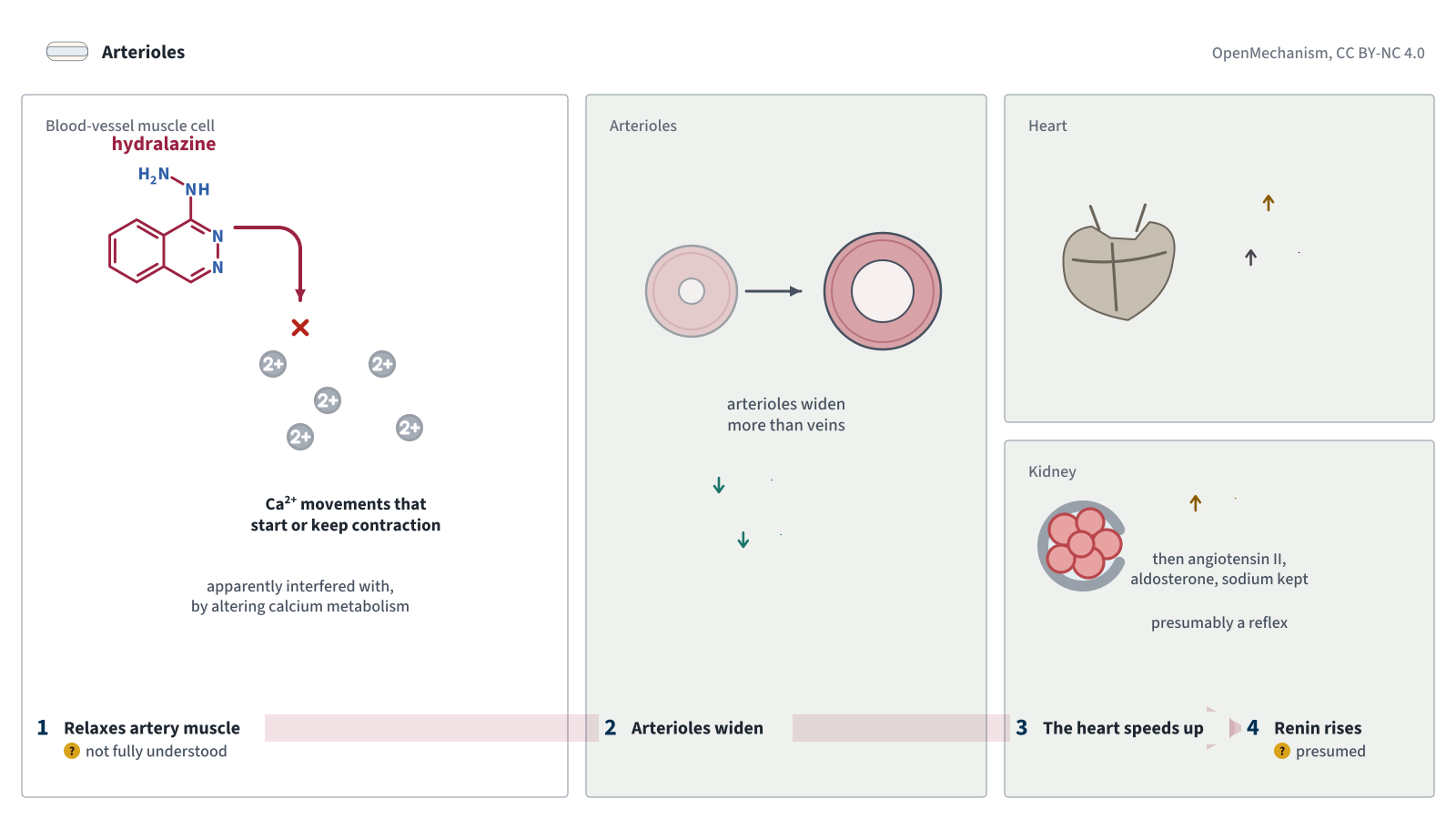
Hydralazine apparently lowers blood pressure by relaxing the muscle of blood vessels directly, interfering with the calcium movements that make it contract, though its precise mechanism is not fully understood. Arterioles widen more than veins, so the heart speeds up and pumps more, and usually rises, presumably as a reflex.
- Acts on
- Calcium movements in vascular smooth muscle (apparently)
- Where
- Arterioles
- Medicine type
- Small molecule
- Used for
- Heart & circulation
Step 1: not fully understood
The hydralazine label says: Although the precise mechanism of action of hydralazine is not fully understood, the major effects are on the cardiovascular system. Hydralazine apparently lowers blood pressure by exerting a peripheral vasodilating effect through a direct relaxation of vascular smooth muscle.
Source 1: Hydralazine hydrochloride tablets: FDA label, Clinical Pharmacology
Clinical study: A Cochrane review looking for randomized trials of hydralazine against placebo in primary hypertension found none: The search strategy did not yield any randomized controlled trials comparing hydralazine to placebo for inclusion in this review.
Kandler MR et al., Cochrane Database Syst Rev 2011 (PMID 22071816)
This study was picked with a literature search and is not yet checked by our reviewer.
Step 4: presumed
The hydralazine label says: Hydralazine usually increases renin activity in plasma, presumably as a result of increased secretion of renin by the renal juxtaglomerular cells in response to reflex sympathetic discharge.
Source 1: Hydralazine hydrochloride tablets: FDA label, Clinical Pharmacology
Clinical study: The same Cochrane review lists effects reported in the literature: Some of the adverse effects related to hydralazine that have been reported in the literature include reflex tachycardia
Kandler MR et al., Cochrane Database Syst Rev 2011 (PMID 22071816)
This study was picked with a literature search and is not yet checked by our reviewer.
Key terms in this drawing
- aldosterone
- Aldosterone. Released by the adrenal glands, it helps the body keep sodium and fluid; angiotensin II stimulates its release.
- angiotensin II
- Angiotensin II. A hormone that strongly tightens blood vessels; ACE makes it from angiotensin I.
- renin
- Renin. An enzyme that cuts angiotensinogen to make angiotensin I.
How it works
Relaxes artery muscle. Although its precise mechanism is not fully understood, hydralazine apparently lowers blood pressure by directly relaxing vascular smooth muscle; by altering cellular calcium metabolism, it interferes with the calcium movements that start or maintain contraction.1
Arterioles widen. It dilates arterioles more than veins, lowering arterial pressure (diastolic more than systolic) and peripheral vascular resistance.1
The heart speeds up. Heart rate, stroke volume and cardiac output rise.1
Renin rises. Plasma renin activity usually rises, presumably because reflex sympathetic discharge makes the kidney's juxtaglomerular cells secrete more renin; the that follows stimulates and sodium reabsorption.1
For teachers: download this drawing.
See also
Condition pages: high blood pressure.
More medicines for heart & circulation: adenosine, aliskiren, ambrisentan, amiloride, amiodarone, amlodipine, atenolol, atorvastatin and 59 more.
Related drawings: minoxidil (also widens arterioles directly; its label does not say how).
Body system: heart, vessels & cholesterol.
Sources
- 1Hydralazine hydrochloride tablets: FDA labelClinical Pharmacology
- 2ChEMBL CHEMBL276832Target and action classification: Unknown
- 3Hydralazine for essential hypertensionKandler MR et al. Cochrane Database Syst Rev 2011 (abstract)
Spotted a mistake? Report an error (hello@openmechanism.com). Since launch, every published error we fix is listed on the corrections page.
Notes and limits
- A schematic teaching drawing: not to scale, not exact structures, binding poses or a complete pathway, and not a guide to dosing, treatment or how a person will respond.
- The label says the precise mechanism of action is not fully understood.
- The label says the rise in renin is presumably a result of reflex sympathetic discharge.
All recorded limits are on the evidence page, and notes that apply to every page are on How to read a page. Version 1.0.0, not yet medically reviewed.
Cite this page
Tran D. Hydralazine [Internet]. OpenMechanism; 2026 [updated 2026 Oct 13; cited 2026 Oct 13]. Available from: https://openmechanism.com/medicines/hydralazine