Lisinopril
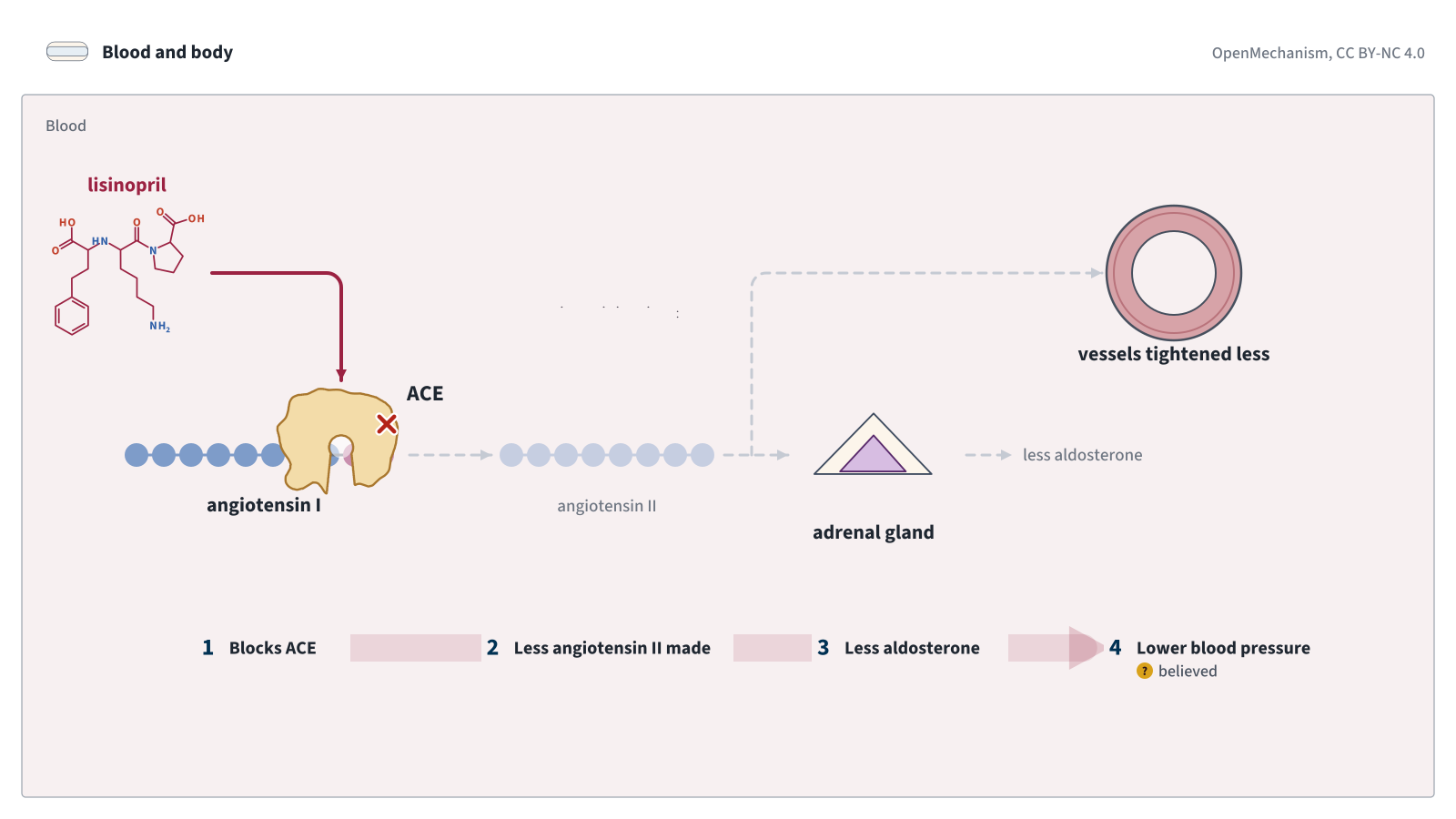
Lisinopril blocks , the enzyme that turns angiotensin I into . With less angiotensin II, blood vessels are tightened less and the adrenal glands release less . Its blood-pressure lowering is believed to come mainly from damping this renin-angiotensin-aldosterone system. ACE also breaks down bradykinin: studies in people given other ACE inhibitors show bradykinin adds to the short-term fall in blood pressure; over weeks of treatment it has been studied in heart failure, with mixed results.
- Acts on
- Angiotensin-converting enzyme (ACE)
- Where
- Blood, blood vessels and adrenal glands
- Medicine type
- Small molecule
- Used for
- Heart & circulation
- Drug class
- ACE inhibitors
Also called Zestril.
Step 4: believed
The Zestril (lisinopril) label says: Whether increased levels of bradykinin, a potent vasodepressor peptide, play a role in the therapeutic effects of Zestril remains to be elucidated. While the mechanism through which Zestril lowers blood pressure is believed to be primarily suppression of the renin-angiotensin-aldosterone system, Zestril is antihypertensive even in patients with low-renin hypertension.
Source 1: Zestril (lisinopril) tablets: FDA label, 12.1 Mechanism of Action; 12.2 Pharmacodynamics
Clinical study: In a 1998 randomized, single-blind study of 27 people (20 with normal and 7 with high blood pressure), studied while salt-depleted (10 mmol of sodium a day) and given the drugs on four separate study days, blocking bradykinin's receptor weakened the effect of an ACE inhibitor (captopril) on blood pressure: These data confirm that bradykinin contributes to the short-term effects of ACE inhibition on blood pressure in normotensive and hypertensive persons
Gainer JV et al., N Engl J Med 1998 (PMID 9791144)
Key terms in this drawing
- ACE
- Angiotensin-converting enzyme. The enzyme that makes angiotensin II from angiotensin I.
- aldosterone
- Aldosterone. Released by the adrenal glands, it helps the body keep sodium and fluid; angiotensin II stimulates its release.
- angiotensin II
- Angiotensin II. A hormone that strongly tightens blood vessels; ACE makes it from angiotensin I.
- renin
- Renin. An enzyme that cuts angiotensinogen to make angiotensin I.
How it works
Blocks ACE. Lisinopril inhibits angiotensin-converting enzyme (ACE), the enzyme that turns angiotensin I into angiotensin II, a substance that tightens blood vessels.1
Less angiotensin II made. With ACE blocked there is less angiotensin II in the blood, so blood vessels are tightened less. Without angiotensin II's negative feedback on , renin activity in the blood rises.1
Less aldosterone. Angiotensin II also makes the adrenal cortex secrete aldosterone. Less angiotensin II means less aldosterone, which may raise blood potassium slightly.1
Lower blood pressure. Lisinopril's benefits in high blood pressure and heart failure appear to come mainly from suppressing the renin-angiotensin-aldosterone system, though it lowers blood pressure even in people with low-renin hypertension. ACE is the same enzyme as kininase, which breaks down bradykinin, a peptide that widens blood vessels. The label says whether more bradykinin plays a part remains to be elucidated. Studies in people given other ACE inhibitors found that blocking bradykinin's receptor weakened the short-term fall in blood pressure; over weeks of treatment it has been studied in heart failure, where one study found bradykinin adds to the effects on the circulation and another found no effect in the forearm.1,2,3,4,5
For teachers: download this drawing.
See also
Condition pages: heart attack, heart failure and high blood pressure.
Other ACE inhibitors: benazepril, captopril and enalapril.
Explained: why ACE inhibitors can cause angioedema; why ACE inhibitors can cause a dry cough; why ACE inhibitors and ARBs can harm a fetus; ACE inhibitors and spironolactone; ACE inhibitors with ARBs or aliskiren; lithium and NSAIDs, diuretics or ACE inhibitors; and why NSAIDs can harm the kidneys.
Body system: heart, vessels & cholesterol.
Sources
- 1Zestril (lisinopril) tablets: FDA label12.1 Mechanism of Action; 12.2 Pharmacodynamics
- 2Effect of bradykinin-receptor blockade on the response to angiotensin-converting-enzyme inhibitor in normotensive and hypertensive subjectsGainer JV et al., N Engl J Med 1998 (abstract)
- 3Bradykinin B(2) receptor antagonism attenuates blood pressure response to acute angiotensin-converting enzyme inhibition in normal menSquire IB et al., Hypertension 2000 (abstract)
- 4Bradykinin contributes to the systemic hemodynamic effects of chronic angiotensin-converting enzyme inhibition in patients with heart failureCruden NL et al., Arterioscler Thromb Vasc Biol 2004 (abstract)
- 5Role of bradykinin in the vasodilator effects of losartan and enalapril in patients with heart failureDavie AP et al., Circulation 1999 (abstract)
- 6ChEMBL CHEMBL1237Target and action classification: Angiotensin-converting enzyme inhibitor
Also used for the drawing
The ACE outline is traced from the crystal structure below.
- 7Human angiotensin-converting enzyme with lisinoprilPDB 1O86; Natesh, R. et al. Nature 2003; 421:551
Spotted a mistake? Report an error (hello@openmechanism.com). Since launch, every published error we fix is listed on the corrections page.
Notes and limits
- A schematic teaching drawing: not to scale, not exact structures, binding poses or a complete pathway, and not a guide to dosing, treatment or how a person will respond.
- The label says lisinopril's blood-pressure lowering is believed to be primarily suppression of the renin-angiotensin-aldosterone system, and that whether bradykinin plays a role remains to be elucidated.
All recorded limits are on the evidence page, and notes that apply to every page are on How to read a page. Version 1.0.1, medically reviewed by Daniel Tran, PharmD, on 28 October 2026.
Cite this page
Tran D. Lisinopril [Internet]. OpenMechanism; 2026 [updated 2026 Oct 28; cited 2026 Oct 28]. Available from: https://openmechanism.com/medicines/lisinopril