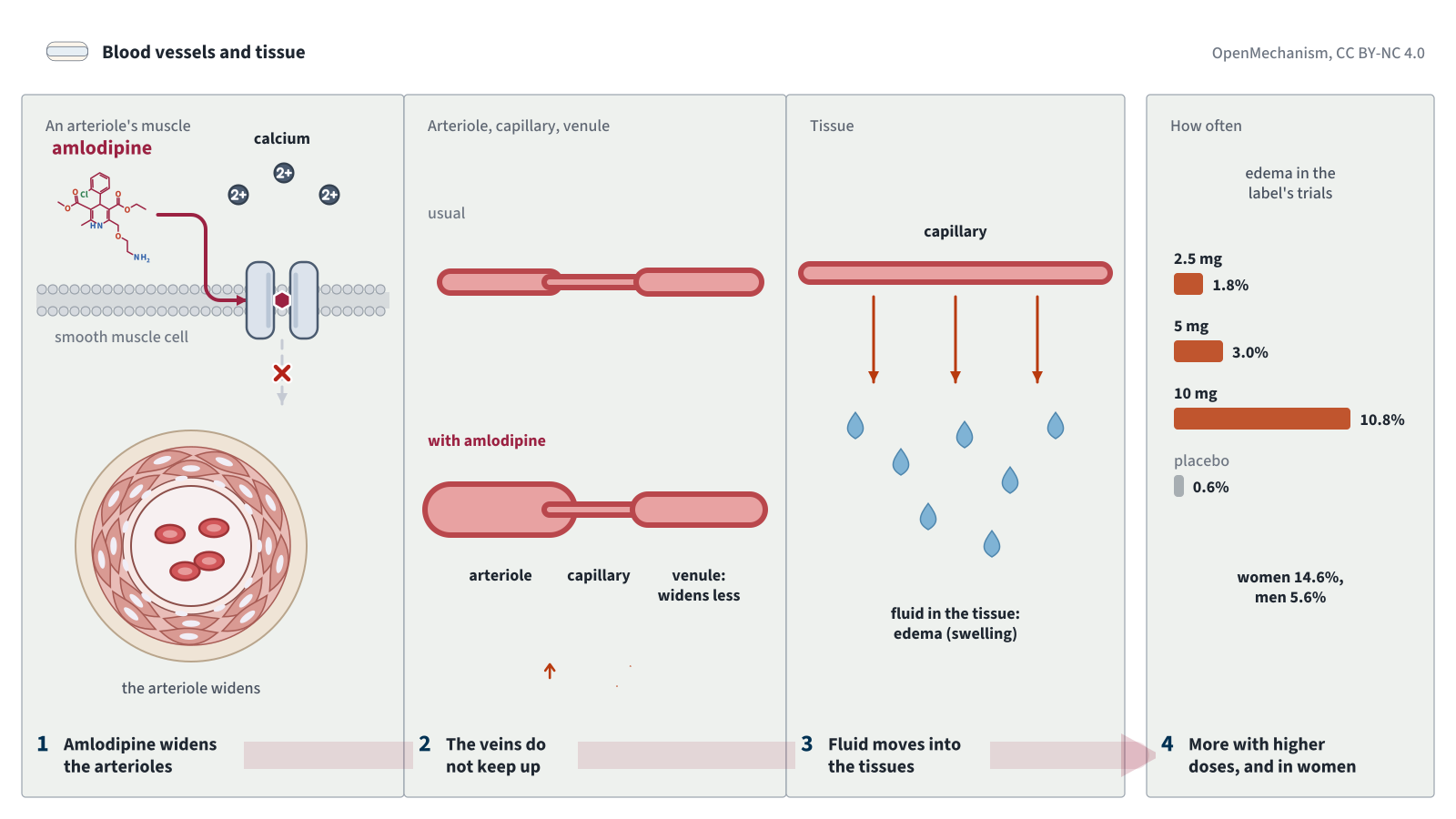
Amlodipine widens the small arteries by reducing the calcium flowing into their muscle. The fall in resistance is not matched in the veins, so pressure rises in the capillaries between them and fluid moves out into the tissues: edema, amlodipine's most common side effect. It rises with the dose, from 1.8% on 2.5 mg to 10.8% on 10 mg in the label's trials, and is more common in women.
Amlodipine widens the arterioles. Vascular smooth muscle needs calcium flowing in through its channels to contract. Amlodipine reduces that inflow, so it widens the small arteries and lowers vascular resistance and blood pressure.1,2,3
What the source says
“Amlodipine is a dihydropyridine calcium antagonist (calcium ion antagonist or slow‑channel blocker) that inhibits the transmembrane influx of calcium ions into vascular smooth muscle and cardiac muscle.”
“The contractile processes of cardiac muscle and vascular smooth muscle are dependent upon the movement of extracellular calcium ions into these cells through specific ion channels.”
“Amlodipine is a peripheral arterial vasodilator that acts directly on vascular smooth muscle to cause a reduction in peripheral vascular resistance and reduction in blood pressure.”
“This disproportionate change in resistance increases hydrostatic pressures in the precapillary circulation and permits fluid shifts into the interstitial compartment.”
Fluid moves into the tissues. Fluid then moves out into the tissues: edema, the most common side effect of amlodipine.2,4
What the source says
“This disproportionate change in resistance increases hydrostatic pressures in the precapillary circulation and permits fluid shifts into the interstitial compartment.”
More with higher doses, and in women. In the label's trials, edema came with 1.8% of people on 2.5 mg, 3.0% on 5 mg and 10.8% on 10 mg, against 0.6% on placebo, and more often in women (14.6%) than men (5.6%). It also relates to being upright and to age.2,4
Ways to ease the swelling are left out: this page explains the mechanism, not what to do.
In a small 12-week placebo-controlled crossover trial in 16 healthy women past menopause, amlodipine did not seem to weaken the lymph vessels, but weaker lymph drainage to begin with made swelling more likely, which may explain why some people swell.5
Claude Opus 5.5 (AI source check), 29 October 2026: 22 statements compared with their sources, 6 flagged for the reviewer. An automated check, not a medical review.
Next review due
29 April 2028
Cite this page
Tran D. Why amlodipine can cause swelling [Internet]. OpenMechanism; 2026 [updated 2026 Oct 29; cited 2026 Oct 29]. Available from: https://openmechanism.com/explained/amlodipine-and-swelling