Why stopping clonidine suddenly can raise blood pressure
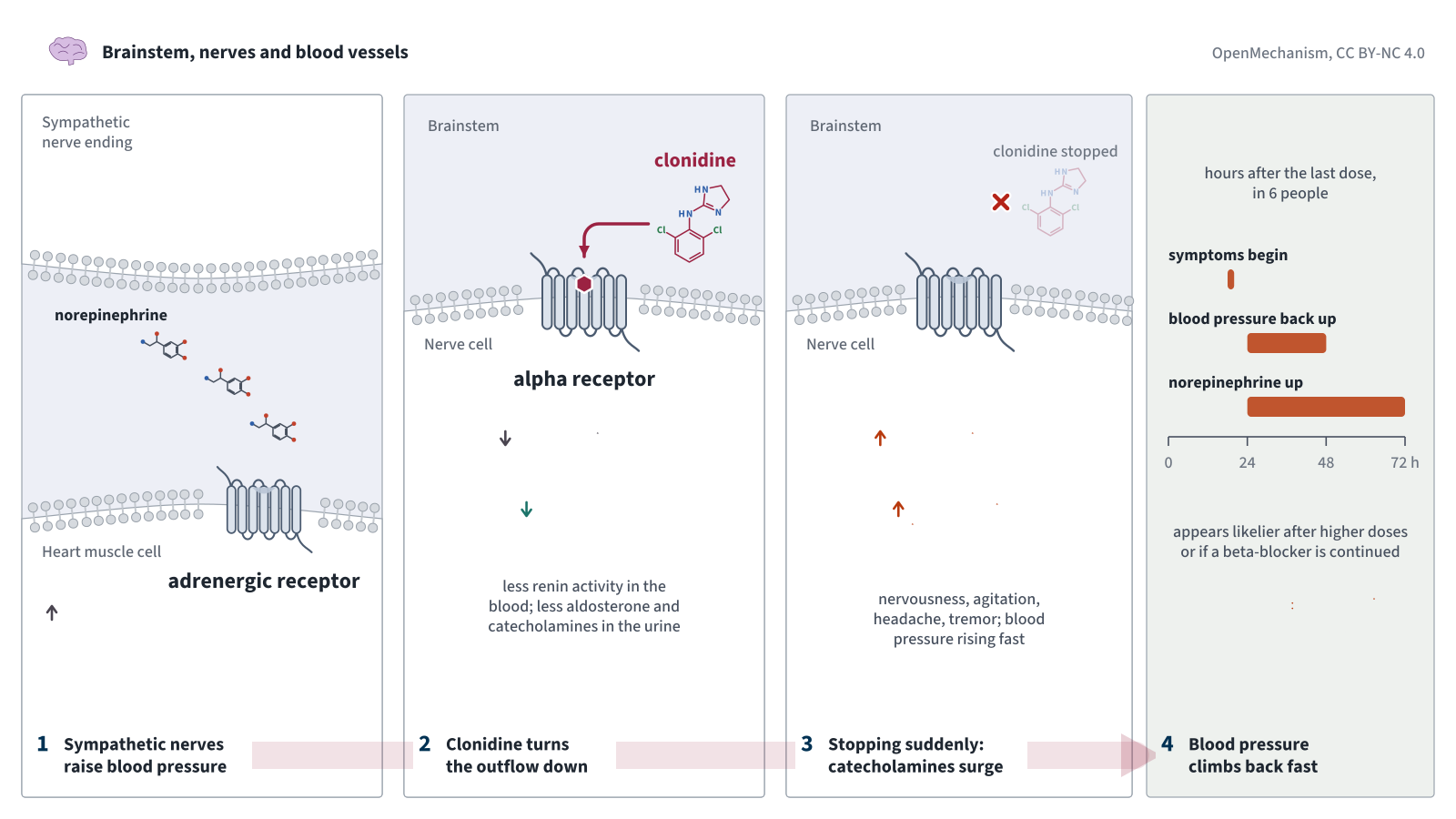
Sympathetic nerves release norepinephrine, which raises blood pressure and the amount of blood the heart pumps. Clonidine acts in the brainstem to turn their outflow down. Stopping it suddenly has, in some cases, brought nervousness, headache and tremor, more catecholamines in the blood and a rapid rise in blood pressure; in a small study blood pressure was back at pretreatment levels within one to two days.
- Kind
- Side effect
- Medicines
- Clonidine
- Sources
- 3
For teachers: download this drawing.
Step by step
Sympathetic nerves raise blood pressure. In the body's fight-or-flight response, sympathetic nerves release norepinephrine from their endings, and the adrenal glands release epinephrine and norepinephrine into the blood. These act on adrenergic receptors on the cells of organs such as the heart, and raise blood pressure and the amount of blood the heart pumps.1
What the source says
“During the "fight-or-flight response," the rise in circulating epinephrine and norepinephrine from the adrenal medulla and norepinephrine secreted from sympathetic nerve terminals cause increased blood pressure and cardiac output”
Source 1“The catecholamine neurohormones interact with adrenergic receptors present on cell membranes of all visceral organs and smooth muscles”
Source 1Clonidine turns the outflow down. Clonidine stimulates alpha receptors in the brainstem, which lowers the sympathetic outflow from the brain: resistance in the blood vessels, the heart rate and blood pressure fall. Studies also found less activity in the blood and less and catecholamines in the urine.2
What the source says
“Clonidine stimulates alpha-adrenoreceptors in the brain stem.”
Source 2“This action results in reduced sympathetic outflow from the central nervous system and in decreases in peripheral resistance, renal vascular resistance, heart rate, and blood pressure.”
Source 2“Other studies in patients have provided evidence of a reduction in plasma renin activity and in the excretion of aldosterone and catecholamines.”
Source 2Stopping suddenly: catecholamines surge. Stopping clonidine suddenly has, in some cases, brought nervousness, agitation, headache and tremor, with or followed by a rapid rise in blood pressure and more catecholamines in the blood.2
What the source says
“Sudden cessation of clonidine treatment has, in some cases, resulted in symptoms such as nervousness, agitation, headache, and tremor accompanied or followed by a rapid rise in blood pressure and elevated catecholamine concentrations in the plasma.”
Source 2Blood pressure climbs back fast. In 6 people with high blood pressure, symptoms began 18 to 20 hours after the last dose; blood pressure rose back to pretreatment levels within 24 to 48 hours, with insomnia, headache, flushing, sweating and apprehension; and blood norepinephrine (noradrenaline) and urine catecholamines rose 24 to 72 hours after it. The label says such reactions appear likelier after higher doses or when a beta-blocker is continued, and rare cases of hypertensive encephalopathy, stroke and death have been reported.2,3
What the source says
“Treatment was interrupted abruptly in 6 hypertensive patients”
Source 3“These symptoms began 18-20 h after the last dose of clonidine.”
Source 3“Blood-pressure rose to pretreatment levels within 24-48 h of withdrawal and was accompanied by insomnia, headache, flushing, sweating, and apprehension.”
Source 3“Plasma-noradrenaline levels and urinary catecholamine excretion increased 24-72 h after withdrawal of clonidine.”
Source 3“The likelihood of such reactions to discontinuation of clonidine therapy appears to be greater after administration of higher doses or continuation of concomitant beta-blocker treatment”
Source 2“Rare instances of hypertensive encephalopathy, cerebrovascular accidents and death have been reported after clonidine withdrawal.”
Source 2
See also
Medicine pages: clonidine.
Other side effects (heart & circulation): why ACE inhibitors and ARBs can harm a fetus; why ACE inhibitors can cause a dry cough; why ACE inhibitors can cause angioedema; why amiodarone can upset the thyroid; why amlodipine can cause swelling; why beta-blockers can tighten the airways; why diuretics can lower potassium; why spironolactone can cause breast growth; why statins can cause muscle problems; and all 65 side effects.
Conditions: high blood pressure.
Sources
- 1Peripheral and central effects of circulating catecholaminesTank AW, Lee Wong D. Compr Physiol 2015 (abstract). Saved copy
- 2Clonidine hydrochloride tablets (Unichem): FDA labelClinical Pharmacology; Warnings (Withdrawal). Saved copy
- 3Clonidine withdrawal in hypertension: changes in blood pressure and plasma and urinary noradrenalineReid JL et al. Lancet 1977 (abstract). Saved copy
Notes and limits
- How these effects of clonidine lower blood pressure has not been fully worked out, the label says.2
- The study had 6 people; symptoms were most marked on higher doses (more than 1 mg a day) and in those who had taken other blood pressure medicines before.3
- Children, who often have stomach illnesses with vomiting, may be especially prone to blood pressure surges when they suddenly cannot take the medicine.2
Notes that apply to every page are on How to read a page.
Spotted a mistake? Report an error (hello@openmechanism.com). Since launch, every published error we fix is listed on the corrections page.
Cite this page
Tran D. Why stopping clonidine suddenly can raise blood pressure [Internet]. OpenMechanism; 2026 [updated 2026 Nov 13; cited 2026 Nov 13]. Available from: https://openmechanism.com/explained/clonidine-withdrawal