Losartan
normally tightens blood vessels and makes the adrenal glands release . Losartan and its active metabolite block the , opposing both effects.
- Acts on
- Angiotensin II AT1 receptor
- Where
- Blood vessels and adrenal glands
- Medicine type
- Small molecule
- Used for
- Heart & circulation
- Drug class
- Angiotensin receptor blockers (ARBs)
Also called Cozaar.
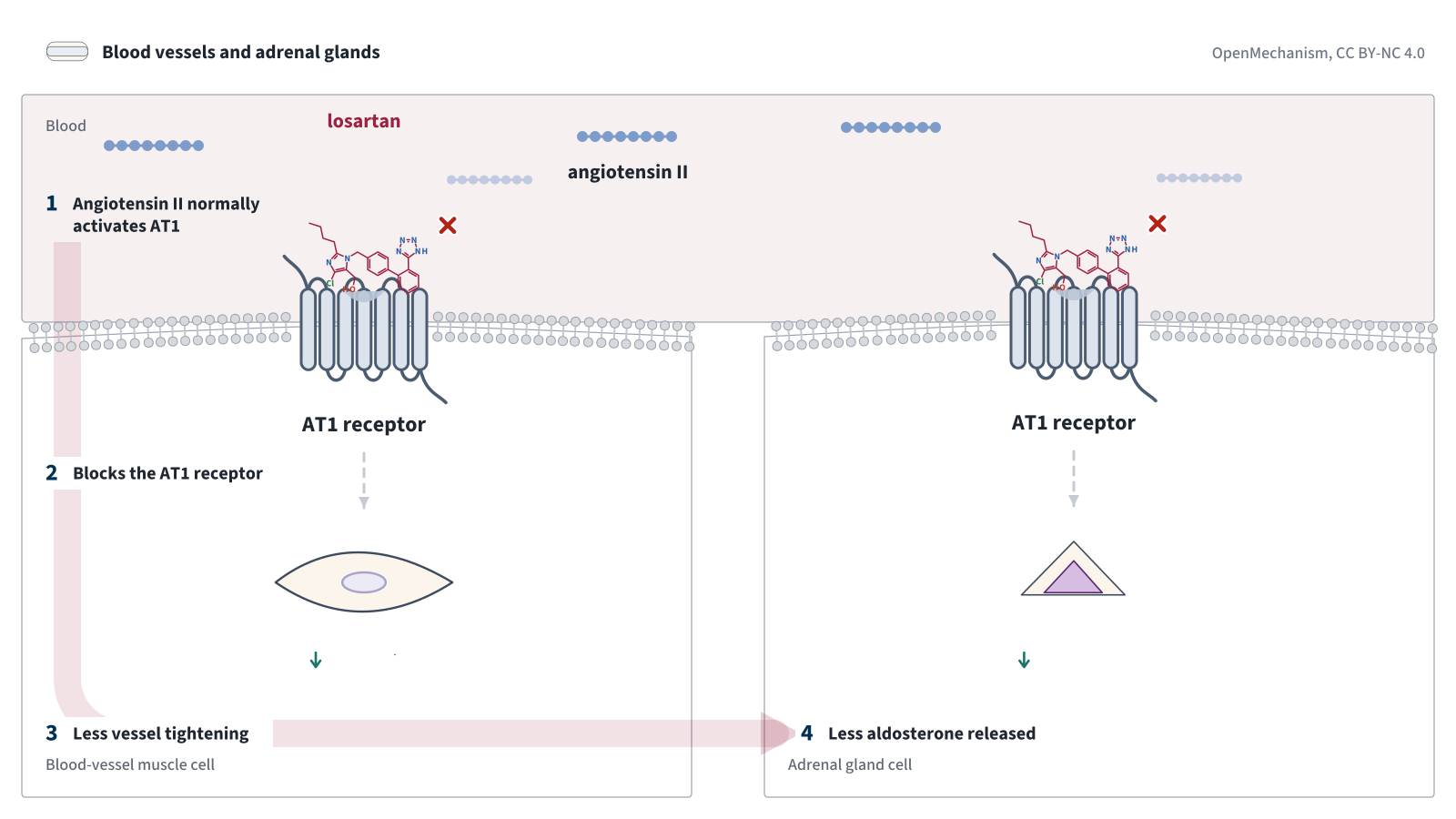
Key terms in this drawing
- aldosterone
- Aldosterone. Released by the adrenal glands, it helps the body keep sodium and fluid; angiotensin II stimulates its release.
- angiotensin II
- Angiotensin II. A hormone that strongly tightens blood vessels; ACE makes it from angiotensin I.
- AT1 receptor
- Angiotensin II type 1 receptor. The receptor angiotensin II acts on to tighten blood vessels and stimulate aldosterone release.
How it works
Angiotensin II normally activates AT1. Angiotensin II normally tightens blood vessels and stimulates the adrenal glands to release aldosterone.1
Blocks the AT1 receptor. Losartan and its active metabolite selectively prevent angiotensin II binding to AT1 receptors. The body converts about 14% of each dose into the metabolite, which does most of the blocking.1
Less vessel tightening. Blocking the receptor opposes angiotensin II's vessel-tightening effect: a 100 mg dose blocks about 85% of the blood-pressure rise from infused angiotensin II at its peak, with 25 to 40% still blocked 24 hours later.1
Less aldosterone released. The same receptor blockade also opposes angiotensin II's aldosterone-releasing effect.1
For teachers: download this drawing or build a slide deck.
See also
Condition pages: chronic kidney disease and high blood pressure.
Side effects: high blood potassium.
Other angiotensin receptor blockers (ARBs): irbesartan, olmesartan and valsartan.
Explained: why ACE inhibitors and ARBs can harm a fetus; ACE inhibitors with ARBs or aliskiren; and rifampin and other medicines.
Body system: heart, vessels & cholesterol.
Inside the body: blood pressure.
Sources
- 1Cozaar (losartan potassium): FDA label12.1 Mechanism of Action; 12.2 Pharmacodynamics; 12.3 Pharmacokinetics
- 2ChEMBL CHEMBL191Target and action classification: Type-1 angiotensin II receptor antagonist
Spotted a mistake? Report an error (hello@openmechanism.com). Since launch, every published error we fix is listed on the corrections page.
Notes and limits
- A schematic teaching drawing: not to scale, not exact structures, binding poses or a complete pathway, and not a guide to dosing, treatment or how a person will respond.
- The steps are in the order that explains them; one step is said to cause the next only where the source says so.
- In lab binding studies, losartan is a reversible, competitive blocker of the AT1 receptor; its active metabolite, 10 to 40 times more potent by weight, appears to be a reversible, non-competitive one.
- ACE inhibition is not part of this mechanism.
All recorded limits are on the evidence page, and notes that apply to every page are on How to read a page. Version 1.0.1, medically reviewed by Daniel Tran, PharmD, on 28 October 2026.
Cite this page
Tran D. Losartan [Internet]. OpenMechanism; 2026 [updated 2026 Oct 28; cited 2026 Oct 28]. Available from: https://openmechanism.com/medicines/losartan