Stomach, gut & liver
How food is broken down and absorbed, and how the liver helps.
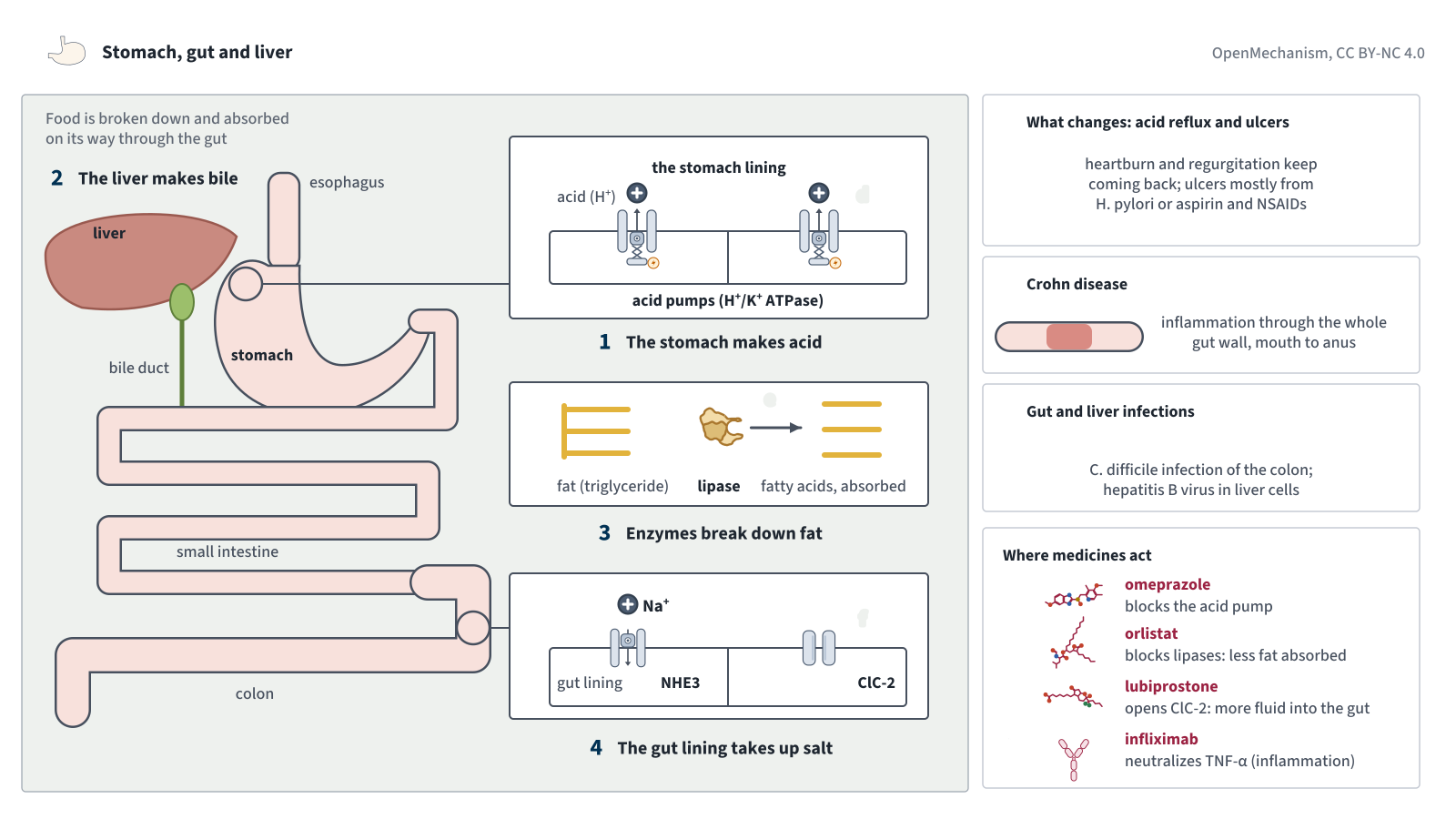
For teachers: download this drawing.
Key terms in this drawing (5)
- ClC-2
- Chloride channel protein 2. A channel that lets chloride out of intestinal lining cells.
- H+/K+-ATPase
- The stomach's acid (proton) pump. An enzyme system at the secretory surface of the stomach's acid-making (parietal) cells; blocking it blocks the last step of acid production.
- NHE3
- Sodium/hydrogen exchanger 3. A carrier on the lining of the small intestine and colon that takes up most of the sodium from food; tenapanor blocks it.
- NSAID
- Nonsteroidal anti-inflammatory drug. A medicine with pain-relieving and anti-inflammatory properties, such as ibuprofen or naproxen; how it works involves blocking the COX enzymes.
- TNF
- Tumor necrosis factor (TNF-α). A signaling molecule (cytokine) that drives inflammation.
How it works
The stomach makes acid. Parietal cells in the stomach lining make acid with the H+/K+ ATPase, the acid (proton) pump; it is the final step of acid production.1
The liver makes bile. Liver cells (hepatocytes) make bile, which flows through the bile ducts to the gallbladder and intestine; its bile acids help the gut absorb nutrients.2,3
What the source says
“Bile is a unique and vital aqueous secretion of the liver that is formed by the hepatocyte”
Source 2“prior to the entry of bile into the gallbladder, common bile duct, and intestine.”
Source 2“Bile acids are important physiological agents for intestinal nutrient absorption”
Source 3Enzymes break down fat. In the stomach and small intestine, gastric and pancreatic lipases break dietary fat (triglycerides) into free fatty acids and monoglycerides that can be absorbed; undigested fat is not absorbed.4
The gut lining takes up salt. The lining of the small intestine and colon takes up dietary sodium, mainly through ; chloride channels sit in its surface membrane.5,6
What changes in disease
Acid reflux and ulcers. In acid reflux disease, troublesome heartburn and regurgitation keep coming back; peptic ulcers usually come from H. pylori infection or medicines such as aspirin and .7,8
What the source says
“Gastroesophageal reflux disease (GERD) is defined by recurrent and troublesome heartburn and regurgitation”
Source 7“Peptic ulcer disease is usually attributable to Helicobacter pylori infection, intake of some medications (such as aspirin and non-steroidal anti-inflammatory medications)”
Source 8Crohn disease. Crohn disease is a long-term inflammatory bowel disease; inflammation through the whole gut wall can appear anywhere from mouth to anus.9
What the source says
“Crohn disease is a chronic idiopathic inflammatory bowel disease condition characterized by skip lesions and transmural inflammation that can affect the entire gastrointestinal tract from the mouth to the anus.”
Source 9Gut and liver infections. Infection of the colon with C. difficile can be life threatening; hepatitis B virus infects liver cells.10,11
Where medicines act
- d
Omeprazole
Blocks the acid pump, the final step of acid production.
- e
Orlistat
Blocks gastric and pancreatic lipases, so less dietary fat is broken down and absorbed.
- f
Lubiprostone
Opens ClC-2 chloride channels, so more fluid is secreted into the gut.
- g
Infliximab
Neutralizes TNF-α, a signal that drives inflammation.
See also
Zoom in: stomach acid.
Conditions
- Acetaminophen overdose
- Acid reflux (GERD)
- C. difficile infection
- Chemotherapy nausea and vomiting
- Chronic constipation
- Colorectal cancer
- Crohn disease
- Cryptosporidiosis
- Ethylene glycol and methanol poisoning
- Food allergy
- Gastrointestinal stromal tumors (GIST)
- Giardiasis and amebiasis
- Head and neck cancer
- Hepatitis B
- Hepatitis C
- Hepatitis D
- Pancreatic cancer
- Peptic ulcers
- Stomach cancer
- Tapeworm larva infections
- Ulcerative colitis
- Worm infections
- Zollinger-Ellison syndrome
More medicines for this area
Sources
- 1Prilosec (omeprazole): FDA label12.1 Mechanism of Action. Saved copy
- 2Bile formation and secretionBoyer JL. Compr Physiol 2013 (abstract). Saved copy
- 3Bile acid metabolism and signalingChiang JY. Compr Physiol 2013 (abstract). Saved copy
- 4Xenical (orlistat): FDA label12.1 Mechanism of Action. Saved copy
- 5Ibsrela (tenapanor): FDA label1 Indications and Usage; 12.1 Mechanism of Action. Saved copy
- 6Amitiza (lubiprostone): FDA label1 Indications and Usage; 12.1 Mechanism of Action. Saved copy
- 7Gastroesophageal reflux disease: a reviewMaret-Ouda J et al. JAMA 2020 (abstract). Saved copy
- 8Peptic ulcer diseaseAlmadi MA et al. Lancet 2024 (abstract). Saved copy
- 9Crohn disease: epidemiology, diagnosis, and managementFeuerstein JD, Cheifetz AS. Mayo Clin Proc 2017 (abstract). Saved copy
- 10Clostridium difficile infectionSmits WK et al. Nat Rev Dis Primers 2016 (abstract). Saved copy
- 11Molecular biology of hepatitis B virus infectionSeeger C, Mason WS. Virology 2015 (abstract). Saved copy
- 12Remicade (infliximab): FDA label1 Indications and Usage; 12.1 Mechanism of Action. Saved copy
- 13Human pancreatic lipase with colipase and an inhibitor in its active sitePDB 1LPB; Egloff, M.P. et al. Biochemistry 1995;34:2751-2762. The lipase outline in the drawing is traced from this structure. Saved copy
Notes and limits
- The drawing is schematic and not to scale; it shows only what the statements above say.
Spotted a mistake? Report an error (hello@openmechanism.com). Since launch, every published error we fix is listed on the corrections page.
Cite this page
Tran D. Stomach, gut & liver [Internet]. OpenMechanism; 2026 [updated 2026 Oct 13; cited 2026 Oct 13]. Available from: https://openmechanism.com/body/digestive