Peptic ulcers
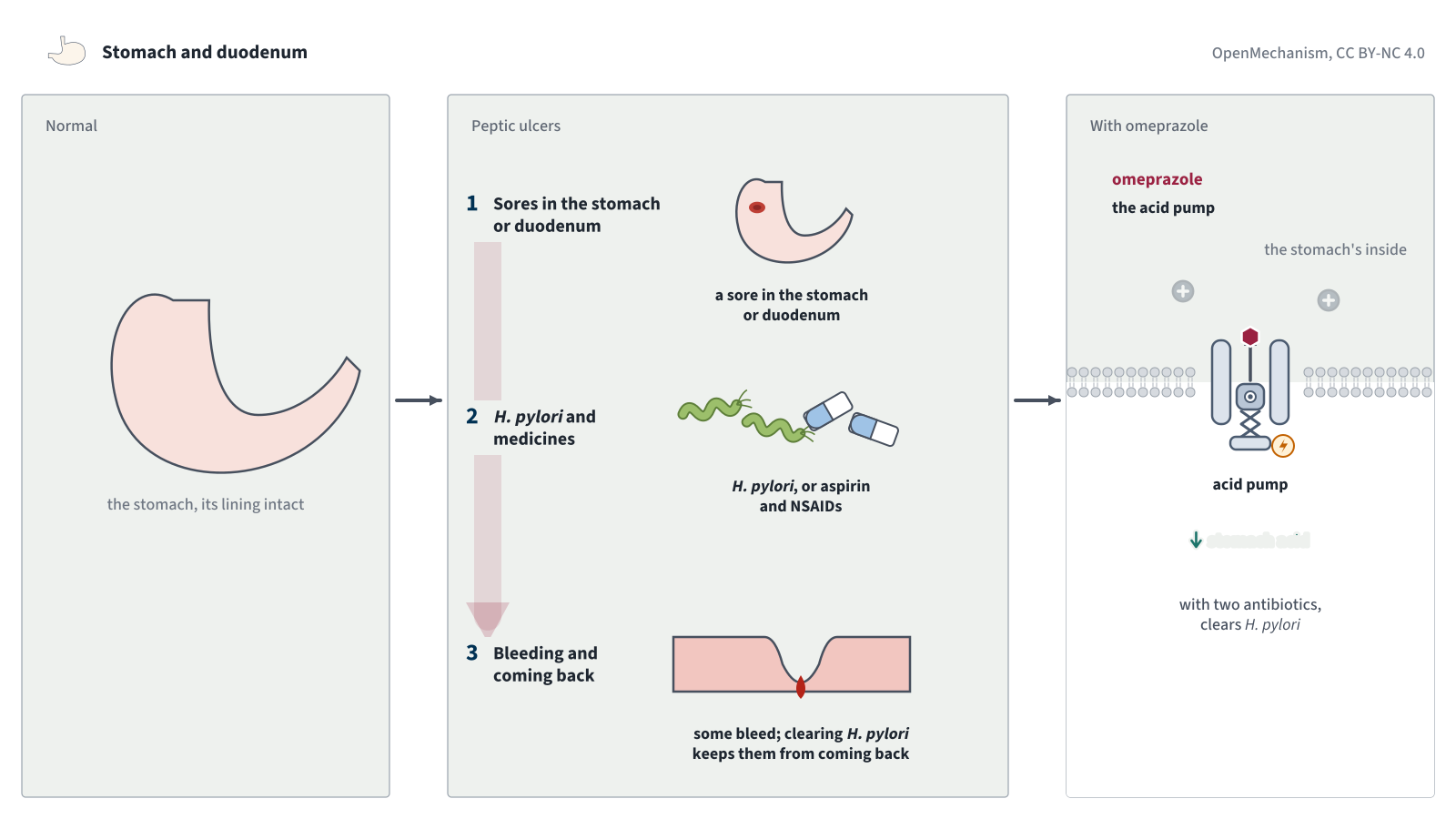
Peptic ulcers are sores in the stomach or duodenum, the first part of the small intestine; up to 1.5% of people have one in a year. Most come from Helicobacter pylori infection or medicines such as aspirin and NSAIDs; usually uncomplicated, they can bleed. Omeprazole blocks the acid pump and, with clarithromycin and amoxicillin, is used to clear H. pylori.
- Where
- Stomach and duodenum
- Body system
- Stomach, gut & liver
- Medicines
- 1 medicine
For teachers: download this drawing.
Key terms in this drawing
- NSAID
- Nonsteroidal anti-inflammatory drug. A medicine with pain-relieving and anti-inflammatory properties, such as ibuprofen or naproxen; how it works involves blocking the COX enzymes.
What goes wrong
Sores in the stomach or duodenum. Peptic ulcers form in the duodenum or the stomach; in a given year, between 0.12% and 1.5% of people have one.1,2
H. pylori and medicines. Most come from Helicobacter pylori infection or from medicines such as aspirin and ; some come with critical illness, and some have no known cause.2
What the source says
“Peptic ulcer disease is usually attributable to Helicobacter pylori infection, intake of some medications (such as aspirin and non-steroidal anti-inflammatory medications), or being critically ill (stress-related), or it can be idiopathic.”
Source 2Bleeding and coming back. Most ulcers are uncomplicated, but they can bleed; clearing H. pylori lowers the risk of a duodenal ulcer coming back.1,2
Where medicines act
- A
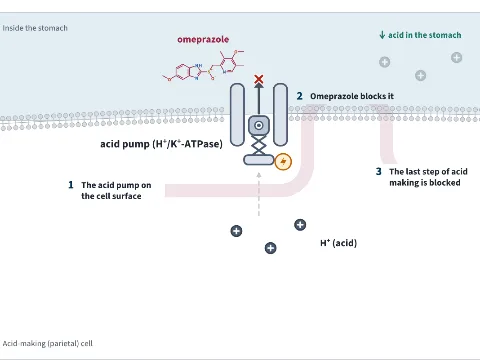
Omeprazole: less acid, and H. pylori cleared with antibiotics
Omeprazole blocks the acid pump, the final step of acid production. With clarithromycin and amoxicillin, it is used to clear H. pylori in people with duodenal ulcers.1
What the source says
“omeprazole has been characterized as a gastric acid-pump inhibitor, in that it blocks the final step of acid production.”
Source 1“PRILOSEC in combination with clarithromycin and amoxicillin, is indicated for treatment of patients with H. pylori infection and duodenal ulcer disease (active or up to 1-year history) to eradicate H. pylori in adults.”
Source 1
See also
Body system: stomach, gut & liver.
Also used for it: sucralfate (“Short-term treatment (up to 8 weeks) of active duodenal ulcer. … Maintenance therapy for duodenal ulcer patients at reduced dosage after healing of acute ulcers.”3); and misoprostol (“Cytotec (misoprostol) is indicated for reducing the risk of NSAID (nonsteroidal anti-inflammatory drugs, including aspirin)–induced gastric ulcers in patients at high risk of complications from gastric ulcer, e.g., the elderly and patients with concomitant debilitating disease, as well as patients at high risk of developing gastric ulceration, such as patients with a history of ulcer.”4).
Related medicines: esomeprazole, famotidine and amoxicillin.
Other conditions: acid reflux (GERD); Zollinger-Ellison syndrome; skin and soft-tissue infections; and urinary tract infections.
Side effects: why NSAIDs can cause stomach ulcers and bleeding.
Sources
- 1Prilosec (omeprazole): FDA label1 Indications and Usage; 12.1 Mechanism of Action. Saved copy
- 2Peptic ulcer diseaseAlmadi MA et al. Lancet 2024 (abstract). Saved copy
- 3Carafate (sucralfate) tablets: FDA labelIndications and Usage. Saved copy
- 4Cytotec (misoprostol): FDA labelIndications and Usage. Saved copy
Notes and limits
- Which critically ill patients need protection from stress-ulcer bleeding, and how, is still uncertain.2
Notes that apply to every page are on How to read a page.
Spotted a mistake? Report an error (hello@openmechanism.com). Since launch, every published error we fix is listed on the corrections page.
Cite this page
Tran D. Peptic ulcers [Internet]. OpenMechanism; 2026 [updated 2026 Oct 16; cited 2026 Oct 16]. Available from: https://openmechanism.com/conditions/peptic-ulcer-disease