Omeprazole
Omeprazole blocks the , the acid pump of the stomach's parietal cells. This blocks the last step of acid production, so both resting and stimulated acid secretion fall. The Prilosec label lists it for short-term treatment of active duodenal ulcers and active benign stomach (gastric) ulcers in adults; for clearing an H. pylori infection in adults with duodenal ulcer disease, together with clarithromycin, or clarithromycin and amoxicillin, to lower the risk of the ulcer coming back; for heartburn and other symptoms of acid reflux (GERD), for up to 4 weeks, from 1 year of age; for short-term treatment of erosive esophagitis from GERD, from 1 month to under 1 year of age and, when it has been diagnosed by endoscopy, from 1 year of age; for keeping it healed, from 1 year of age (its controlled studies lasted no longer than 12 months); and for long-term treatment of conditions in which the stomach secretes too much (pathological hypersecretory conditions), such as Zollinger-Ellison syndrome, in adults.
- Acts on
- H+/K+-ATPase (the acid pump)
- Where
- Acid-making cells of the stomach
- Medicine type
- Small molecule
- Used for
- Digestion
- Drug class
- Proton pump inhibitors (PPIs)
Also called Prilosec (delayed-release omeprazole magnesium).
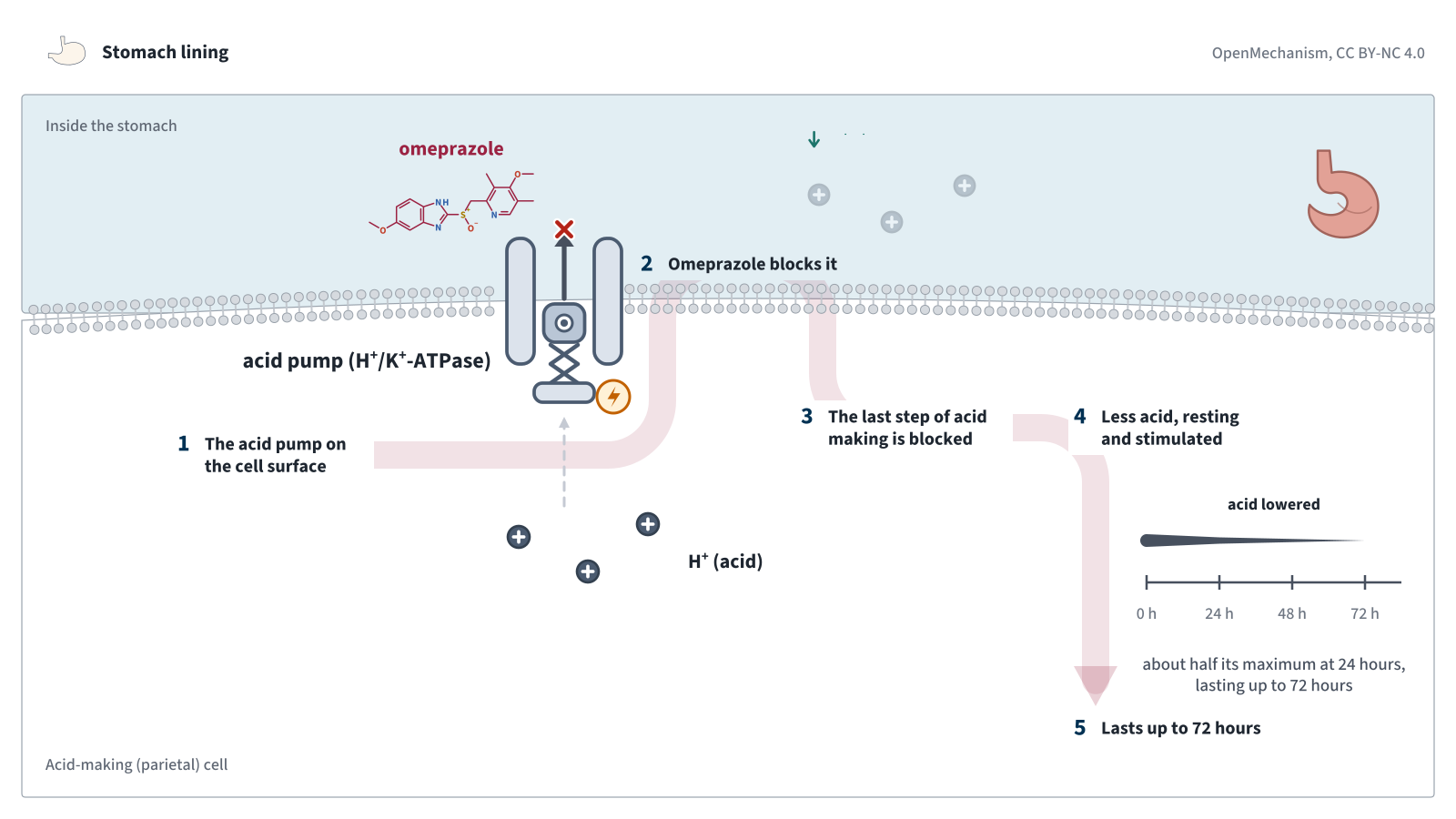
Key terms in this drawing
- H+/K+-ATPase
- The stomach's acid (proton) pump. An enzyme system at the secretory surface of the stomach's acid-making (parietal) cells; blocking it blocks the last step of acid production.
How it works
The acid pump on the cell surface. The H+/K+-ATPase, the acid pump, is at the secretory surface of the stomach's parietal cells.1
Omeprazole blocks it. Omeprazole specifically inhibits this enzyme system.1
The last step of acid making is blocked. Pump inhibition blocks the final step of gastric acid production.1
Less acid, resting and stimulated. This effect is dose-related and leads to less resting (basal) and stimulated acid secretion, whatever the stimulus.1
Lasts up to 72 hours. After a dose by mouth, the effect began within an hour and peaked within two hours; at 24 hours it was about half its maximum, and it lasted up to 72 hours, far longer than omeprazole's very short in the blood (under an hour) would suggest, apparently because it stays bound to the pump.1
For teachers: download this drawing or build a slide deck.
See also
Condition pages: acid reflux (GERD), peptic ulcers and Zollinger-Ellison syndrome.
Other proton pump inhibitors (PPIs): esomeprazole and pantoprazole.
Explained: clopidogrel and omeprazole; levothyroxine and calcium, iron or acid reducers; and why PPIs and metformin can lower vitamin B12.
Body system: stomach, gut & liver.
Inside the body: stomach acid.
Sources
- 1Prilosec (omeprazole magnesium) for delayed-release oral suspension: FDA label1 Indications and Usage; 12.1 Mechanism of Action; 12.2 Pharmacodynamics
- 2ChEMBL CHEMBL1503Target and action classification: Potassium-transporting ATPase inhibitor
Spotted a mistake? Report an error (hello@openmechanism.com). Since launch, every published error we fix is listed on the corrections page.
Notes and limits
- A schematic teaching drawing: not to scale, not exact structures, binding poses or a complete pathway, and not a guide to dosing, treatment or how a person will respond.
- The steps are in the order that explains them; one step is said to cause the next only where the source says so.
- The label's mechanism section does not describe the chemistry of omeprazole's binding or which parts of the pump it binds.
All recorded limits are on the evidence page, and notes that apply to every page are on How to read a page. Version 1.0.1, medically reviewed by Daniel Tran, PharmD, on 13 November 2026.
Cite this page
Tran D. Omeprazole [Internet]. OpenMechanism; 2026 [updated 2026 Nov 13; cited 2026 Nov 13]. Available from: https://openmechanism.com/medicines/omeprazole