Chronic constipation
Chronic constipation is common and can badly affect quality of life. Its types overlap: normal-transit and slow-transit constipation, and problems emptying the rectum. In irritable bowel syndrome, belly pain comes with stool changes, from disordered gut–brain communication. Lubiprostone opens chloride channels in the gut lining so more fluid is secreted; tenapanor blocks sodium uptake so more water enters the gut.
- Where
- Gut
- Body system
- Stomach, gut & liver
- Medicines
- 2 medicines
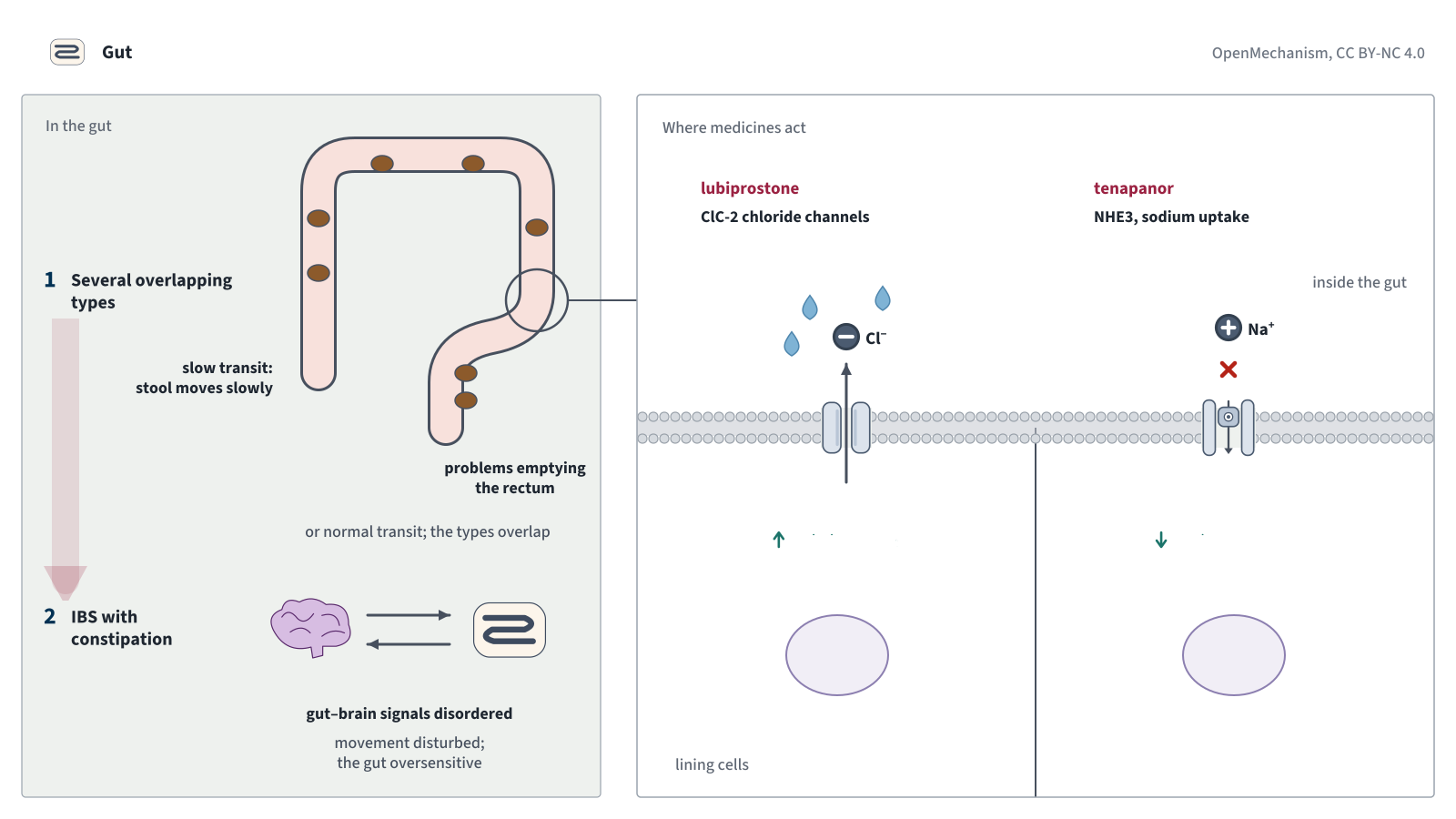
For teachers: download this drawing.
Key terms in this drawing
- ClC-2
- Chloride channel protein 2. A channel that lets chloride out of intestinal lining cells.
- NHE3
- Sodium/hydrogen exchanger 3. A carrier on the lining of the small intestine and colon that takes up most of the sodium from food; tenapanor blocks it.
What goes wrong
Several overlapping types. It has overlapping types: normal-transit constipation, slow-transit constipation and problems emptying the rectum.1
What the source says
“Several types of primary chronic constipation, which show substantial overlap, have been described, including normal-transit constipation, rectal evacuation disorders and slow-transit constipation.”
Source 1IBS with constipation. In irritable bowel syndrome, belly pain comes with a change in stool form or frequency; disordered gut–brain communication disturbs movement and makes the gut oversensitive.2
What the source says
“Irritable bowel syndrome is a functional gastrointestinal disorder with symptoms including abdominal pain associated with a change in stool form or frequency.”
Source 2“there is disordered communication between the gut and the brain, leading to motility disturbances, visceral hypersensitivity, and altered CNS processing.”
Source 2
Where medicines act
- A
Lubiprostone: more fluid into the gut
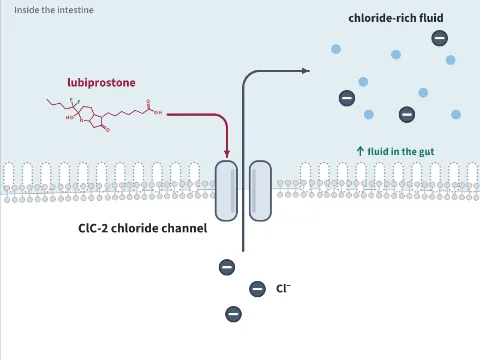
Lubiprostone opens chloride channels () on the gut lining, so more chloride-rich fluid is secreted; the gut moves more and stool passes more easily. It treats chronic idiopathic constipation, among others.3
What the source says
“Lubiprostone is a locally acting chloride channel activator that enhances a chloride-rich intestinal fluid secretion without altering sodium and potassium concentrations in the serum.”
Source 3“By increasing intestinal fluid secretion, lubiprostone increases motility in the intestine, thereby facilitating the passage of stool and alleviating symptoms associated with chronic idiopathic constipation.”
Source 3“Amitiza ® is indicated for the treatment of chronic idiopathic constipation (CIC) in adults.”
Source 3 - B
Tenapanor: less sodium taken up, more water in the gut
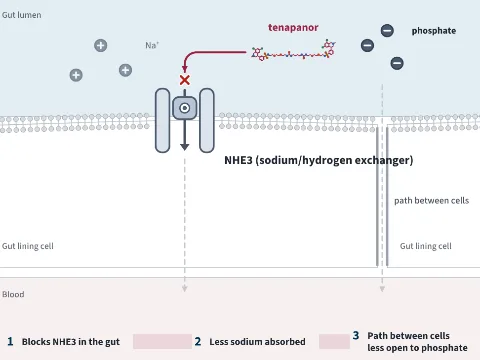
Tenapanor blocks , the gut lining's sodium uptake; more water is secreted into the gut, transit speeds up and stool softens. It treats IBS with constipation.4
What the source says
“By inhibiting NHE3 on the apical surface of the enterocytes, tenapanor reduces absorption of sodium from the small intestine and colon, resulting in an increase in water secretion into the intestinal lumen, which accelerates intestinal transit time and results in a softer stool consistency.”
Source 4“IBSRELA is indicated for treatment of irritable bowel syndrome with constipation (IBS-C) in adults.”
Source 4
See also
Body system: stomach, gut & liver.
Also used for it: lactulose (“For the treatment of constipation. … In patients with a history of chronic constipation, lactulose solution therapy increases the number of bowel movements per day and the number of days on which bowel movements occur.”5).
Other conditions: chronic kidney disease and high phosphate on dialysis.
Sources
- 1Chronic constipationCamilleri M et al. Nat Rev Dis Primers 2017 (abstract). Saved copy
- 2Irritable bowel syndromeFord AC et al. Lancet 2020 (abstract). Saved copy
- 3Amitiza (lubiprostone): FDA label1 Indications and Usage; 12.1 Mechanism of Action. Saved copy
- 4Ibsrela (tenapanor): FDA label1 Indications and Usage; 12.1 Mechanism of Action. Saved copy
- 5Constulose (lactulose solution): FDA labelIndications and Usage. Saved copy
Notes and limits
- How irritable bowel syndrome arises is only partly understood.2
Notes that apply to every page are on How to read a page.
Spotted a mistake? Report an error (hello@openmechanism.com). Since launch, every published error we fix is listed on the corrections page.
Cite this page
Tran D. Chronic constipation [Internet]. OpenMechanism; 2026 [updated 2026 Oct 16; cited 2026 Oct 16]. Available from: https://openmechanism.com/conditions/chronic-constipation