Sucralfate
Sucralfate is barely absorbed and acts locally. It forms a complex that sticks to the protein-rich fluid at an ulcer. In lab and human studies it holds back acid, lowers the activity of the enzyme pepsin and takes up bile salts, which suggests it covers the ulcer and protects it from acid, pepsin and bile salts. How it speeds the healing of duodenal ulcers remains to be fully defined.
- Acts on
- The protein-rich fluid at the ulcer site
- Where
- The lining of the duodenum
- Medicine type
- Unknown
- Used for
- Digestion
Also called Carafate.
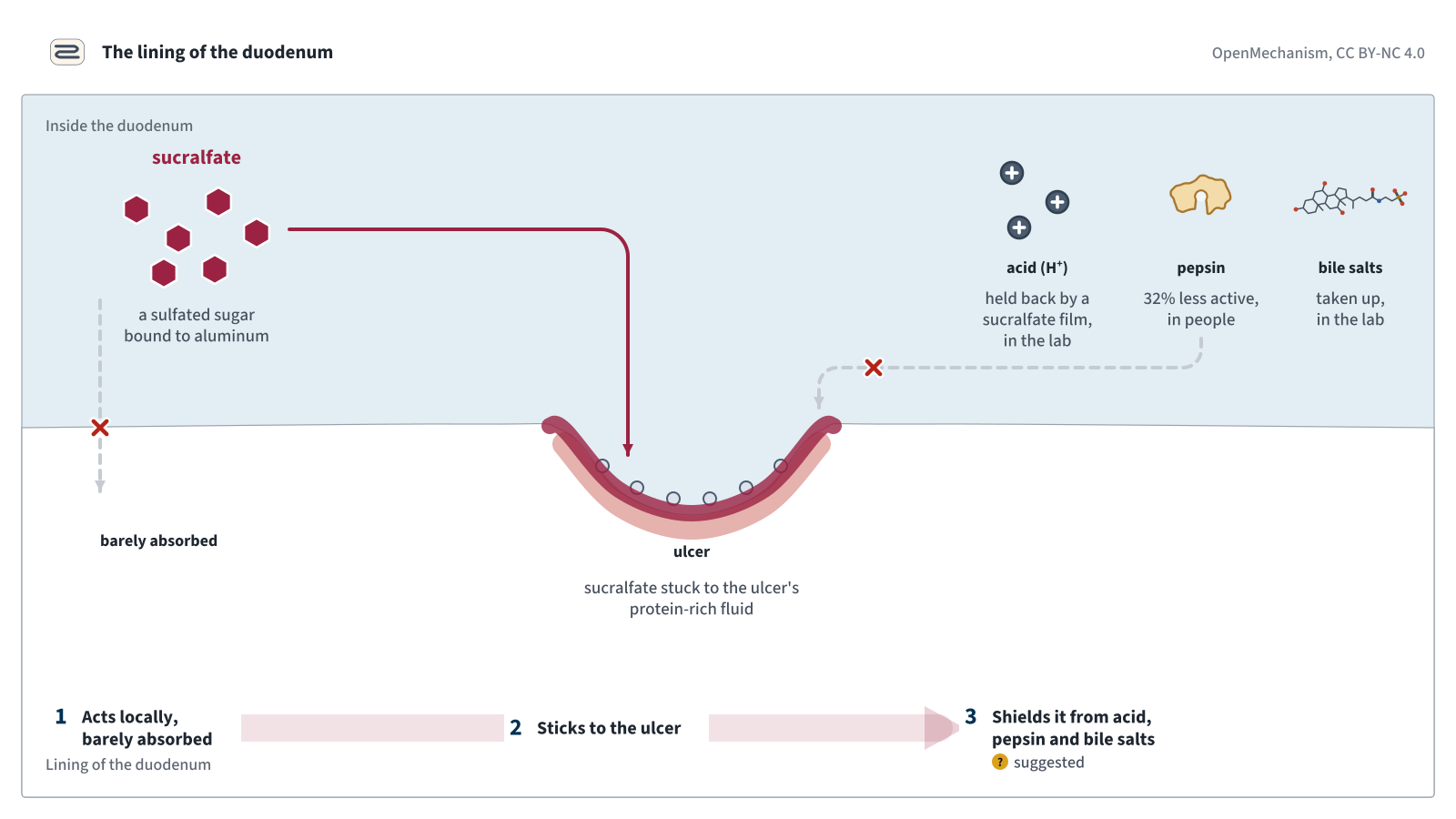
Step 3: suggested
The Carafate label says: Although the mechanism of sucralfate’s ability to accelerate healing of duodenal ulcers remains to be fully defined, it is known that it exerts its effect through a local, rather than systemic, action. … These observations suggest that sucralfate’s antiulcer activity is the result of formation of an ulcer-adherent complex that covers the ulcer site and protects it against further attack by acid, pepsin, and bile salts.
Source 1: Carafate (sucralfate) tablets: FDA label, Description; Clinical Pharmacology
Clinical study: In a study in people with stomach ulcers who took sucralfate before surgery to remove part of the stomach, measuring how much sucralfate was bound to the ulcer and to the lining around it: The ulcerated mucosa was found to contain, on the average, 6-7 times more sucralfate per square centimeter than the control mucosa (P less than 0.01 and less than 0.05 for aluminum and sulfated disaccharide, respectively).
Nakazawa S et al., Dig Dis Sci 1981 (PMID 6894571)
This study was picked with a literature search and is not yet checked by our reviewer.
How it works
Acts locally, barely absorbed. Sucralfate is a sulfated sugar (a disaccharide) bound to aluminum. Only a little is absorbed from the gut, and that little leaves in the urine. It is known to work locally, where it lands, not through the body as a whole.1
Sticks to the ulcer. In people and in animal models of ulcer disease, sucralfate forms a complex that sticks to the ulcer, with the protein-rich fluid (exudate) at the ulcer site.1
Shields it from acid, pepsin and bile salts. In the lab, a film of sucralfate and the protein albumin is a barrier to hydrogen ions (acid); in people, sucralfate lowers the activity of pepsin, a protein-digesting enzyme, in stomach juice by 32%; and in the lab it takes up (adsorbs) bile salts. These observations suggest that it works by covering the ulcer and protecting it from further attack by acid, pepsin and bile salts. How it speeds the healing of duodenal ulcers remains to be fully defined.1
For teachers: download this drawing.
See also
Condition pages: peptic ulcers.
Body system: stomach, gut & liver.
Sources
- 1Carafate (sucralfate) tablets: FDA labelDescription; Clinical Pharmacology
- 2ChEMBL CHEMBL6067980Target and action classification: Glycoproteins cross-linking agent; Pepsin A inhibitor
- 3Selective binding of sucralfate to gastric ulcer in manNakazawa S et al. Dig Dis Sci 1981 (abstract)
Also used for the drawing
The pepsin outline is traced from the crystal structure below.
- 4Human pepsin 3A (its two catalytic aspartates mark the active site)PDB 1PSN; Fujinaga, M. et al. Protein Sci. 1995; 4:960-972
Spotted a mistake? Report an error (hello@openmechanism.com). Since launch, every published error we fix is listed on the corrections page.
Notes and limits
- A schematic teaching drawing: not to scale, not exact structures, binding poses or a complete pathway, and not a guide to dosing, treatment or how a person will respond.
- The Carafate label says the mechanism of sucralfate's ability to accelerate healing of duodenal ulcers remains to be fully defined, and that the observations suggest its antiulcer activity is the result of an ulcer-adherent complex that covers the ulcer site and protects it against further attack by acid, pepsin and bile salts.
All recorded limits are on the evidence page, and notes that apply to every page are on How to read a page. Version 1.0.0, not yet medically reviewed.
Cite this page
Tran D. Sucralfate [Internet]. OpenMechanism; 2026 [updated 2026 Oct 17; cited 2026 Oct 17]. Available from: https://openmechanism.com/medicines/sucralfate