Metoclopramide
Metoclopramide blocks dopamine . Its anti-vomiting effect appears to come from blocking , including in the brain's chemoreceptor trigger zone, which dopamine stimulates to bring on nausea and vomiting. It also strengthens the stomach's contractions, relaxes its outlet and speeds emptying, and it raises the resting tone of the lower esophageal sphincter. The Reglan label lists the tablets for adults: for 4 to 12 weeks of treatment of symptomatic, documented gastroesophageal reflux that has not responded to conventional therapy, and for relief of symptoms of acute and recurrent diabetic gastroparesis. It says exactly how metoclopramide works in these uses has not been fully established, and that it seems to make the tissues more sensitive to acetylcholine. The injection's label also lists it, among other uses, for preventing the vomiting that cancer chemotherapy can cause.
- Acts on
- Dopamine D2 receptors
- Where
- The brain's vomiting trigger zone and the upper gut
- Medicine type
- Small molecule
- Used for
- Digestion
Also called Reglan.
Step 2: appears
The metoclopramide injection label says: The antiemetic properties of metoclopramide appear to be a result of its antagonism of central and peripheral dopamine receptors.
Source 2: Metoclopramide injection (Hospira): FDA label, Indications and Usage; Clinical Pharmacology
Clinical study: In Gralla and colleagues' two 1981 double-blind randomized trials in 41 people with advanced cancer given cisplatin, high doses of metoclopramide into a vein were compared with placebo or with prochlorperazine; the trials measured vomiting and nausea, not how metoclopramide works: Patients given metoclopramide had significantly fewer episodes of emesis than patients given placebo (medians, 1.0 vs. 10.5; P = 0.001) or prochlorperazine (medians, 1.5 vs. 12.0; P = 0.005).
Gralla RJ et al., N Engl J Med 1981 (PMID 7024807)
Step 3: not fully established
The Reglan label says: The exact mechanism of action of metoclopramide in the treatment of gastroesophageal reflux and acute and recurrent diabetic gastroparesis has not been fully established. It seems to sensitize tissues to the action of acetylcholine.
Clinical study: In McCallum and colleagues' 1983 randomized, single-blind study, 13 people with reflux and slow stomach emptying each received metoclopramide 10 mg into a muscle and, on another day, bethanechol 0.07 mg/kg under the skin; the study measured how fast the stomach emptied, not how metoclopramide works: After parenteral metoclopramide, gastric emptying was significantly (p less than 0.05) faster compared with both the initial basal day and the bethanechol treatment day.
McCallum RW et al., Gastroenterology 1983 (PMID 6132852)
Key terms in this drawing
- dopamine receptors
- Dopamine receptors. Receptors that dopamine acts on, among them D1, D2, D3 and D4; olanzapine binds these four strongly.
How it works
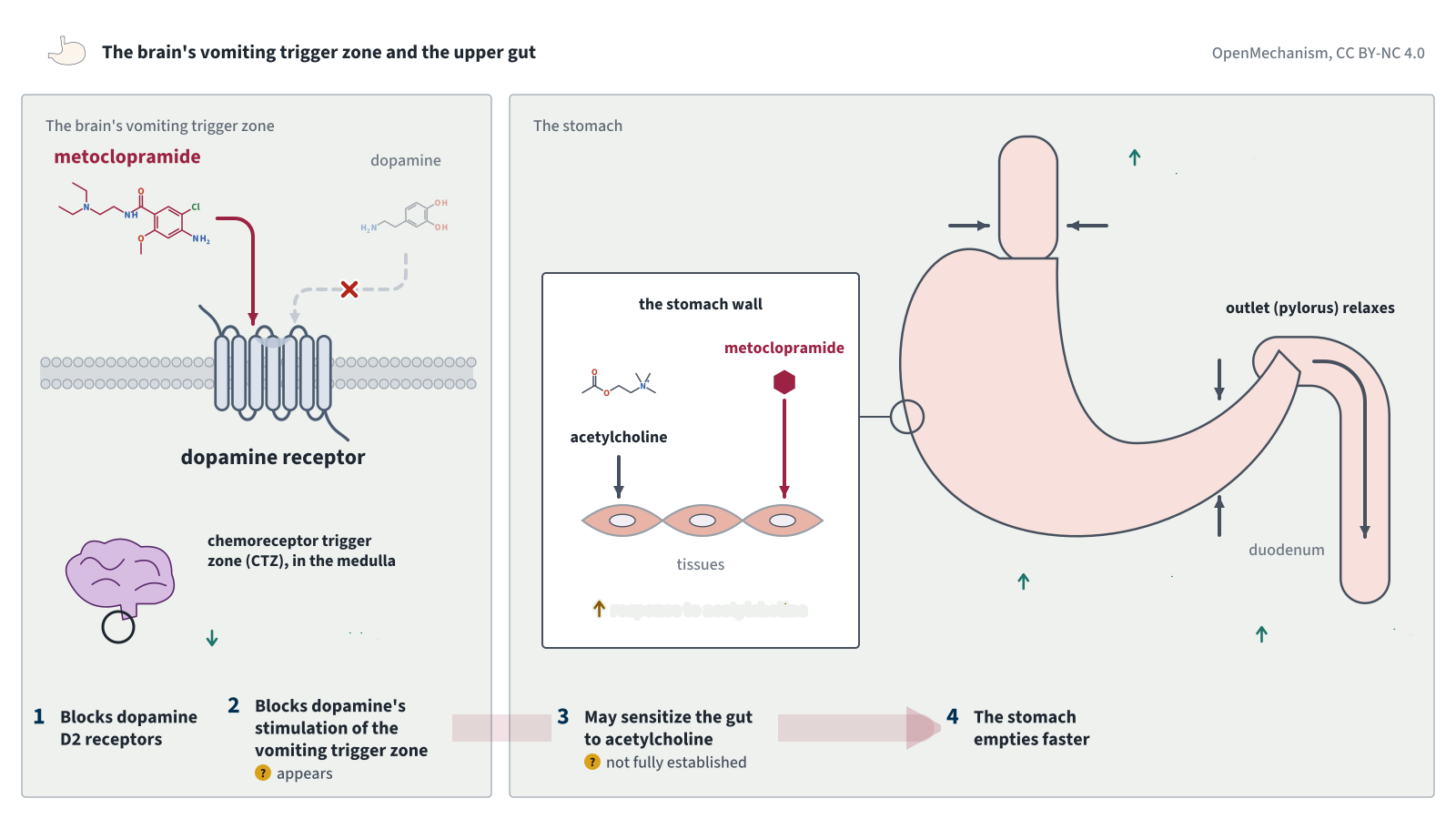
Blocks dopamine D2 receptors. Metoclopramide blocks (antagonizes) dopamine-2 (D2) receptors.1
Blocks dopamine's stimulation of the vomiting trigger zone. Its anti-vomiting effect appears to come from blocking dopamine receptors in the brain and outside it. Dopamine brings on nausea and vomiting by stimulating the chemoreceptor trigger zone (CTZ) in the medulla, and metoclopramide blocks that stimulation by medicines that raise dopamine or act like it, such as l-dopa and apomorphine.2
May sensitize the gut to acetylcholine. Metoclopramide also speeds the movement (motility) of the upper gut without stimulating stomach, bile or pancreatic secretions. The Reglan label says exactly how it works in reflux and diabetic gastroparesis has not been fully established, and that it seems to make the tissues more sensitive to acetylcholine. Its effect on motility does not depend on intact vagus nerves, but medicines that block acetylcholine (anticholinergics) can abolish it.1
The stomach empties faster. The stomach's contractions, especially in its lower part (the antrum), increase in tone and size; the pyloric sphincter (at the stomach's outlet) and the first part of the duodenum (the duodenal bulb) relax; and the duodenum and jejunum move more (peristalsis). So the stomach empties, and the intestine passes its contents, faster. The resting tone of the lower esophageal sphincter rises. It has little, if any, effect on the movement of the colon or gallbladder.1
For teachers: download this drawing.
See also
Condition pages: chemotherapy nausea and vomiting; and acid reflux (GERD).
Side effects: methemoglobinemia and tardive dyskinesia.
Explained: why antipsychotics can cause movement problems.
Body system: stomach, gut & liver.
Sources
- 1Reglan (metoclopramide) tablets: FDA label1 Indications and Usage; 11 Description; 12.1 Mechanism of Action; Boxed Warning
- 2Metoclopramide injection (Hospira): FDA labelIndications and Usage; Clinical Pharmacology
- 3ChEMBL CHEMBL86Target and action classification: Dopamine D2 receptor antagonist; Serotonin 3a (5-HT3a) receptor antagonist; Serotonin 4 (5-HT4) receptor agonist
- 4Antiemetic efficacy of high-dose metoclopramide: randomized trials with placebo and prochlorperazine in patients with chemotherapy-induced nausea and vomitingGralla RJ et al. N Engl J Med 1981 (abstract)
- 5Effects of metoclopramide and bethanechol on delayed gastric emptying present in gastroesophageal reflux patientsMcCallum RW et al. Gastroenterology 1983 (abstract)
Spotted a mistake? Report an error (hello@openmechanism.com). Since launch, every published error we fix is listed on the corrections page.
Notes and limits
- A schematic teaching drawing: not to scale, not exact structures, binding poses or a complete pathway, and not a guide to dosing, treatment or how a person will respond.
- The steps are in the order that explains them; one step is said to cause the next only where the source says so.
- The Reglan label has a boxed warning: metoclopramide can cause tardive dyskinesia, a potentially irreversible serious movement disorder, and the risk increases with the length of treatment and the total cumulative dose.
- The metoclopramide injection label says the antiemetic properties of metoclopramide appear to be a result of its antagonism of central and peripheral dopamine receptors.
- The Reglan label says the exact mechanism of action of metoclopramide in gastroesophageal reflux and diabetic gastroparesis has not been fully established, and that it seems to sensitize tissues to the action of acetylcholine.
All recorded limits are on the evidence page, and notes that apply to every page are on How to read a page. Version 1.0.1, medically reviewed by Daniel Tran, PharmD, on 7 November 2026.
Cite this page
Tran D. Metoclopramide [Internet]. OpenMechanism; 2026 [updated 2026 Nov 7; cited 2026 Nov 7]. Available from: https://openmechanism.com/medicines/metoclopramide