Acetaminophen overdose
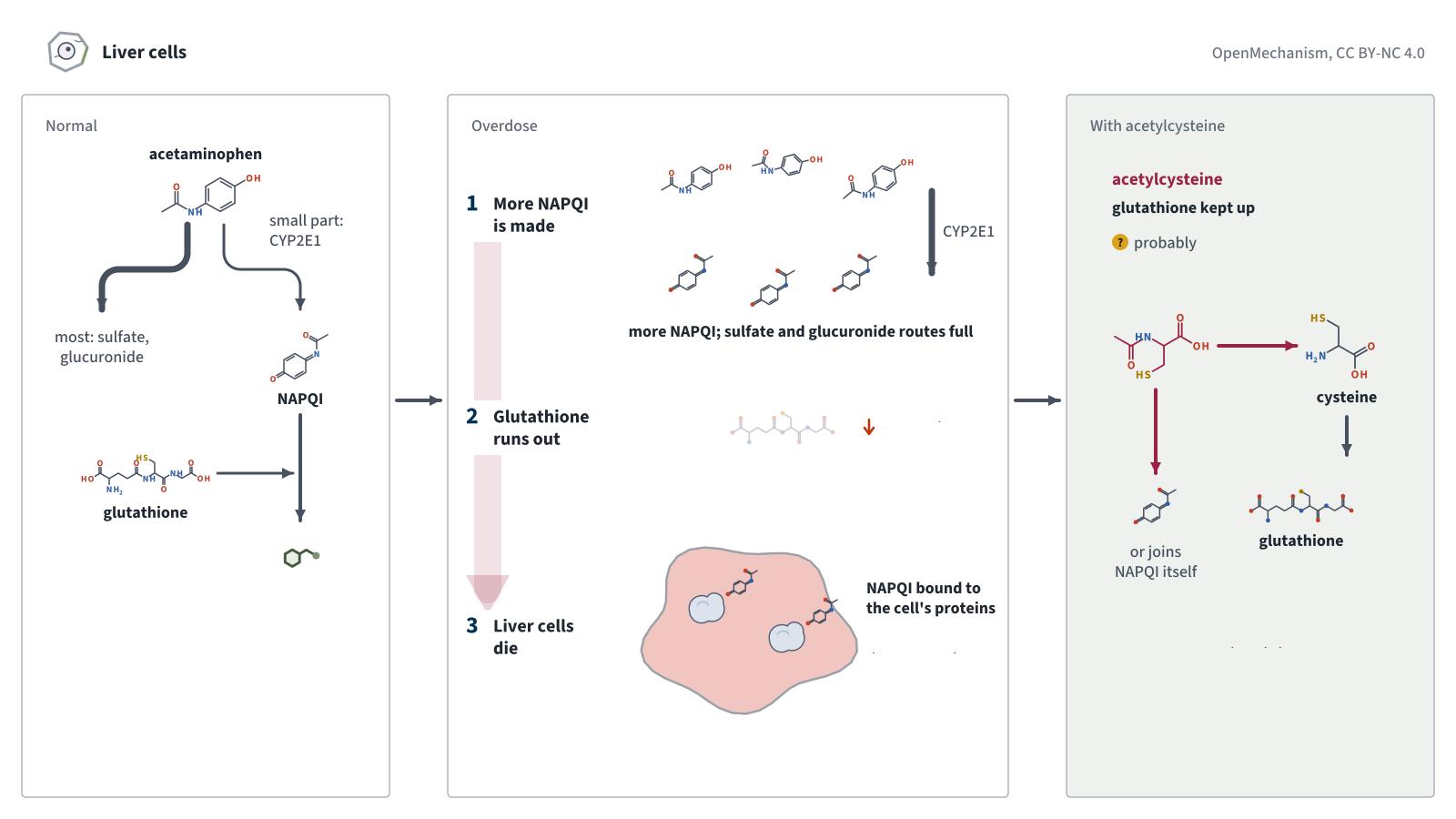
At usual doses the liver makes a small amount of a reactive by-product of acetaminophen, NAPQI, harmless with its glutathione. After an overdose more NAPQI is made, glutathione can run out, and NAPQI kills liver cells. Acetylcysteine, the antidote, probably works by keeping glutathione up.
- Where
- Liver cells
- Body system
- Stomach, gut & liver
- Medicines
- 1 medicine
Probably
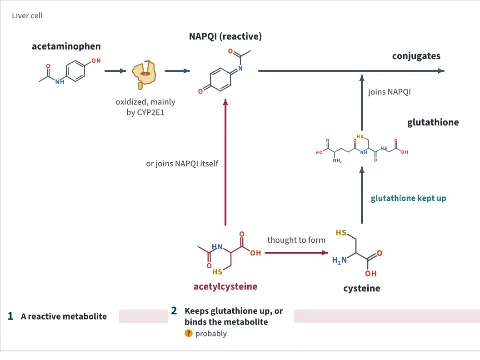
The Acetadote (acetylcysteine) label says: Acetylcysteine probably protects the liver by maintaining or restoring the glutathione levels, or by acting as an alternate substrate for conjugation with, and thus detoxification of, the reactive metabolite of acetaminophen.
Clinical study: In 100 people with severe paracetamol (acetaminophen) poisoning treated with intravenous acetylcysteine, compared with earlier patients given supportive care alone; the study measured liver damage, not how acetylcysteine works: There was virtually complete protection against liver damage in 40 patients treated within eight hours after ingestion (mean maximum serum alanine transaminase activity 27 IU/1). … Only one out of 62 patients treated within 10 hours developed severe liver damage compared with 33 out of 57 patients (58%) studied retrospectively who received supportive treatment alone.
Prescott LF et al., Br Med J 1979 (PMID 519312)
This study was picked with a literature search and is not yet checked by our reviewer.
For teachers: download this drawing.
What goes wrong
More NAPQI is made. At usual doses most acetaminophen is joined to sulfate or glucuronide and leaves in the urine; the small part that CYP2E1 turns into NAPQI is quickly joined to glutathione and made harmless. After a large overdose, the sulfate and glucuronide routes are full, so a larger part goes down the CYP2E1 route and more NAPQI is made.1,2
What the source says
“It is extensively metabolized in the liver to form principally the sulfate and glucoronide conjugates which are excreted in the urine.”
Source 1“A small fraction of an ingested dose is metabolized in the liver by isozyme CYP2E1 of the cytochrome P-450 mixed function oxidase enzyme system to form a reactive, potentially toxic, intermediate metabolite.”
Source 1“With therapeutic doses, NAPQI undergoes rapid conjugation with glutathione and is then further metabolized to form cysteine and mercapturic acid conjugates.”
Source 2“However, following ingestion of a large overdose, the glucuronide and sulfate conjugation pathways are saturated resulting in a larger fraction of the drug being metabolized via the cytochrome P-450 pathway and therefore, the amount of acetaminophen metabolized to the reactive intermediate increases.”
Source 1Glutathione runs out. The extra NAPQI may use up the liver's glutathione.1
What the source says
“The increased formation of the reactive metabolite may deplete the hepatic stores of glutathione”
Source 1Liver cells die. NAPQI then binds proteins inside liver cells, and the cells die. Doses higher than recommended may injure the liver, with a risk of liver failure and death; doses of 150 mg/kg or more have been linked with liver damage.1,3,4
What the source says
“with subsequent binding of the metabolite to protein molecules within the hepatocyte resulting in cellular necrosis”
Source 1“Administration of acetaminophen in doses higher than recommended may result in hepatic injury, including the risk of liver failure and death”
Source 3“Acetaminophen doses of 150 mg/kg or greater have been associated with hepatotoxicity.”
Source 4
Where medicines act
In liver cells
- A
Acetylcysteine targets Glutathione (probably)
Probably keeps glutathione up or restores it, or joins the reactive metabolite itself.4
Used forAcetaminophen overdose: to prevent or lessen liver injury, after one large amount or repeated high doses
What the label says
“ACETADOTE is an antidote for acetaminophen overdose indicated to prevent or lessen hepatic injury after ingestion of a potentially hepatotoxic quantity of acetaminophen in adults and pediatric patients who weigh 5 kg or greater with acute ingestion or from repeated supratherapeutic ingestion (RSI)”
Source 4“Acetylcysteine has been shown to reduce the extent of liver injury following acetaminophen overdose.”
Source 4“Acetylcysteine probably protects the liver by maintaining or restoring the glutathione levels, or by acting as an alternate substrate for conjugation with, and thus detoxification of, the reactive metabolite of acetaminophen.”
Source 4“Acetylcysteine (i.e., N -acetylcysteine) is postulated to form cysteine and disulfides (N,N-diacetylcysteine and N -acetylcysteine).”
Source 4“Cysteine is further metabolized to form glutathione and other metabolites.”
Source 4
See also
Body system: stomach, gut & liver.
Can raise or cause it: acetaminophen (“Administration of acetaminophen in doses higher than recommended may result in hepatic injury, including the risk of liver failure and death”3).
Other conditions: ethylene glycol and methanol poisoning; cyanide poisoning; methemoglobinemia; heavy metal poisoning; and acute pain and period pain.
Side effects: why too much acetaminophen harms the liver.
Sources
- 1Acetylcysteine injection (Fresenius Kabi): FDA label12.1 Mechanism of Action: Acetaminophen Overdose. Saved copy
- 2Acetaminophen injection: FDA label12.3 Pharmacokinetics: Metabolism. Saved copy
- 3Acetaminophen injection: FDA label5.1 Hepatic Injury. Saved copy
- 4Acetadote (acetylcysteine): FDA label1 Indications and Usage; 12.1 Mechanism of Action; 12.3 Pharmacokinetics. Saved copy
- 5Intravenous N-acetylcystine: the treatment of choice for paracetamol poisoningPrescott LF et al. Br Med J 1979 (abstract). Saved copy
Notes and limits
- The acetaminophen label advises caution in liver disease, alcoholism, long-term undernutrition, severe low blood volume and severe kidney impairment, and counts acetaminophen from every product toward the daily maximum.3
Notes that apply to every page are on How to read a page.
Spotted a mistake? Report an error (hello@openmechanism.com). Since launch, every published error we fix is listed on the corrections page.
Cite this page
Tran D. Acetaminophen overdose [Internet]. OpenMechanism; 2026 [updated 2026 Oct 20; cited 2026 Oct 20]. Available from: https://openmechanism.com/conditions/acetaminophen-overdose