Lactulose
Lactulose is a man-made sugar that no enzyme in the human gut can split, so it reaches the colon unchanged. There, bacteria turn it mainly into lactic acid, which raises the osmotic pressure and slightly acidifies the colon's contents, so the stool holds more water and softens; a bowel movement may take 24 to 48 hours. In hepatic encephalopathy it lowers blood ammonia. This is considered to come from the acid colon trapping ammonia as ammonium, which the laxative action then passes out.
- Acts on
- Bacteria in the colon, which break it down
- Where
- The colon
- Medicine type
- Small molecule
- Used for
- Digestion
- Drug class
- Osmotic laxatives
Also called Constulose and Enulose.
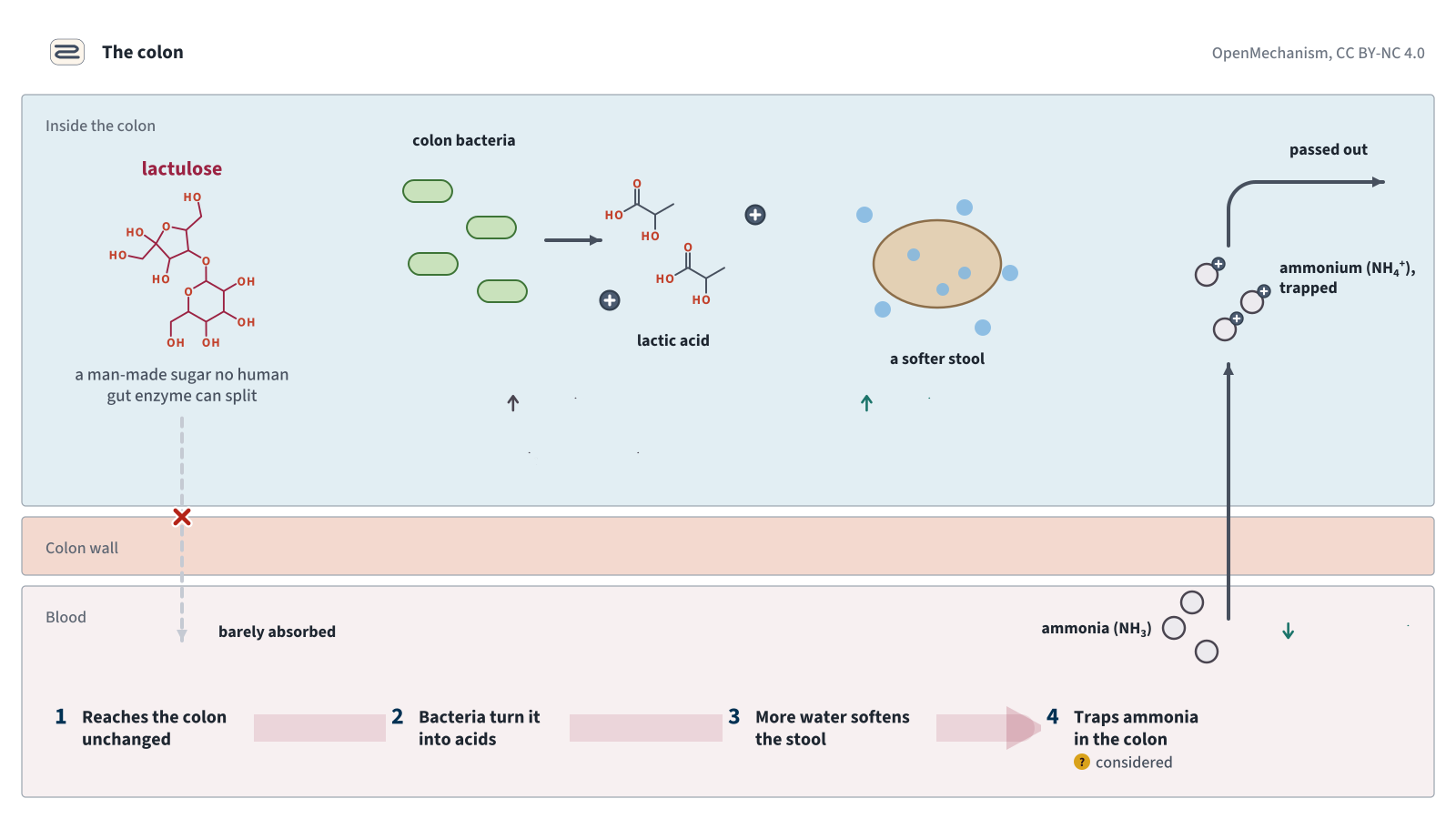
Step 4: considered
The Enulose label says: These actions are considered to be results of the following: Bacterial degradation of lactulose in the colon acidifies the colonic contents. … Since the colonic contents are then more acid than the blood, ammonia can be expected to migrate from the blood into the colon to form the ammonium ion.
Source 2: Enulose (lactulose solution): FDA label, Clinical Pharmacology; Indications and Usage
Clinical study: In an open-label randomized trial of lactulose against placebo in people with cirrhosis who had recovered from hepatic encephalopathy (HE); it measured whether HE came back, not how lactulose works: Lactulose is effective for prevention of recurrence of HE in patients with cirrhosis.
Sharma BC et al., Gastroenterology 2009 (PMID 19501587)
This study was picked with a literature search and is not yet checked by our reviewer.
How it works
Reaches the colon unchanged. Lactulose is a man-made sugar (a disaccharide). It is poorly absorbed, and no enzyme in the human gut can split it, so it reaches the colon virtually unchanged; only small amounts reach the blood.1
Bacteria turn it into acids. In the colon, bacteria break lactulose down, mainly to lactic acid, with small amounts of formic and acetic acids. This raises the osmotic pressure of the colon's contents and makes them slightly acid.1
More water softens the stool. The stool's water content rises and the stool softens. Because lactulose acts only once it reaches the colon, and passage through the colon may be slow, a bowel movement may take 24 to 48 hours.1
Traps ammonia in the colon. In people with portal-systemic (hepatic) encephalopathy, lactulose lowers blood ammonia, by 25 to 50% in controlled studies. This is considered to work this way: the acid contents of the colon turn ammonia (NH3) into the ammonium ion (NH4+), which is trapped there and not absorbed; ammonia can be expected to move from the blood into the more acid colon; and the laxative action passes the trapped ammonium out.2
For teachers: download this drawing.
See also
Condition pages: chronic constipation.
Other osmotic laxatives: polyethylene glycol 3350.
More medicines for digestion: aluminum hydroxide and magnesium carbonate; aprepitant; esomeprazole; famotidine; loperamide; lubiprostone; mesalamine; metoclopramide; and 8 more.
Body system: stomach, gut & liver.
Sources
- 1Constulose (lactulose solution): FDA labelDescription; Clinical Pharmacology
- 2Enulose (lactulose solution): FDA labelClinical Pharmacology; Indications and Usage
- 3ChEMBL CHEMBL296306Target and action classification: Colonic bacteria substrate
- 4Secondary prophylaxis of hepatic encephalopathy: an open-label randomized controlled trial of lactulose versus placeboSharma BC et al. Gastroenterology 2009 (abstract)
Spotted a mistake? Report an error (hello@openmechanism.com). Since launch, every published error we fix is listed on the corrections page.
Notes and limits
- A schematic teaching drawing: not to scale, not exact structures, binding poses or a complete pathway, and not a guide to dosing, treatment or how a person will respond.
- The Enulose label says the decrease in blood ammonia and in portal-systemic encephalopathy are considered to be results of the acidification of the colon's contents, and that ammonia can be expected to migrate from the blood into the colon.
All recorded limits are on the evidence page, and notes that apply to every page are on How to read a page. Version 1.0.0, not yet medically reviewed.
Cite this page
Tran D. Lactulose [Internet]. OpenMechanism; 2026 [updated 2026 Oct 16; cited 2026 Oct 16]. Available from: https://openmechanism.com/medicines/lactulose