Mesalamine
In ulcerative colitis, the colon lining makes more arachidonic acid products. Mesalamine appears to act locally on the cells lining the colon, possibly by blocking cyclooxygenase and lowering prostaglandin production; its mechanism is not fully understood. About a fifth of a Lialda dose is absorbed.
- Acts on
- Possibly cyclooxygenase in the colon lining
- Where
- The lining of the colon
- Medicine type
- Small molecule
- Used for
- Digestion
- Drug class
- Aminosalicylates
Also called Lialda (delayed-release mesalamine).
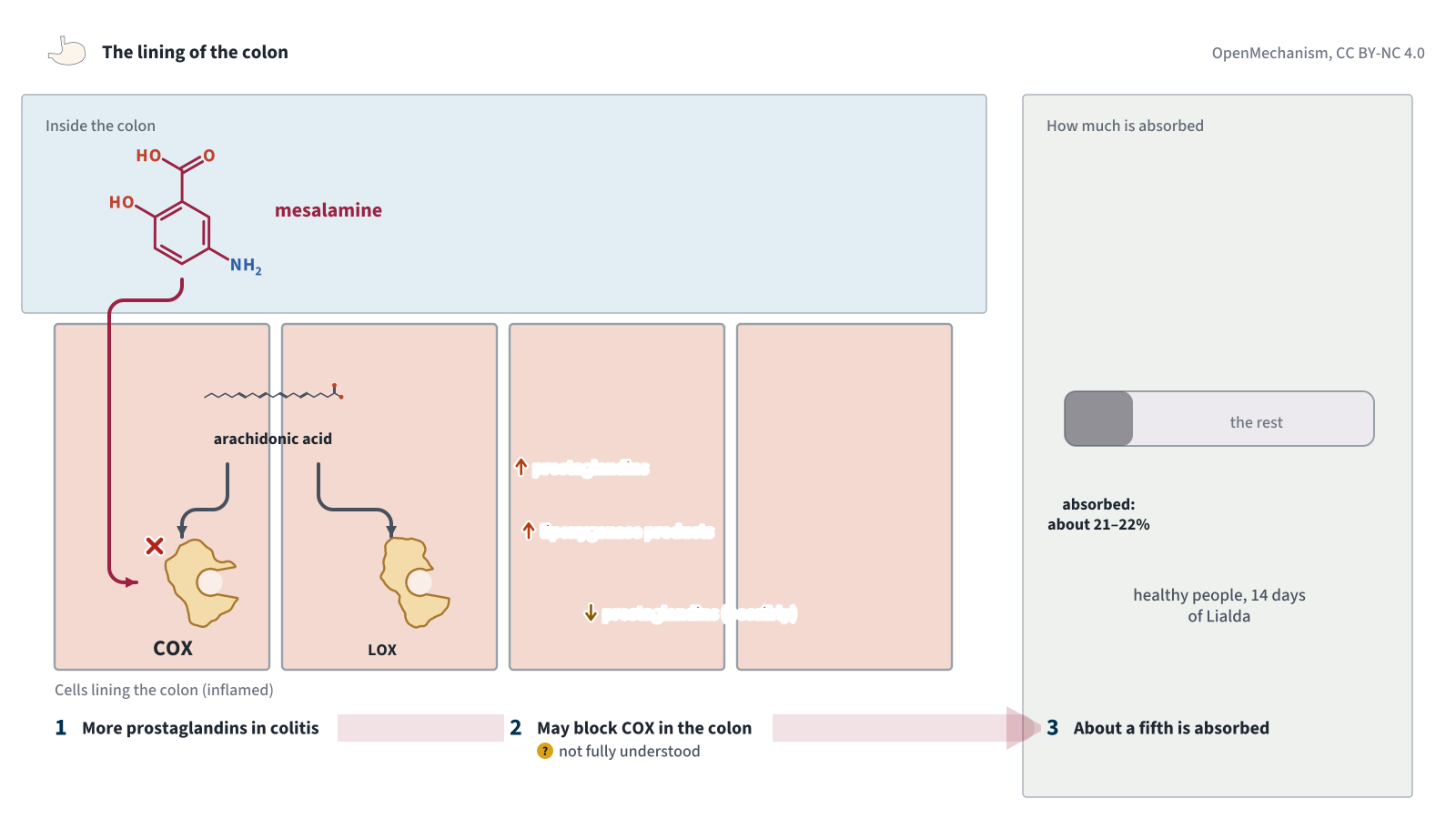
Step 2: not fully understood
The Lialda label says: The mechanism of action of mesalamine is not fully understood, but it appears to have a topical anti-inflammatory effect on the colonic epithelial cells. … it is possible that mesalamine diminishes inflammation by blocking cyclooxygenase and inhibiting prostaglandin production in the colon.
Clinical study: In a Cochrane review of 54 randomized trials (9612 people) of oral 5-ASA, the group mesalamine belongs to, for active ulcerative colitis; the trials measured remission, not how mesalamine works: There is high-certainty evidence that 5-ASA is superior to placebo
Murray A et al., Cochrane Database Syst Rev 2020 (PMID 32786164)
This study was picked with a literature search and is not yet checked by our reviewer.
Key terms in this drawing
- COX
- Cyclooxygenase. The enzymes, COX-1 and COX-2, that make prostaglandins.
- LOX
- Lipoxygenase. An enzyme pathway that, like cyclooxygenase, makes inflammatory signals from arachidonic acid; it is more active in ulcerative colitis.
How it works
More prostaglandins in colitis. In ulcerative colitis, the lining of the colon makes more arachidonic acid products, through both the cyclooxygenase and the pathways.1
May block COX in the colon. Mesalamine appears to have a local (topical) anti-inflammatory effect on the cells lining the colon. It is possible that it eases inflammation by blocking cyclooxygenase and lowering prostaglandin production in the colon; its mechanism is not fully understood.1
About a fifth is absorbed. In healthy people taking Lialda once daily for 14 days, about 21 to 22% of the dose was absorbed into the body.1
For teachers: download this drawing.
See also
Condition pages: ulcerative colitis.
Body system: stomach, gut & liver.
Sources
- 1Lialda (mesalamine) delayed-release tablets: FDA label12.1 Mechanism of Action; 12.3 Pharmacokinetics
- 2ChEMBL CHEMBL704Target and action classification: Arachidonate 5-lipoxygenase inhibitor; Cyclooxygenase inhibitor; Peroxisome proliferator-activated receptor gamma agonist
- 3Oral 5-aminosalicylic acid for induction of remission in ulcerative colitisMurray A et al. Cochrane Database Syst Rev 2020 (abstract)
Also used for the drawing
The COX and 5-lipoxygenase outlines are traced from the crystal structures below.
- 4Human cyclooxygenase-2 (COX-2) with mefenamic acidPDB 5IKR; Orlando, B.J., Malkowski, M.G. J.Biol.Chem. 2016; 291:15069-15081
- 5Human 5-lipoxygenase (a stabilized form) with its catalytic ironPDB 3O8Y; Gilbert, N.C. et al. Science 2011; 331:217-219
Spotted a mistake? Report an error (hello@openmechanism.com). Since launch, every published error we fix is listed on the corrections page.
Notes and limits
- A schematic teaching drawing: not to scale, not exact structures, binding poses or a complete pathway, and not a guide to dosing, treatment or how a person will respond.
- The label says the mechanism of action of mesalamine is not fully understood, and that it is possible that it diminishes inflammation by blocking cyclooxygenase and inhibiting prostaglandin production in the colon.
All recorded limits are on the evidence page, and notes that apply to every page are on How to read a page. Version 1.0.0, not yet medically reviewed.
Cite this page
Tran D. Mesalamine [Internet]. OpenMechanism; 2026 [updated 2026 Oct 11; cited 2026 Oct 11]. Available from: https://openmechanism.com/medicines/mesalamine