Pantoprazole
Pantoprazole, a proton pump inhibitor, binds covalently to the , the acid pump of the stomach's parietal cells. This suppresses the last step of acid production, so both resting and stimulated acid secretion fall, and the effect lasts more than 24 hours at all the doses tested (20 mg to 120 mg). The Protonix label lists it for short-term treatment (up to 8 weeks) to heal erosive esophagitis linked to acid reflux (GERD) and relieve its symptoms, in adults and children 5 years and older; for keeping the esophagitis healed and lowering how often daytime and nighttime heartburn comes back, in adults with GERD (its controlled studies lasted no longer than 12 months); and for long-term treatment of conditions in which the stomach secretes too much (pathological hypersecretory conditions), including Zollinger-Ellison syndrome.
- Acts on
- H+/K+-ATPase (the acid pump)
- Where
- Acid-making cells of the stomach
- Medicine type
- Small molecule
- Used for
- Digestion
- Drug class
- Proton pump inhibitors (PPIs)
Also called Protonix (delayed-release pantoprazole sodium).
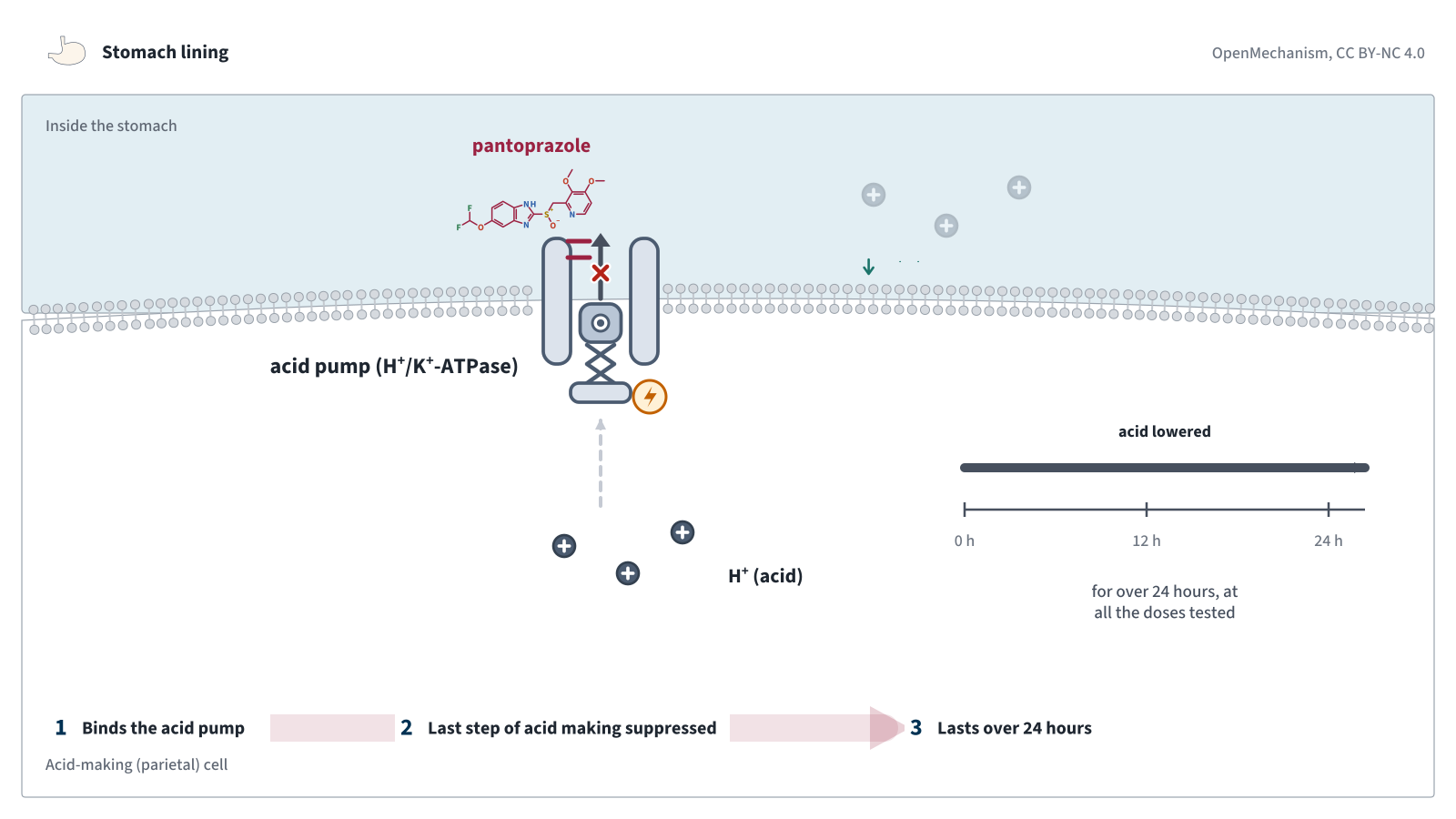
Key terms in this drawing
- H+/K+-ATPase
- The stomach's acid (proton) pump. An enzyme system at the secretory surface of the stomach's acid-making (parietal) cells; blocking it blocks the last step of acid production.
How it works
Binds the acid pump. Pantoprazole, a proton pump inhibitor (PPI), binds covalently to the H+/K+-ATPase, the acid pump at the secretory surface of the stomach's parietal cell.1
Last step of acid making suppressed. This suppresses the final step of acid production, so both resting (basal) and stimulated acid secretion fall, whatever the stimulus.1
Lasts over 24 hours. Because of this binding, the acid-lowering effect lasts longer than 24 hours at all the doses tested (20 mg to 120 mg).1
For teachers: download this drawing.
See also
Condition pages: acid reflux (GERD) and Zollinger-Ellison syndrome.
Other proton pump inhibitors (PPIs): esomeprazole and omeprazole.
Explained: clopidogrel and omeprazole; levothyroxine and calcium, iron or acid reducers; and why PPIs and metformin can lower vitamin B12.
Body system: stomach, gut & liver.
Sources
- 1Protonix (pantoprazole sodium) delayed-release: FDA label1 Indications and Usage; 12.1 Mechanism of Action
- 2ChEMBL CHEMBL1502Target and action classification: Potassium-transporting ATPase inhibitor
Spotted a mistake? Report an error (hello@openmechanism.com). Since launch, every published error we fix is listed on the corrections page.
Notes and limits
- A schematic teaching drawing: not to scale, not exact structures, binding poses or a complete pathway, and not a guide to dosing, treatment or how a person will respond.
All recorded limits are on the evidence page, and notes that apply to every page are on How to read a page. Version 1.0.1, medically reviewed by Daniel Tran, PharmD, on 13 November 2026.
Cite this page
Tran D. Pantoprazole [Internet]. OpenMechanism; 2026 [updated 2026 Nov 13; cited 2026 Nov 13]. Available from: https://openmechanism.com/medicines/pantoprazole