Famotidine
Famotidine competitively blocks histamine . Its main effect is less stomach secretion: both the acid concentration and the volume fall. In adults, after a dose by mouth, the effect begins within an hour, and after 20 mg or 40 mg doses it lasts 10 to 12 hours. The label lists it in adults for active duodenal and stomach (gastric) ulcers, for lowering the risk of a duodenal ulcer coming back, for acid reflux (GERD) with symptoms but no erosions, for erosive esophagitis from GERD diagnosed by biopsy, and for conditions in which the stomach secretes too much (pathological hypersecretory conditions), such as Zollinger-Ellison syndrome; in children 1 year and older for peptic ulcers and for GERD with or without esophagitis and ulcers; and from birth to under 1 year for GERD.
- Acts on
- Histamine H2 receptors
- Where
- The stomach
- Medicine type
- Small molecule
- Used for
- Digestion
- Drug class
- H2 blockers
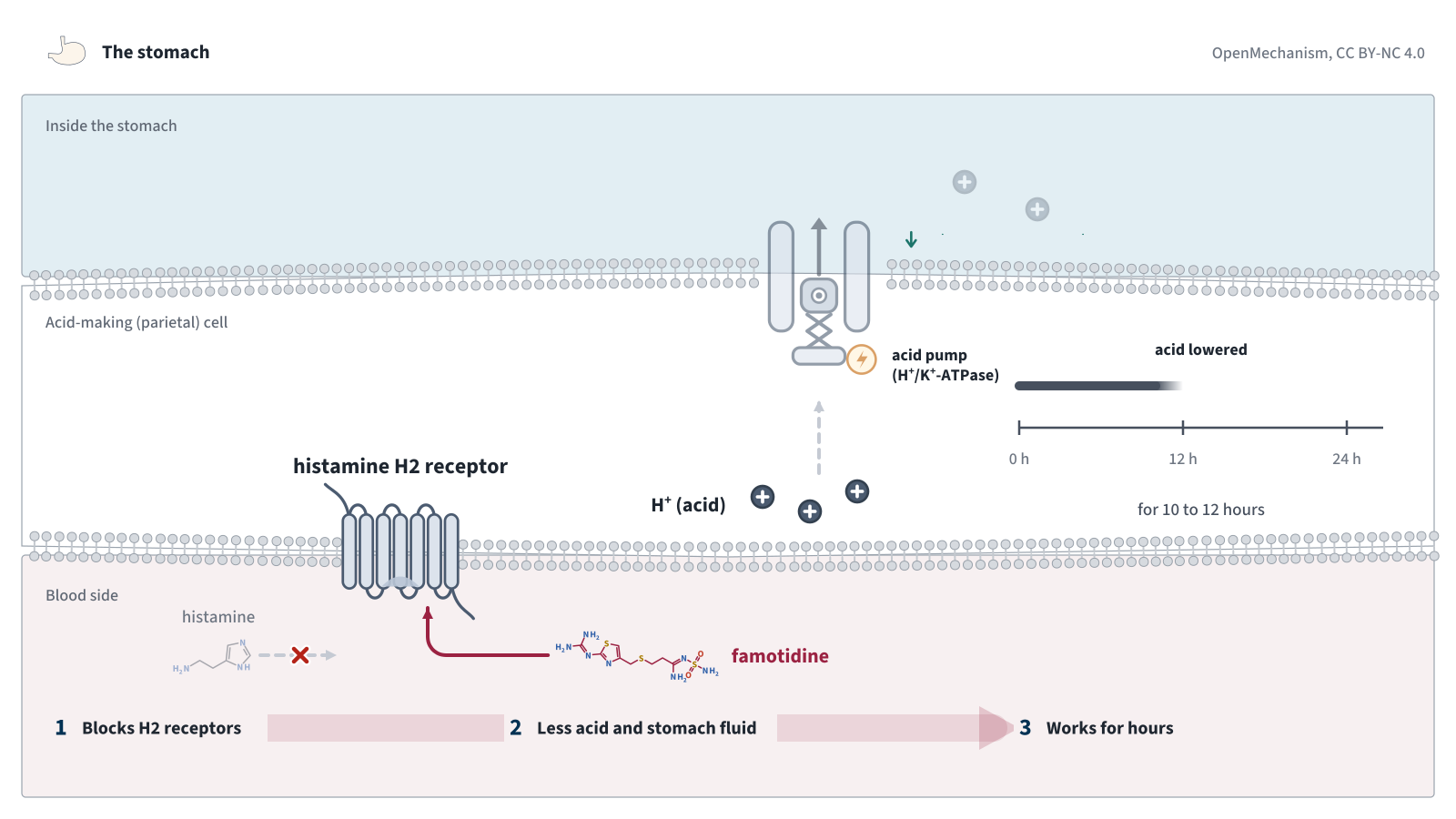
Key terms in this drawing
- H+/K+-ATPase
- The stomach's acid (proton) pump. An enzyme system at the secretory surface of the stomach's acid-making (parietal) cells; blocking it blocks the last step of acid production.
- H2 receptor
- Histamine H2 receptor. A histamine receptor; blocking it, as famotidine does, cuts the stomach's acid secretion.
How it works
Blocks H2 receptors. Histamine, gastrin and acetylcholine are known to stimulate stomach acid secretion. Famotidine competitively blocks (inhibits) histamine H2 receptors.1,2
Less acid and stomach fluid. Its main clinically important effect is less stomach secretion: both the acid concentration and the volume of stomach secretions fall, and pepsin secretion changes in proportion to the volume.1
Works for hours. In adults it lowered resting (basal) and night-time acid secretion, and secretion stimulated by food and pentagastrin. After a dose by mouth, the effect began within 1 hour and peaked within 1 to 3 hours, the peak depending on the dose; after 20 mg and 40 mg doses it lasted 10 to 12 hours, though in some people given 20 mg it wore off within 6 to 8 hours.1
For teachers: download this drawing.
See also
Condition pages: acid reflux (GERD), peptic ulcers and Zollinger-Ellison syndrome.
Explained: why PPIs and metformin can lower vitamin B12.
Body system: stomach, gut & liver.
Sources
- 1Famotidine for oral suspension: FDA label1 Indications and Usage; 12.1 Mechanism of Action; 12.2 Pharmacodynamics
- 2Intrinsic factor secretion and cobalamin absorption. Physiology and pathophysiology in the gastrointestinal tractFesten HP, Scand J Gastroenterol Suppl 1991 (abstract)
- 3ChEMBL CHEMBL902Target and action classification: Histamine H2 receptor antagonist
Also used for the drawing
The drawing names the acid-making (parietal) cell and its acid pump (H+/K+-ATPase) as the omeprazole and pantoprazole drawings do. The saved sections of the famotidine label name neither; the Prilosec label places the acid pump at the secretory surface of the stomach's parietal cell.
- 4Prilosec (omeprazole magnesium) for delayed-release oral suspension: FDA label12.1 Mechanism of Action
Spotted a mistake? Report an error (hello@openmechanism.com). Since launch, every published error we fix is listed on the corrections page.
Notes and limits
- A schematic teaching drawing: not to scale, not exact structures, binding poses or a complete pathway, and not a guide to dosing, treatment or how a person will respond.
- The steps are in the order that explains them; one step is said to cause the next only where the source says so.
All recorded limits are on the evidence page, and notes that apply to every page are on How to read a page. Version 1.0.1, medically reviewed by Daniel Tran, PharmD, on 13 November 2026.
Cite this page
Tran D. Famotidine [Internet]. OpenMechanism; 2026 [updated 2026 Nov 13; cited 2026 Nov 13]. Available from: https://openmechanism.com/medicines/famotidine