Misoprostol
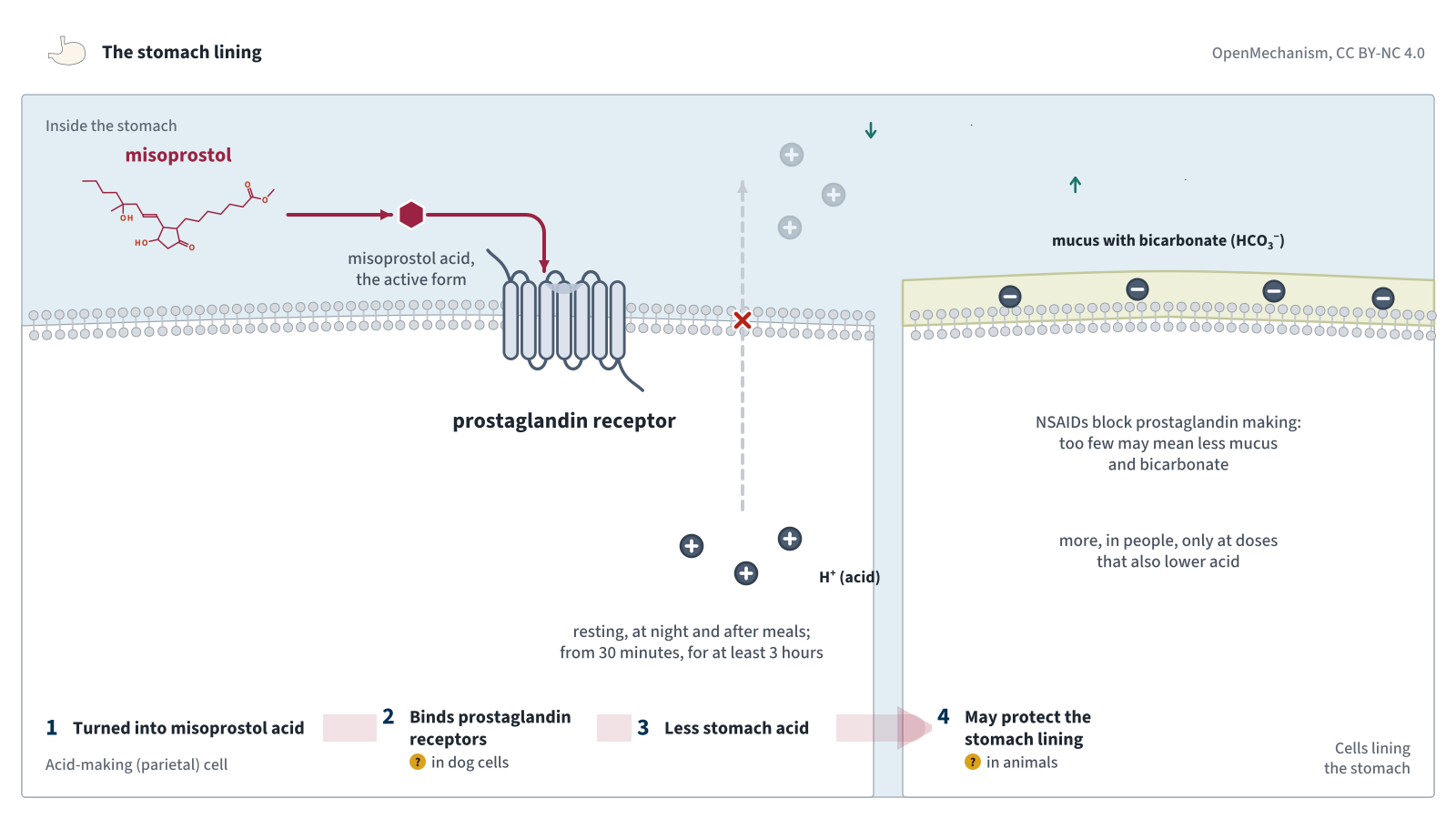
Misoprostol, a man-made copy of prostaglandin E1, is quickly changed into misoprostol acid, its active form. In lab studies of dogs' acid-making cells, it binds specific prostaglandin receptors. It lowers the stomach's resting, nighttime and meal-stimulated acid for at least 3 hours. cut the prostaglandins in the stomach lining; misoprostol protects the lining in animals and can raise mucus and bicarbonate in people, but it is not possible to tell whether it lowers the risk of stomach ulcers with NSAIDs through less acid, a protected lining, or both.
- Acts on
- Prostaglandin receptors on the stomach's acid-making cells
- Where
- The stomach lining
- Medicine type
- Small molecule
- Used for
- Digestion
- Drug class
- Uterotonics
Also called Cytotec.
Step 2: in dog cells
The Cytotec label says: In vitro studies on canine parietal cells using tritiated misoprostol acid as the ligand have led to the identification and characterization of specific prostaglandin receptors. … It is likely that these specific receptors allow misoprostol taken with food to be effective topically, despite the lower serum concentrations attained.
Clinical study: In a randomized study in eight healthy men given misoprostol or placebo by mouth; it measured stomach acid and mucus, not the receptors: Misoprostol in 200-, 400-, and 800-micrograms doses reduced basal acid secretion by 91%, 93%, and 93%, respectively.
Wilson DE et al., Dig Dis Sci 1986 (PMID 3080283)
This study was picked with a literature search and is not yet checked by our reviewer.
Step 4: in animals
The Cytotec label says: Misoprostol has both antisecretory (inhibiting gastric acid secretion) and (in animals) mucosal protective properties. … It is therefore not possible to tell whether the ability of misoprostol to reduce the risk of gastric ulcer is the result of its antisecretory effect, its mucosal protective effect, or both.
Clinical study: In a randomized, double-blind trial of misoprostol against placebo for 6 months in 8843 people with rheumatoid arthritis taking NSAIDs; it measured serious complications in the stomach and upper gut, not how misoprostol protects: Serious upper gastrointestinal complications were reduced by 40% (odds ratio, 0.598 [95% CI, 0.364 to 0.982; P = 0.049]) among patients receiving misoprostol (25 of 4404 patients) compared with those receiving placebo (42 of 4439 patients).
Silverstein FE et al., Ann Intern Med 1995 (PMID 7611589)
This study was picked with a literature search and is not yet checked by our reviewer.
Key terms in this drawing
- NSAID
- Nonsteroidal anti-inflammatory drug. A medicine with pain-relieving and anti-inflammatory properties, such as ibuprofen or naproxen; how it works involves blocking the COX enzymes.
How it works
Turned into misoprostol acid. Misoprostol is a man-made copy (analog) of prostaglandin E1. It is absorbed well and quickly changed (de-esterified) into its free acid, misoprostol acid, which carries its activity.1
Binds prostaglandin receptors. In lab studies of acid-making (parietal) cells from dogs, misoprostol acid binds specific prostaglandin receptors, which also bind other E-type prostaglandins but not histamine. How strongly misoprostol binds them matches an indirect measure of how much it lowers acid, and these receptors likely let misoprostol taken with food act directly on the stomach (topically).1
Less stomach acid. Misoprostol lowers the stomach's resting and nighttime acid, and the acid made in response to meals, histamine, pentagastrin and coffee. The effect begins within 30 minutes and lasts at least 3 hours.1
May protect the stomach lining. NSAIDs block prostaglandin making, and too few prostaglandins in the stomach lining may lower its bicarbonate and mucus and add to the damage NSAIDs cause. Misoprostol protects the lining in animals. In people it can raise bicarbonate and mucus, but only at doses that also lower acid, so it is not possible to tell whether it lowers the risk of stomach (gastric) ulcers through less acid, a protected lining, or both.1
For teachers: download this drawing.
See also
Condition pages: peptic ulcers.
Other uterotonics: methylergonovine and oxytocin.
Explained: why NSAIDs can cause stomach ulcers and bleeding.
Body system: stomach, gut & liver.
Sources
- 1Cytotec (misoprostol): FDA labelDescription; Clinical Pharmacology (Pharmacokinetics; Pharmacodynamics)
- 2ChEMBL CHEMBL606Target and action classification: Prostanoid EP3 receptor agonist
- 3Effects of misoprostol on gastric acid and mucus secretion in manWilson DE et al. Dig Dis Sci 1986 (abstract)
- 4Misoprostol reduces serious gastrointestinal complications in patients with rheumatoid arthritis receiving nonsteroidal anti-inflammatory drugs. A randomized, double-blind, placebo-controlled trialSilverstein FE et al. Ann Intern Med 1995 (abstract)
Spotted a mistake? Report an error (hello@openmechanism.com). Since launch, every published error we fix is listed on the corrections page.
Notes and limits
- A schematic teaching drawing: not to scale, not exact structures, binding poses or a complete pathway, and not a guide to dosing, treatment or how a person will respond.
- The Cytotec label says these specific prostaglandin receptors were identified in in vitro studies on canine parietal cells, and that it is likely these receptors allow misoprostol taken with food to be effective topically.
- The Cytotec label says misoprostol has mucosal protective properties in animals, that in man more bicarbonate and mucus has been shown only at doses that are also antisecretory, and that it is not possible to tell whether its ability to reduce the risk of gastric ulcer is the result of its antisecretory effect, its mucosal protective effect, or both.
All recorded limits are on the evidence page, and notes that apply to every page are on How to read a page. Version 1.0.0, not yet medically reviewed.
Cite this page
Tran D. Misoprostol [Internet]. OpenMechanism; 2026 [updated 2026 Oct 16; cited 2026 Oct 16]. Available from: https://openmechanism.com/medicines/misoprostol