Loperamide
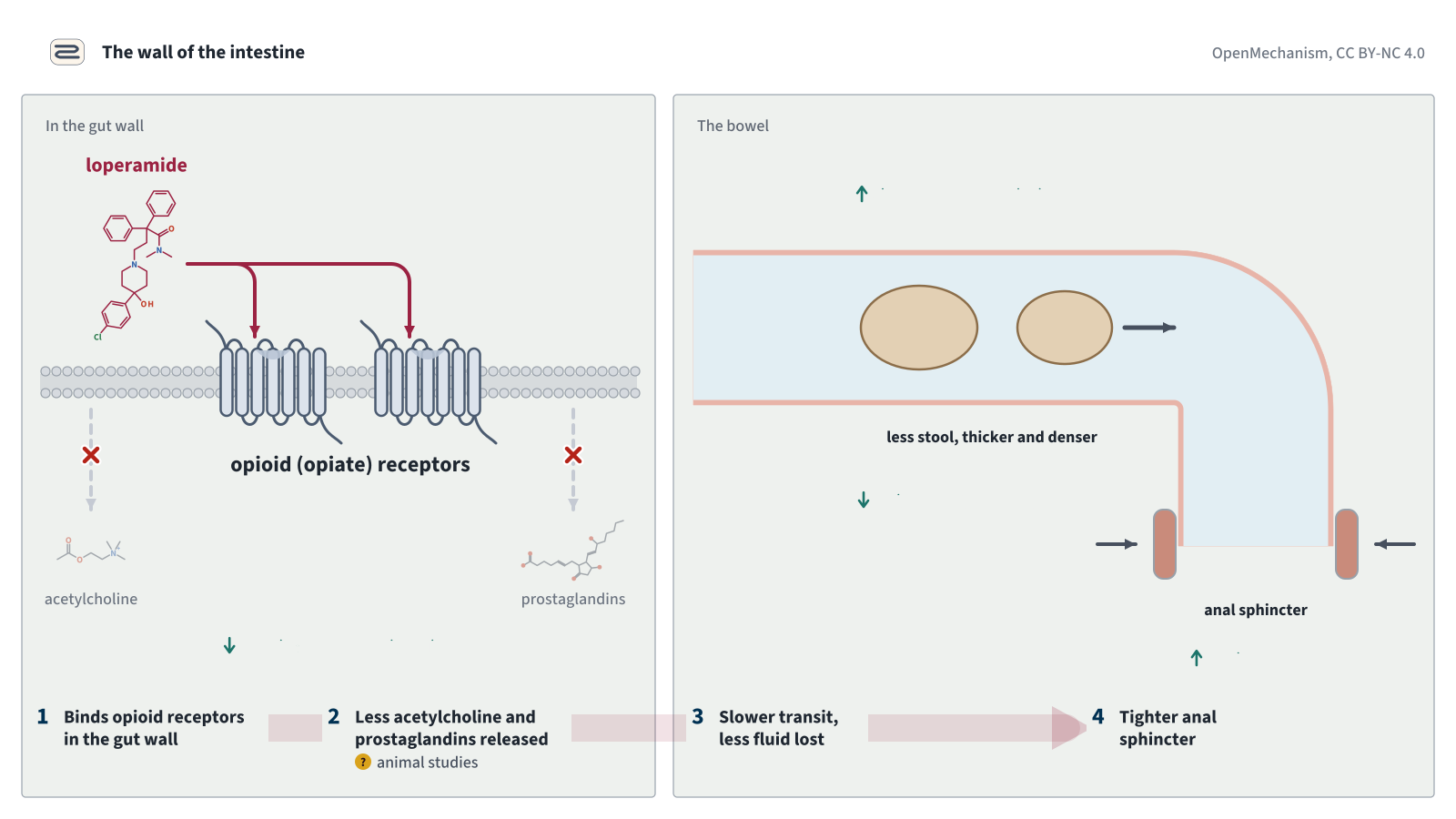
Loperamide binds the opiate (opioid) receptor in the gut wall. In lab and animal studies, this holds back the release of acetylcholine and prostaglandins, so the gut's pushing waves weaken. The gut's contents pass more slowly, stools become smaller, thicker and denser, with less fluid lost, and the anal sphincter tightens, which reduces incontinence and urgency.
- Acts on
- Opioid (opiate) receptors in the gut wall
- Where
- The wall of the intestine
- Medicine type
- Small molecule
- Used for
- Digestion
- Drug class
- Opioids
Step 2: animal studies
The loperamide label says: In vitro and animal studies show that loperamide hydrochloride capsules act by slowing intestinal motility and by affecting water and electrolyte movement through the bowel. … Consequently, it inhibits the release of acetylcholine and prostaglandins, thereby reducing propulsive peristalsis, and increasing intestinal transit time.
Source 1: Loperamide hydrochloride capsules: FDA label, Mechanism of Action; Pharmacodynamics
Clinical study: In a study in five people given a large infusion of salt solution into the stomach to cause diarrhea, which tested how loperamide works: These results suggest that loperamide exerts its antidiarrheal effect by a change in the motor function of the intestine, which results in increased capacitance of the gut and a delay in the passage of fluid through the intestine.
Schiller LR et al., Gastroenterology 1984 (PMID 6714575)
This study was picked with a literature search and is not yet checked by our reviewer.
How it works
Binds opioid receptors in the gut wall. Loperamide binds to the opiate (opioid) receptor in the gut wall.1
Less acetylcholine and prostaglandins released. In lab (in vitro) and animal studies, loperamide works by slowing the gut's movement and by changing how water and electrolytes move through the bowel. By binding the receptor, it holds back the release of acetylcholine and prostaglandins, so the pushing waves (propulsive peristalsis) weaken and the gut's contents take longer to pass.1
Slower transit, less fluid lost. Loperamide lengthens the time the gut's contents take to pass (transit time). Daily stool volume falls, stool becomes thicker and denser, and less fluid and electrolytes are lost. No tolerance to its anti-diarrhea effect has been seen.1
Tighter anal sphincter. Loperamide increases the tone of the anal sphincter, which reduces incontinence and urgency.1
For teachers: download this drawing.
See also
Condition pages: Crohn disease and ulcerative colitis.
Other opioids: buprenorphine, fentanyl, hydrocodone, morphine, oxycodone and tramadol.
Body system: stomach, gut & liver.
Sources
- 1Loperamide hydrochloride capsules: FDA labelMechanism of Action; Pharmacodynamics
- 2ChEMBL CHEMBL841Target and action classification: Mu opioid receptor agonist
- 3Mechanism of the antidiarrheal effect of loperamideSchiller LR et al. Gastroenterology 1984 (abstract)
Spotted a mistake? Report an error (hello@openmechanism.com). Since launch, every published error we fix is listed on the corrections page.
Notes and limits
- A schematic teaching drawing: not to scale, not exact structures, binding poses or a complete pathway, and not a guide to dosing, treatment or how a person will respond.
- The loperamide label says in vitro and animal studies show that loperamide acts by slowing intestinal motility and by affecting water and electrolyte movement through the bowel.
All recorded limits are on the evidence page, and notes that apply to every page are on How to read a page. Version 1.0.0, not yet medically reviewed.
Cite this page
Tran D. Loperamide [Internet]. OpenMechanism; 2026 [updated 2026 Oct 16; cited 2026 Oct 16]. Available from: https://openmechanism.com/medicines/loperamide