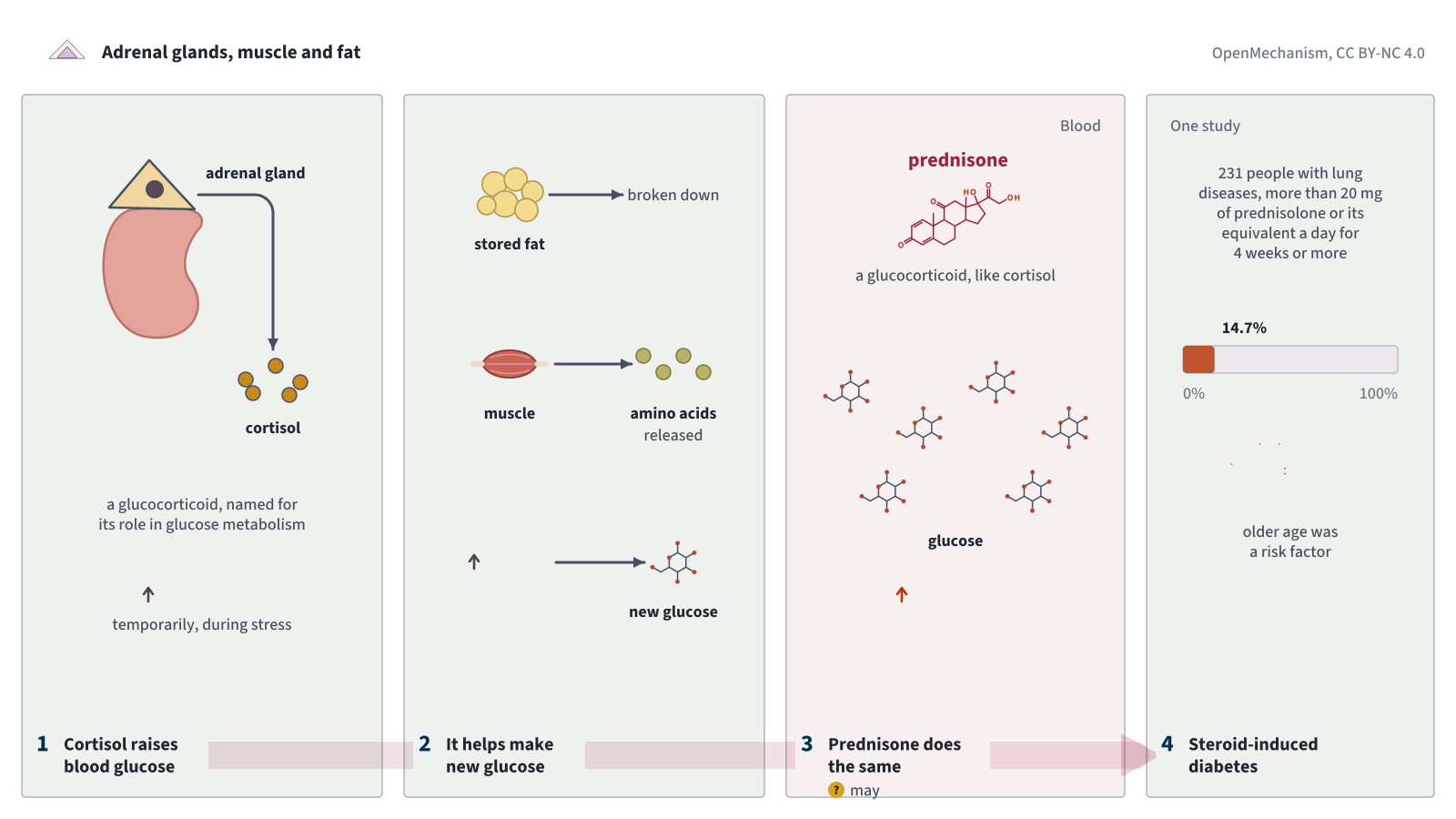
Cortisol, the adrenal glands' glucocorticoid, temporarily raises blood glucose during stress. It also helps to break down stored fat, release amino acids from muscle and boost the enzymes that make new glucose. Prednisone is a glucocorticoid too, and corticosteroids may raise blood glucose; in one study of people with lung diseases who took more than 20 mg of prednisolone (or an equivalent dose) a day for at least 4 weeks, 14.7% developed steroid-induced diabetes.
Clinical study: In Kim and colleagues' 2011 retrospective study of 231 people with lung diseases given more than 20 mg of prednisolone (or an equivalent dose of another glucocorticoid) a day for at least 4 weeks, 34 developed steroid-induced diabetes; the authors conclude: S-DM is frequent among patients with respiratory diseases treated with glucocorticoid.Kim SY et al., J Korean Med Sci 2011 (PMID 21286019)
Cortisol raises blood glucose. The adrenal cortex makes glucocorticoids, named for their role in glucose metabolism; the most important is cortisol, which temporarily raises blood glucose during stress.1,2,3,4
What the source says
“A hormone made by the adrenal cortex (the outer layer of the adrenal gland).”
“Despite having been initially named based on their role in glucose metabolism, glucocorticoids are also fundamental in the regulation of developmental, metabolic, and neurobiological processes, as well as several other biological functions.”
“Overall, the major glucocorticoid effect on glucose homeostasis is to preserve plasma glucose for brain during stress, as transiently raising blood glucose is important to promote maximal brain function.”
It helps make new glucose. Cortisol helps to break down stored fat, release amino acids from muscle and boost the enzymes that make new glucose.5
What the source says
“Cortisol helps to stimulate lipolysis, inhibit protein synthesis, facilitate amino acid mobilization from muscle, induce the enzymes of gluconeogenesis, enhance secretion of glucagon, inhibit insulin secretion, and stimulate conversion of lactic acid to glycogen.”
Steroid-induced diabetes. In a study of 231 people with lung diseases who took more than 20 mg of prednisolone (or an equivalent dose of another glucocorticoid) a day for at least 4 weeks, 34 (14.7%) developed steroid-induced diabetes; older age was a risk factor.7
What the source says
“A retrospective study examined patients with respiratory diseases treated with a prednisolone-equivalent glucocorticoid dose exceeding 20 mg/day for at least 4 weeks”
The study looked back at records from one group of patients with lung diseases, excluding people who already had diabetes or a first random glucose above 200 mg/dL; it counted steroid-induced diabetes as a fasting glucose above 126 mg/dL or a random glucose above 200 mg/dL at least twice after steroids began. The patients' median time on steroids was 193 days.7
text 13e442d38434…; drawings 8cc6954ee335…; notes bb45ba912261…
AI source check
Claude Opus 5.5 (AI source check), 30 October 2026: 60 statements compared with their sources, 12 flagged for the reviewer. An automated check, not a medical review.
text 6286ae6a7581…; drawings c42685f8d226…; notes bb45ba912261…
AI source check
The file of this review’s AI source check was later saved over by the check for the review of 13 November 2026, so its own date and counts are not shown. An automated check, not a medical review.
Next review due
30 April 2028
Cite this page
Tran D. Why steroid medicines can raise blood sugar [Internet]. OpenMechanism; 2026 [updated 2026 Nov 13; cited 2026 Nov 13]. Available from: https://openmechanism.com/explained/steroids-and-high-blood-sugar