Medically reviewed by Daniel Tran, PharmD, on 12 November 2026.
Why steroid medicines can weaken bones
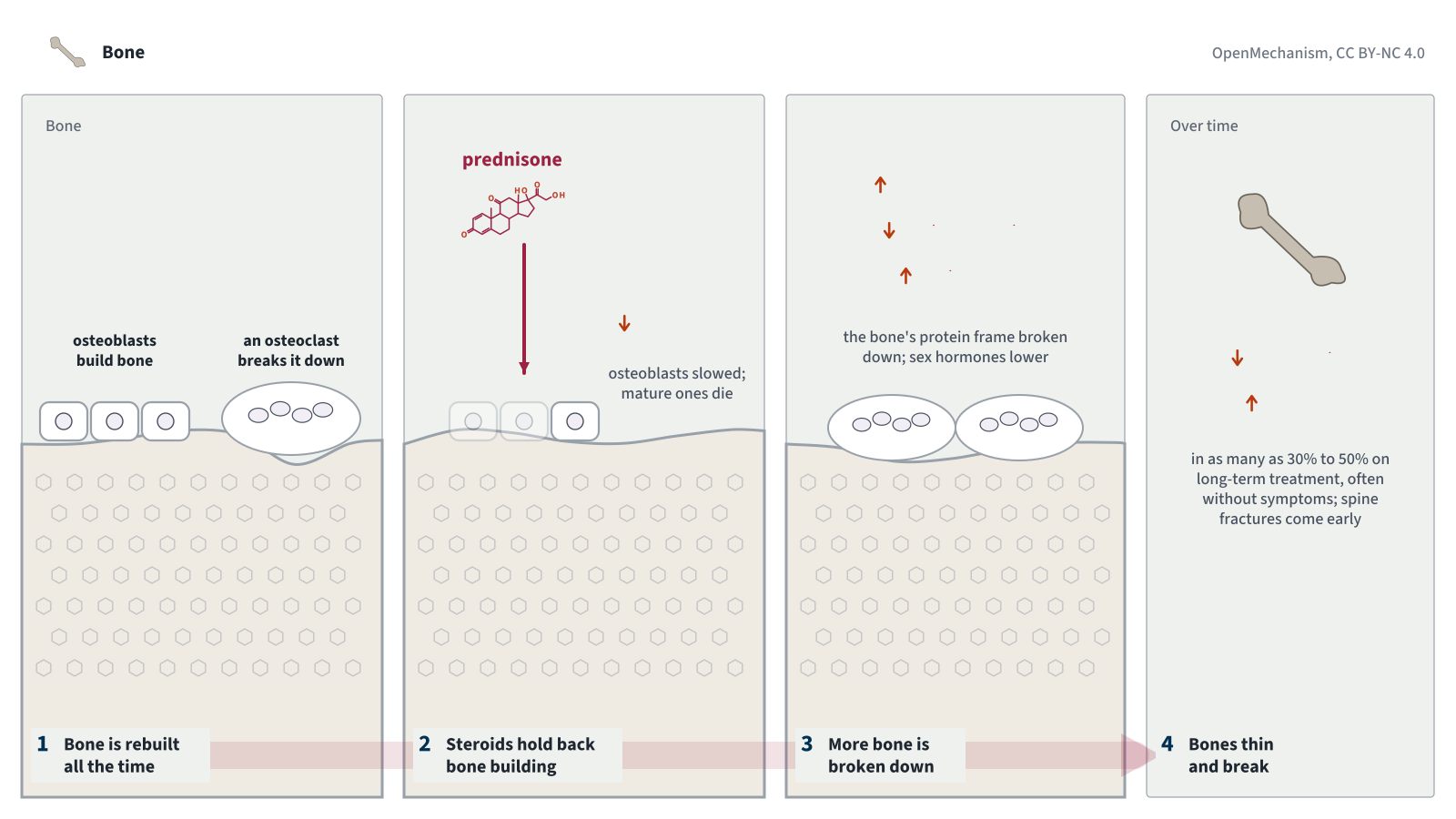
Bone is rebuilt all the time: osteoblasts form new bone and osteoclasts break old bone down. Steroid medicines such as prednisone hold back the osteoblasts, even killing mature ones, and favor the osteoclasts; they also lower the calcium taken in from food, raise the calcium the body loses, break down the bone's protein framework and lower the sex hormones. Bone density falls fast at first, and fractures, often without symptoms, may occur in as many as 30% to 50% of people on long-term treatment.
- Kind
- Side effect
- Medicines
- Prednisone
- Sources
- 4
For teachers: download this drawing.
Step by step
Bone is rebuilt all the time. Osteoblasts form new bone and osteoclasts break old bone down, all the time, replacing old and damaged bone; an imbalance between them leads to bone disease.1
What the source says
“The bone remodelling cycle replaces old and damaged bone and is a highly regulated, lifelong process”
Source 1“During the bone remodelling cycle, osteoclastic resorption is tightly coupled to osteoblastic bone formation.”
Source 1“any resulting imbalance between bone resorption and formation leads to metabolic bone disease”
Source 1Steroids hold back bone building. Steroid medicines such as prednisone slow the multiplying, maturing and work of osteoblasts and make mature osteoblasts and osteocytes die, so less new bone is formed.2,3
What the source says
“Glucocorticoids impair the replication, differentiation and function of osteoblasts and induce the apoptosis of mature osteoblasts and osteocytes. These effects lead to a suppression of bone formation, a central feature in the pathogenesis of GIO.”
Source 2“Corticosteroids decrease bone formation and increase bone resorption both through their effect on calcium regulation (i.e., decreasing absorption and increasing excretion) and inhibition of osteoblast function.”
Source 3More bone is broken down. They also favor the making of osteoclasts, so more bone is broken down; the body takes in less calcium and loses more; and the bone's protein framework is broken down and sex hormones fall.2,3
What the source says
“Glucocorticoids also favor osteoclastogenesis and as a consequence increase bone resorption.”
Source 2“both through their effect on calcium regulation (i.e., decreasing absorption and increasing excretion)”
Source 3“All corticosteroids increase calcium excretion.”
Source 3“This, together with a decrease in the protein matrix of the bone secondary to an increase in protein catabolism, and reduced sex hormone production, may lead to inhibition of bone growth in pediatric patients and the development of osteoporosis at any age.”
Source 3Bones thin and break. Bone density falls fast early in treatment, when spine fractures already occur. Fractures, often without symptoms, can occur in as many as 30% to 50% of people on long-term treatment; bone loss from steroid medicines is the most common kind of osteoporosis with an outside cause.2
What the source says
“Vertebral fractures occur early after exposure to glucocorticoids, at a time when bone mineral density (BMD) declines rapidly.”
Source 2“Fractures, which are often asymptomatic, may occur in as many as 30-50% of patients receiving chronic glucocorticoid therapy.”
Source 2“Glucocorticoid-induced osteoporosis (GIO) is the most common form of secondary osteoporosis.”
Source 2
See also
Medicine pages: prednisone.
Also used for it: alendronate (for glucocorticoid-induced osteoporosis: “FOSAMAX is indicated for the treatment of glucocorticoid-induced osteoporosis in men and women receiving glucocorticoids in a daily dosage equivalent to 7.5 mg or greater of prednisone and who have low bone mineral density”4).
Other side effects (hormones & metabolism): why GLP-1 medicines slow the stomach; why insulin and albuterol can lower potassium; why metformin can cause lactic acidosis; why SGLT2 inhibitors can cause genital yeast infections; why steroid medicines can raise blood sugar; why steroid medicines can suppress the adrenal glands; why sulfonylureas can cause low blood sugar; and all 65 side effects.
Conditions: osteoporosis and rheumatoid arthritis.
Sources
- 1The bone remodelling cycleKenkre JS, Bassett JHD. Ann Clin Biochem 2018 (abstract). Saved copy
- 2Glucocorticoid-induced osteoporosis: pathophysiology and therapyCanalis E et al. Osteoporos Int 2007 (abstract). Saved copy
- 3Prednisone tablets: FDA labelWarnings; Precautions (Musculoskeletal). Saved copy
- 4Fosamax (alendronate sodium): FDA label1.4 Treatment of Glucocorticoid-Induced Osteoporosis. Saved copy
Notes and limits
- The label's advice on the lowest dose, supplements, exercise and bone medicines is left out: this page explains the mechanism, not what to do.
- Fractures tend to happen at a higher bone density than in osteoporosis after menopause, and after the early fast fall, bone density keeps falling more slowly.2
- In children, the same effects can hold back bone growth.3
Notes that apply to every page are on How to read a page.
Spotted a mistake? Report an error (hello@openmechanism.com). Since launch, every published error we fix is listed on the corrections page.
Medical review
Earlier reviews (1)
Cite this page
Tran D. Why steroid medicines can weaken bones [Internet]. OpenMechanism; 2026 [updated 2026 Nov 12; cited 2026 Nov 12]. Available from: https://openmechanism.com/explained/steroids-and-bone-loss