Gout
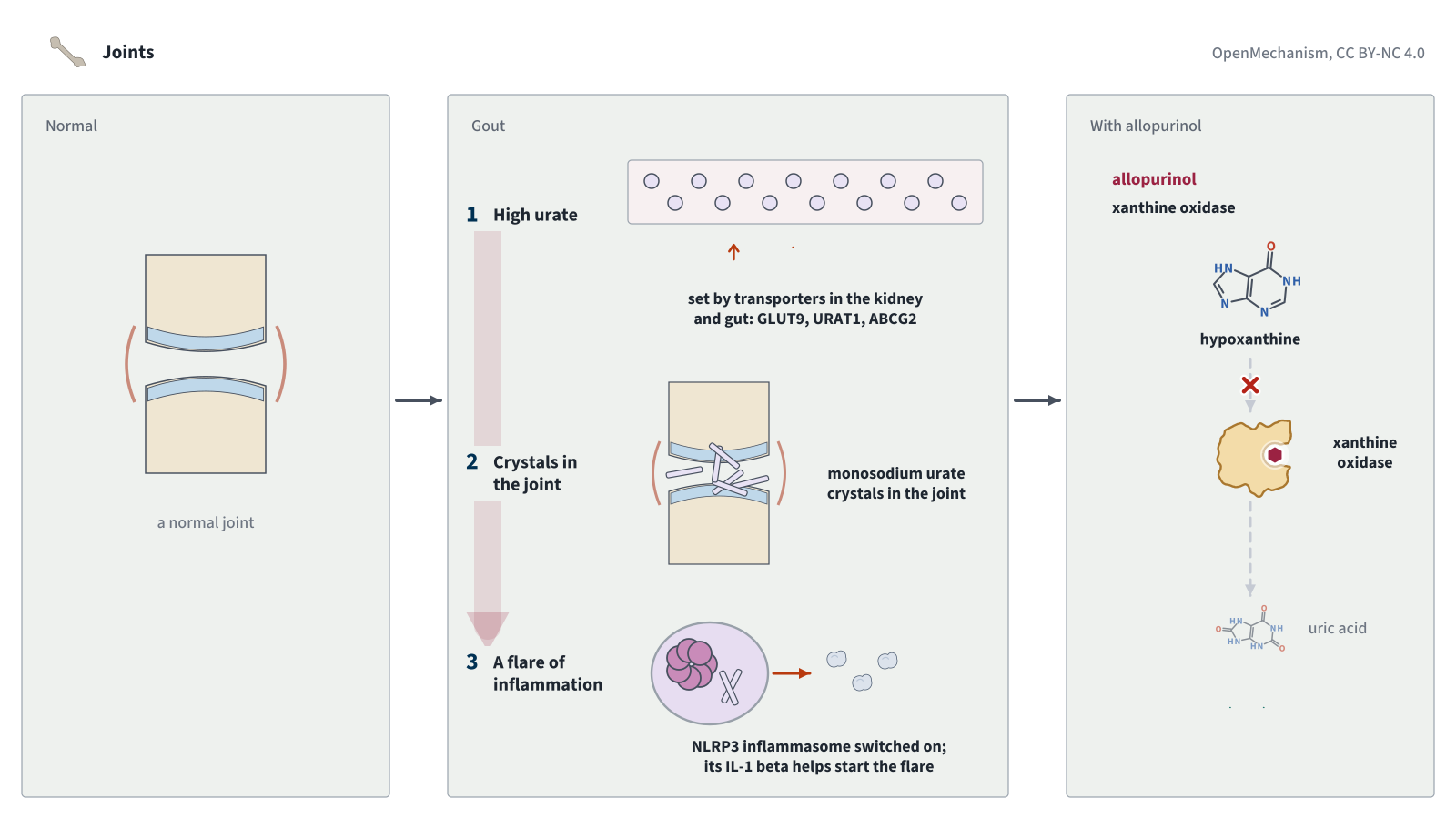
Gout is caused by crystals of monosodium urate building up in and around joints. High blood urate is the biggest risk; urate levels are set by transporters in the kidney and gut. The crystals switch on the NLRP3 inflammasome and the release of IL-1 beta, which helps start a flare. Allopurinol blocks xanthine oxidase, the enzyme that makes uric acid.
- Where
- Joints
- Body system
- Muscles, bones & joints
- Medicines
- 1 medicine
For teachers: download this drawing.
Key terms in this drawing (5)
- ABCG2
- ABCG2 transporter. A urate transporter in the kidney and gut; with GLUT9 and URAT1 it helps set the urate level in the blood.
- GLUT9
- Glucose transporter 9 (SLC2A9). A urate transporter in the kidney and gut; with URAT1 and ABCG2 it helps set the urate level in the blood.
- IL-1
- Interleukin-1. A signaling molecule (cytokine) that drives inflammation.
- NLRP3
- NLRP3 gene (cryopyrin). The gene for cryopyrin, which forms inflammasomes: protein complexes inside cells that release IL-1β.
- URAT1
- Urate transporter 1 (SLC22A12). A urate transporter in the kidney and gut; with GLUT9 and ABCG2 it helps set the urate level in the blood.
What goes wrong
High urate. High urate in the blood is the most important risk; urate levels are set by transporters in the kidney and gut, such as , and .1
Crystals in the joint. Gout is caused by monosodium urate crystals deposited in joints and other tissues.1
What the source says
“Gout is a common and treatable disease caused by the deposition of monosodium urate crystals in articular and non-articular structures.”
Source 1A flare of inflammation. The crystals switch on the inflammasome, and the beta it releases helps start the flare.1
What the source says
“Activation of the NLRP3 inflammasome by monosodium urate crystals with release of IL-1β plays a major role in the initiation of the gout flare”
Source 1
Where medicines act
- A
Allopurinol: less uric acid made
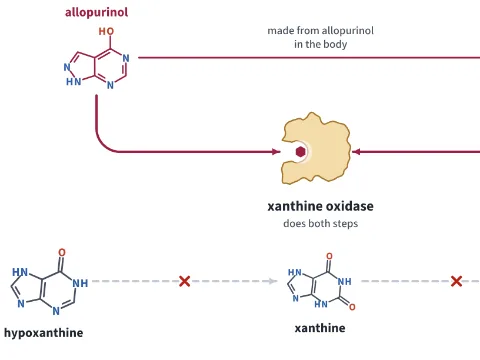
Allopurinol blocks xanthine oxidase, the enzyme that turns hypoxanthine into xanthine and xanthine into uric acid, so less uric acid is made. It is used for gout.2
What the source says
“It reduces the production of uric acid by inhibiting the biochemical reactions immediately preceding its formation.”
Source 2“It is an inhibitor of xanthine oxidase, the enzyme responsible for the conversion of hypoxanthine to xanthine and of xanthine to uric acid”
Source 2“The management of adults with signs and symptoms of primary or secondary gout (acute attacks, tophi, joint destruction, uric acid lithiasis, and/or nephropathy)”
Source 2
See also
Body system: muscles, bones & joints.
Zoom in: urate crystals in a joint.
Also used for it: methylprednisolone (“As adjunctive therapy for short-term administration (to tide the patient over an acute episode or exacerbation) in acute gouty arthritis”3); hydrocortisone (“As adjunctive therapy for short-term administration (to tide the patient over an acute episode or exacerbation) in acute gouty arthritis”4); dexamethasone (“As adjunctive therapy for short-term administration (to tide the patient over an acute episode or exacerbation) in: … Acute gouty arthritis”5); colchicine (“MITIGARE (colchicine) capsules are indicated for prophylaxis of gout flares in adults.”6); febuxostat (“ULORIC is a xanthine oxidase (XO) inhibitor indicated for the chronic management of hyperuricemia in adult patients with gout who have an inadequate response to a maximally titrated dose of allopurinol, who are intolerant to allopurinol, or for whom treatment with allopurinol is not advisable.”7); and probenecid (for the high uric acid of gout: “Probenecid tablets are indicated for the treatment of the hyperuricemia associated with gout and gouty arthritis.”8).
Related medicines: rasburicase, naproxen and prednisone.
Other conditions: ankylosing spondylitis, juvenile idiopathic arthritis, rheumatoid arthritis, psoriatic arthritis, adrenal insufficiency and asthma.
Interactions: allopurinol and mercaptopurine; colchicine with clarithromycin; and probenecid and penicillin.
The medicine in the body: allopurinol and the HLA-B*58:01 variant.
Sources
- 1GoutDalbeth N et al. Lancet 2021 (abstract). Saved copy
- 2Allopurinol tablets: FDA label1 Indications and Usage; 12.1 Mechanism of Action. Saved copy
- 3Solu-Medrol (methylprednisolone sodium succinate): FDA labelIndications and Usage. Saved copy
- 4Solu-Cortef (hydrocortisone sodium succinate): FDA labelIndications and Usage. Saved copy
- 5Dexamethasone sodium phosphate injection: FDA labelIndications and Usage. Saved copy
- 6Mitigare (colchicine) capsules: FDA label1 Indications and Usage. Saved copy
- 7Uloric (febuxostat): FDA label1 Indications and Usage. Saved copy
- 8Probenecid tablets (REMEDYREPACK): FDA labelIndications and Usage. Saved copy
- 9Bovine milk xanthine dehydrogenase with oxipurinol boundPDB 3BDJ; Okamoto, K. et al. Nucleosides Nucleotides Nucleic Acids 2008;27:888-893. The xanthine oxidase outline in the drawing is traced from this structure. Saved copy
Notes and limits
- Although it comes in flares, gout is a long-lasting disease; lowering urate over the long term dissolves the crystals.1
Notes that apply to every page are on How to read a page.
Spotted a mistake? Report an error (hello@openmechanism.com). Since launch, every published error we fix is listed on the corrections page.
Cite this page
Tran D. Gout [Internet]. OpenMechanism; 2026 [updated 2026 Oct 20; cited 2026 Oct 20]. Available from: https://openmechanism.com/conditions/gout