Budesonide
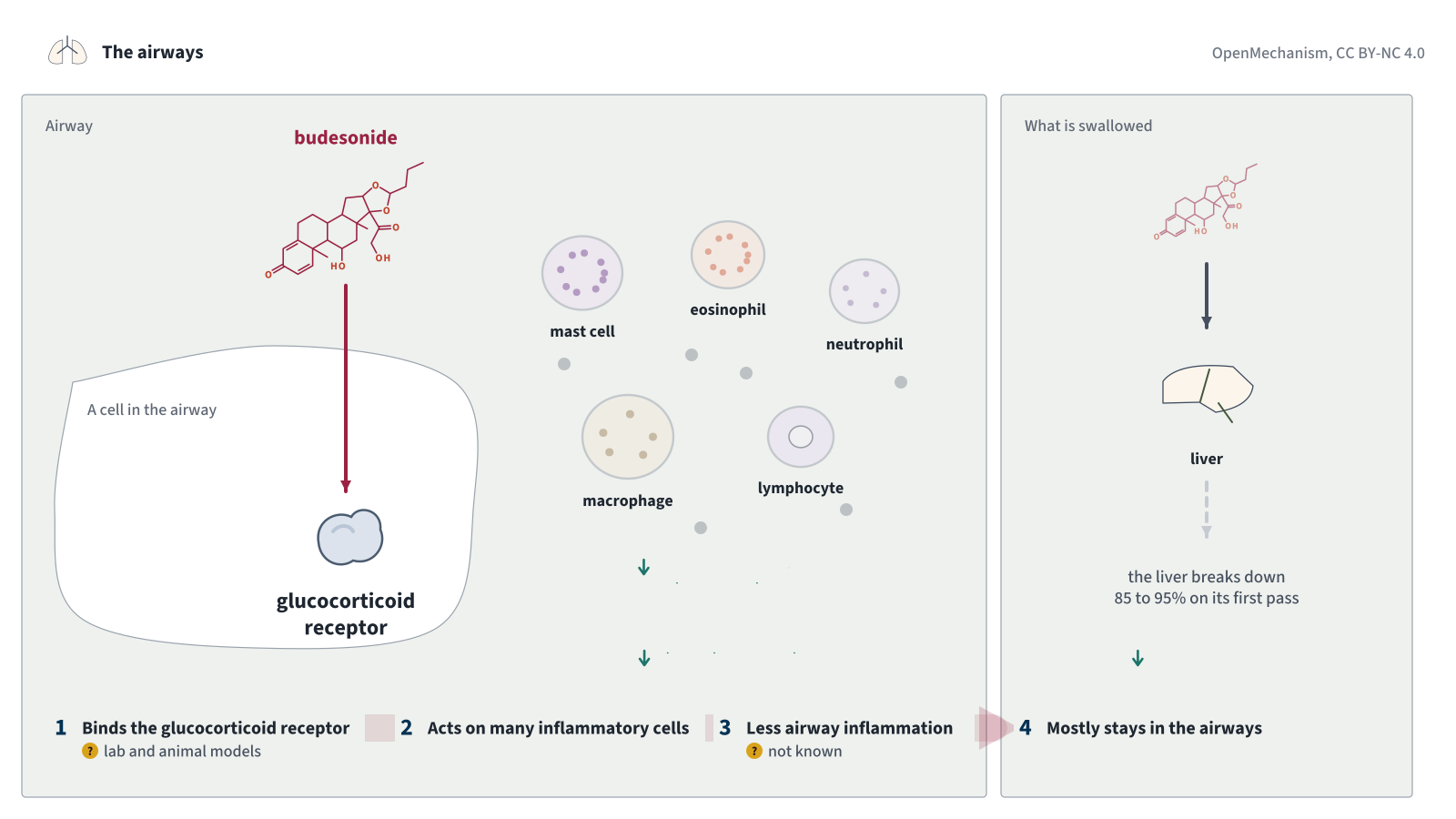
Budesonide is a corticosteroid that binds the glucocorticoid receptor about 200 times more strongly than cortisol. Corticosteroids hold back many of the cells and chemical messengers of inflammation, which may explain their effect in asthma, though the precise mechanism is not known. Inhaled, it acts mainly in the airways: the liver breaks down 85 to 95% of the swallowed medicine on its first pass.
- Acts on
- Glucocorticoid receptor
- Where
- The airways
- Medicine type
- Small molecule
- Used for
- Lungs & airways
- Drug class
- Corticosteroids
Also called Pulmicort Flexhaler.
Step 1: lab and animal models
The Pulmicort Flexhaler label says: In standard in vitro and animal models, budesonide has approximately a 200-fold higher affinity for the glucocorticoid receptor and a 1000-fold higher topical anti-inflammatory potency than cortisol (rat croton oil ear edema assay).
Source 1: Pulmicort Flexhaler (budesonide): FDA label, 12.1 Mechanism of Action
Clinical study: In a randomized, double-blind trial in 14 adults with newly diagnosed asthma, airway biopsies were taken after 3 months of inhaled budesonide or terbutaline, a beta-2 agonist; it measured inflammation in the airways, not binding to the receptor: inhaled budesonide improved lung function and bronchial hyperreactivity in adult subjects with asthma treated for 3 months and that this corticosteroid was more effective in ameliorating abnormalities of the bronchial epithelium and decreasing inflammation in the airways.
Laitinen LA et al., J Allergy Clin Immunol 1992 (PMID 1629507)
This study was picked with a literature search and is not yet checked by our reviewer.
Step 3: not known
The Pulmicort Flexhaler label says: The precise mechanism of corticosteroid actions on inflammation in asthma is not known. … These anti-inflammatory actions of corticosteroids may contribute to their efficacy in asthma.
Source 1: Pulmicort Flexhaler (budesonide): FDA label, 12.1 Mechanism of Action
Clinical study: In a 3-year randomized trial against placebo in 7241 people with recent mild persistent asthma; the trial measured severe asthma events, not how budesonide works: Long-term, once-daily treatment with low-dose budesonide decreases the risk of severe exacerbations and improves asthma control in patients with mild persistent asthma of recent onset.
Pauwels RA et al., Lancet 2003 (PMID 12672309)
This study was picked with a literature search and is not yet checked by our reviewer.
Key terms in this drawing
- mast cell
- Mast cell. An immune cell in tissues such as the skin and the airways that releases histamine and other signals.
How it works
Binds the glucocorticoid receptor. Budesonide is an anti-inflammatory corticosteroid with potent glucocorticoid activity and weak mineralocorticoid activity. In laboratory and animal models, it binds the glucocorticoid receptor about 200 times more strongly than cortisol.1
Acts on many inflammatory cells. Inflammation is an important part of asthma. Corticosteroids hold back many cell types (, eosinophils, neutrophils, macrophages and lymphocytes) and chemical messengers (histamine, eicosanoids, and ) involved in allergic and non-allergic inflammation.1
Less airway inflammation. These anti-inflammatory actions may contribute to its effect in asthma, but the precise way corticosteroids act on inflammation in asthma is not known.1
Mostly stays in the airways. In studies of people with asthma, inhaled budesonide had a favorable balance between its anti-inflammatory activity in the airways and its effects on the rest of the body, over a wide range of doses. The label explains this by a high local effect, extensive breakdown of the swallowed and absorbed medicine by the liver on its first pass (85 to 95%), and metabolites of low potency.1
For teachers: download this drawing.
See also
Condition pages: asthma.
Other corticosteroids: clobetasol, dexamethasone, fluticasone propionate, hydrocortisone, methylprednisolone, prednisone and triamcinolone.
Body system: lungs & airways.
Sources
- 1Pulmicort Flexhaler (budesonide): FDA label12.1 Mechanism of Action
- 2ChEMBL CHEMBL1370Target and action classification: Glucocorticoid receptor agonist
- 3A comparative study of the effects of an inhaled corticosteroid, budesonide, and a beta 2-agonist, terbutaline, on airway inflammation in newly diagnosed asthma: a randomized, double-blind, parallel-group controlled trialLaitinen LA et al. J Allergy Clin Immunol 1992 (abstract)
- 4Early intervention with budesonide in mild persistent asthma: a randomised, double-blind trialPauwels RA et al. Lancet 2003 (abstract)
Spotted a mistake? Report an error (hello@openmechanism.com). Since launch, every published error we fix is listed on the corrections page.
Notes and limits
- A schematic teaching drawing: not to scale, not exact structures, binding poses or a complete pathway, and not a guide to dosing, treatment or how a person will respond.
- The label says the precise mechanism of corticosteroid actions on inflammation in asthma is not known.
All recorded limits are on the evidence page, and notes that apply to every page are on How to read a page. Version 1.0.0, not yet medically reviewed.
Cite this page
Tran D. Budesonide [Internet]. OpenMechanism; 2026 [updated 2026 Oct 14; cited 2026 Oct 14]. Available from: https://openmechanism.com/medicines/budesonide