Osteoarthritis
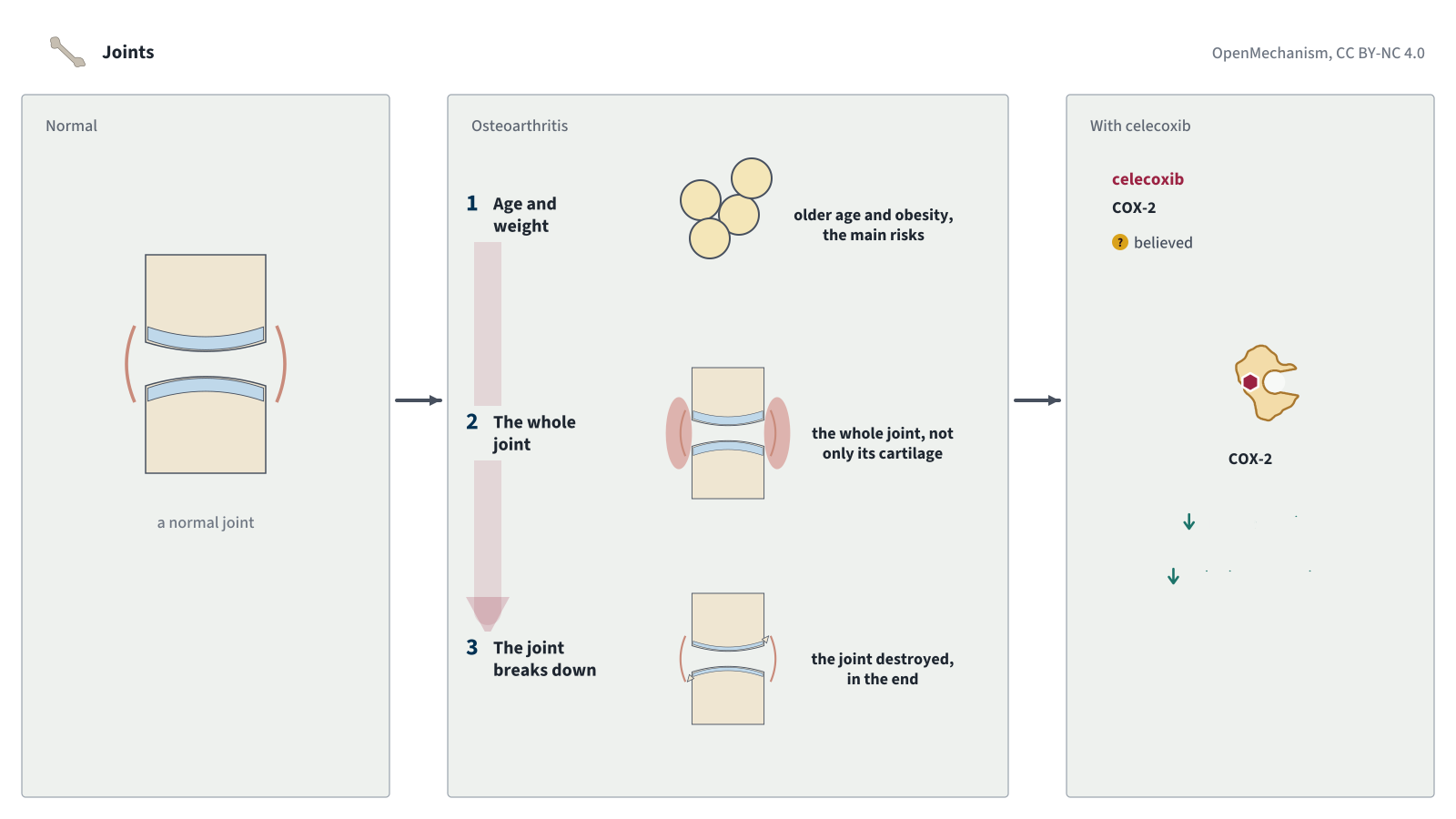
Osteoarthritis is the most common joint disorder; age and obesity are its main risk factors. Once seen as a disease of cartilage alone, it is now understood to affect the whole joint, ending in its destruction. Celecoxib relieves pain and inflammation, thought to be by blocking prostaglandin making, mainly through COX-2; no approved medicine yet slows the disease itself.
- Where
- Joints
- Body system
- Muscles, bones & joints
- Medicines
- 1 medicine
Believed
The Celebrex (celecoxib) label says: The mechanism of action of CELEBREX is believed to be due to inhibition of prostaglandin synthesis, primarily via inhibition of COX-2.
Source 2: Celebrex (celecoxib): FDA label, 1 Indications and Usage; 12.1 Mechanism of Action
Clinical study: In a 12-week randomized, double-blind trial of celecoxib, naproxen or placebo in 1003 people with osteoarthritis of the knee; the trial measured signs and symptoms, not how celecoxib works: Celecoxib treatment led to significant improvement in the signs and symptoms of osteoarthritis as determined by all efficacy measures.
Bensen WG et al., Mayo Clin Proc 1999 (PMID 10560596)
This study was picked with a literature search and is not yet checked by our reviewer.
For teachers: download this drawing.
Key terms in this drawing
- COX-2
- Cyclooxygenase-2. An enzyme that makes prostaglandins.
What goes wrong
Age and weight. Primary osteoarthritis comes from several risk factors, the main ones being older age and obesity.1
What the source says
“Primary OA results from a combination of risk factors, with increasing age and obesity being the most prominent.”
Source 1The whole joint. Once seen as a disease of cartilage alone, it is now understood to affect the whole joint.1
What the source says
“The concept of the pathophysiology is still evolving, from being viewed as cartilage-limited to a multifactorial disease that affects the whole joint.”
Source 1The joint breaks down. Local and body-wide factors interact and lead, in the end, to destruction of the joint.1
What the source says
“An intricate relationship between local and systemic factors modulates its clinical and structural presentations, leading to a common final pathway of joint destruction.”
Source 1
Where medicines act
- A
Celecoxib: fewer prostaglandins
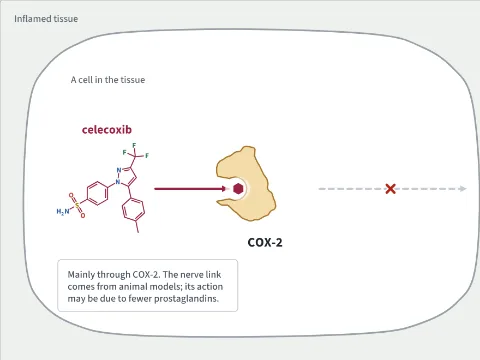
Celecoxib relieves pain and inflammation, thought to be by blocking prostaglandin making, mainly through . It treats the signs and symptoms of osteoarthritis.2
What the source says
“Celecoxib has analgesic, anti-inflammatory, and antipyretic properties.”
Source 2“The mechanism of action of CELEBREX is believed to be due to inhibition of prostaglandin synthesis, primarily via inhibition of COX-2.”
Source 2“For the management of the signs and symptoms of OA”
Source 2
See also
Body system: muscles, bones & joints.
Also used for it: dexamethasone (“As adjunctive therapy for short-term administration (to tide the patient over an acute episode or exacerbation) in: … Post-traumatic osteoarthritis Synovitis of osteoarthritis”3).
Related medicines: meloxicam, diclofenac, naproxen and prednisone.
Other conditions: rheumatoid arthritis, ankylosing spondylitis, juvenile idiopathic arthritis, gout, psoriatic arthritis and acute lymphoblastic leukemia.
Sources
- 1OsteoarthritisMartel-Pelletier J et al. Nat Rev Dis Primers 2016 (abstract). Saved copy
- 2Celebrex (celecoxib): FDA label1 Indications and Usage; 12.1 Mechanism of Action. Saved copy
- 3Dexamethasone sodium phosphate injection: FDA labelIndications and Usage. Saved copy
- 4Treatment of osteoarthritis with celecoxib, a cyclooxygenase-2 inhibitor: a randomized controlled trialBensen WG et al. Mayo Clin Proc 1999 (abstract). Saved copy
- 5Human cyclooxygenase-2 (COX-2) with mefenamic acidPDB 5IKR; Orlando, B.J., Malkowski, M.G. J.Biol.Chem. 2016;291:15069-15081. The COX-2 outline in the drawing is traced from this structure. Saved copy
Notes and limits
- Medicines mainly relieve symptoms; none approved yet slows or stops the disease.1
- How osteoarthritis develops is still being worked out.1
Notes that apply to every page are on How to read a page.
Spotted a mistake? Report an error (hello@openmechanism.com). Since launch, every published error we fix is listed on the corrections page.
Cite this page
Tran D. Osteoarthritis [Internet]. OpenMechanism; 2026 [updated 2026 Oct 16; cited 2026 Oct 16]. Available from: https://openmechanism.com/conditions/osteoarthritis