Fluticasone propionate
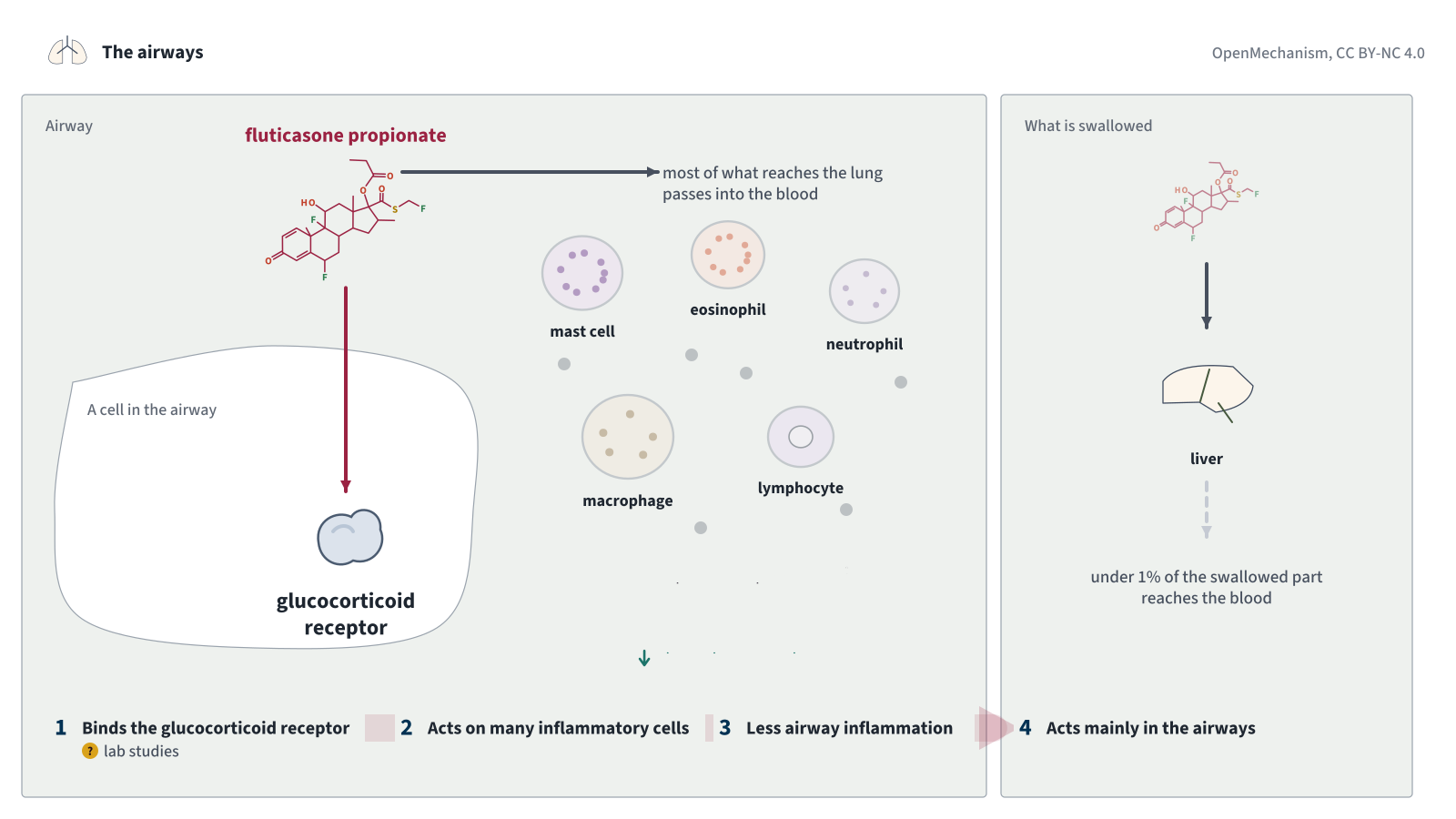
Fluticasone propionate is a corticosteroid that, in laboratory studies, binds the glucocorticoid receptor. Corticosteroids act on many of the cells and chemical messengers of inflammation, which is an important part of asthma; the full benefit may take 1 to 2 weeks or longer. Inhaled, it acts mainly in the airways. Under 1% of the part that is swallowed reaches the blood, but most of the medicine that reaches the lungs is absorbed into the blood. Its label lists the inhaled aerosol for maintenance treatment of asthma, to prevent symptoms, in people aged 4 and older, and says it is not for relieving sudden airway narrowing (acute bronchospasm).
- Acts on
- Glucocorticoid receptor
- Where
- The airways
- Medicine type
- Small molecule
- Used for
- Lungs & airways
- Drug class
- Corticosteroids
Step 1: lab studies
The fluticasone propionate inhalation aerosol label says: Fluticasone propionate has been shown in vitro to exhibit a binding affinity for the human glucocorticoid receptor that is 18 times that of dexamethasone, almost twice that of beclomethasone-17-monopropionate (BMP), the active metabolite of beclomethasone dipropionate, and over 3 times that of budesonide. Data from the McKenzie vasoconstrictor assay in man are consistent with these results. The clinical significance of these findings is unknown.
Clinical study: In Olivieri and colleagues' 1997 double-blind trial, 20 nonsmoking people with mild asthma took inhaled fluticasone propionate (FP, 250 micrograms twice daily) or placebo for 6 weeks, and 17 finished (9 on FP); airway biopsies taken before and after were compared between the groups; it measured inflammation in the airways, not binding to the receptor: In conclusion, our results show that short-term treatment with low-dose FP reduces inflammatory cell infiltration into the lamina propria in bronchial biopsy specimens.
Olivieri D et al., Am J Respir Crit Care Med 1997 (PMID 9196087)
Key terms in this drawing
- mast cell
- Mast cell. An immune cell in tissues such as the skin and the airways that releases histamine and other signals.
How it works
Binds the glucocorticoid receptor. Fluticasone propionate is a synthetic corticosteroid with anti-inflammatory activity. In laboratory studies it binds the human glucocorticoid receptor.1
Acts on many inflammatory cells. Inflammation is an important part of asthma. Corticosteroids act in many ways on many kinds of cells (such as , eosinophils, neutrophils, macrophages and lymphocytes) and chemical messengers (such as histamine, eicosanoids, and ) involved in inflammation.1
Less airway inflammation. These anti-inflammatory actions contribute to its effect in asthma. Corticosteroids do not ease asthma symptoms right away: the full benefit may take 1 to 2 weeks or longer.1
Acts mainly in the airways. In asthma trials at recommended doses, inhaled fluticasone propionate had a favorable balance between its anti-inflammatory activity in the airways and its effects on the rest of the body. Most of the medicine that reaches the lung passes into the blood. The label explains the favorable balance by a relatively high local effect, a negligible share of the swallowed medicine reaching the blood (under 1%), and the minimal activity of the only metabolite found in people.1
For teachers: download this drawing.
See also
Condition pages: asthma.
Other corticosteroids: budesonide, clobetasol, dexamethasone, hydrocortisone, methylprednisolone, prednisone and triamcinolone.
Explained: why inhaled steroids can cause thrush and why steroid medicines can suppress the adrenal glands.
Body system: lungs & airways.
Sources
- 1Fluticasone propionate inhalation aerosol: FDA label1 Indications and Usage; 12.1 Mechanism of Action; 12.3 Pharmacokinetics
- 2ChEMBL CHEMBL1473Target and action classification: Glucocorticoid receptor agonist
- 3Effect of short-term treatment with low-dose inhaled fluticasone propionate on airway inflammation and remodeling in mild asthma: a placebo-controlled studyOlivieri D et al. Am J Respir Crit Care Med 1997 (abstract)
Spotted a mistake? Report an error (hello@openmechanism.com). Since launch, every published error we fix is listed on the corrections page.
Notes and limits
- A schematic teaching drawing: not to scale, not exact structures, binding poses or a complete pathway, and not a guide to dosing, treatment or how a person will respond.
- The steps are in the order that explains them; one step is said to cause the next only where the source says so.
- The label gives the under 1% for doses taken by mouth; it doesn't say whether, or how much of, an inhaled dose is swallowed.
All recorded limits are on the evidence page, and notes that apply to every page are on How to read a page. Version 1.0.1, medically reviewed by Daniel Tran, PharmD, on 13 November 2026.
Cite this page
Tran D. Fluticasone propionate [Internet]. OpenMechanism; 2026 [updated 2026 Nov 13; cited 2026 Nov 13]. Available from: https://openmechanism.com/medicines/fluticasone-propionate