Why steroid medicines can suppress the adrenal glands
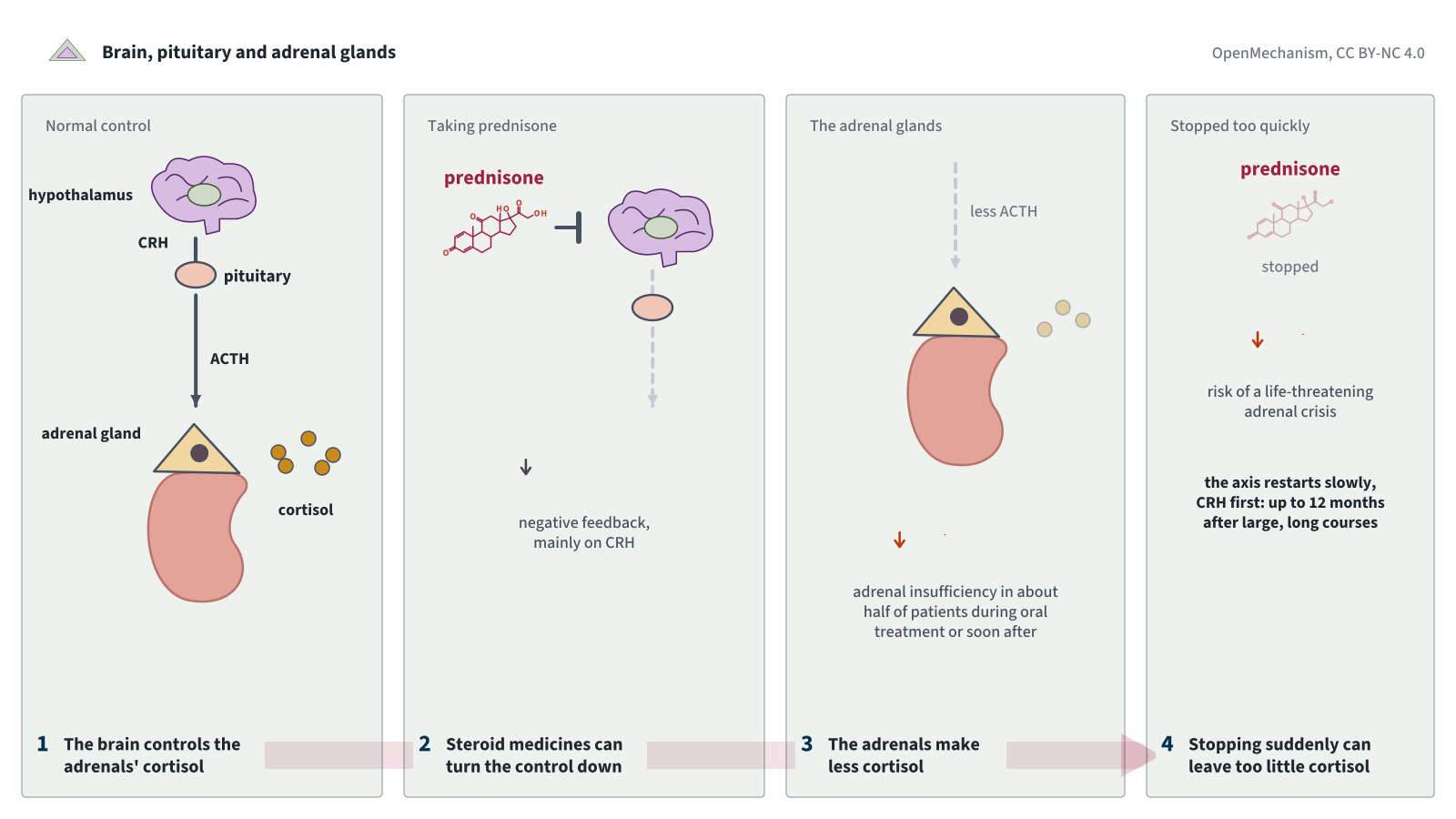
The hypothalamus and the pituitary control how much cortisol the adrenal glands make, through the hormones CRH and ACTH. Steroid medicines such as prednisone, taken for a long time, can turn this control down by negative feedback, so the adrenal glands make less cortisol of their own. If the medicine is stopped too quickly, the body can be left short of cortisol, and the control can take months to recover: up to 12 months after large doses taken for long periods.
The brain controls the adrenals' cortisol. In the hypothalamic-pituitary-adrenal (HPA) axis, the hypothalamus releases corticotropin-releasing hormone (CRH), which triggers the release of adrenocorticotropic hormone (ACTH) from the pituitary, and ACTH stimulates the outer layer of the adrenal glands (the adrenal cortex) to make cortisol.1,2,3
What the source says
“Corticotropin-releasing hormone (CRH) plays a central role in the regulation of the hypothalamic-pituitary-adrenal (HPA)-axis, i.e., the final common pathway in the stress response.”
Steroid medicines can turn the control down. Prednisone is a man-made relative of the body's own glucocorticoids, the most important of which is cortisol. Taken for a long time, steroid medicines like it can suppress the HPA axis through its negative feedback loop, which mainly involves CRH, the most important driver of ACTH release.1,2,4,5
What the source says
“The most important glucocorticoid in humans is cortisol”
“People who take glucocorticoid medicines, such as prednisone, for a long time and then stop are most likely to develop tertiary adrenal insufficiency.”
“Naturally occurring glucocorticoids (hydrocortisone and cortisone), which also have salt-retaining properties, are used as replacement therapy in adrenocortical deficiency states. Their synthetic analogs are primarily used for their potent anti-inflammatory effects in disorders of many organ systems.”
“Corticosteroids can produce reversible hypothalamic-pituitary adrenal (HPA) axis suppression with the potential for corticosteroid insufficiency after withdrawal of treatment.”
“This effect is mediated by the negative feedback loop on the hypothalamus-pituitary-adrenal (HPA) axis, which mainly involves corticotropin-release hormone (CRH), which represents the most important driver of adrenocorticotropic hormone (ACTH) release.”
The adrenals make less cortisol. With less ACTH to trigger them, the adrenal glands make less cortisol of their own. Adrenal insufficiency caused this way, by steroid medicines, is the most common kind: a 2022 review reports that, during oral steroid treatment or soon after stopping it, about half of patients have adrenal insufficiency, though what mild to moderate deficiency after stopping means clinically has not been established.2,6
What the source says
“Less CRH means less ACTH, which in turn causes the adrenal glands to stop making cortisol.”
“Glucocorticoid-induced adrenal insufficiency is caused by exogenous glucocorticoid suppression of the hypothalamic-pituitary-adrenal axis and is the most prevalent form of adrenal insufficiency.”
Stopping suddenly can leave too little cortisol. If the medicine is stopped or cut too quickly, or during an acute stress, the body can be left short of cortisol, with a risk of a life-threatening adrenal crisis. The HPA axis needs time to restart, CRH first: after large doses taken for long periods, the shortfall may last up to 12 months.4,5,6
What the source says
“Adrenocortical insufficiency may result from too rapid withdrawal of corticosteroids”
“patients on chronic GC therapy are at risk to develop tertiary adrenal insufficiency after the reduction or the withdrawal of corticosteroids or during acute stress”
Also used for it: hydrocortisone (“Naturally occurring glucocorticoids (hydrocortisone and cortisone), which also have salt-retaining properties, are used as replacement therapy in adrenocortical deficiency states.”4).
Can raise or cause it: fluticasone propionate (“Hypercorticism and adrenal suppression may occur with very high dosages or at the regular dosage in susceptible individuals.”7).
The labels' advice on lowering the dose slowly, on extra doses during illness or stress and on warning cards is left out: this page explains the mechanism, not what to do.
How much the HPA axis is held back depends on the medicine, how it is given, the total dose, how long it is taken and medicines that raise its levels, and it differs between people.5
Inhaled fluticasone often holds the HPA axis back less than equally effective doses of prednisone by mouth, though the label says this may be expected only when recommended doses are not exceeded. Yet people with asthma have died of adrenal insufficiency while or after moving from steroids that act on the whole body to inhaled steroids, and the fluticasone label says recovery takes a number of months after whole-body steroids are stopped.7
Stopping after a long course can also bring withdrawal symptoms, such as muscle and joint aches and feeling unwell.4
The sources name the shortfall differently: the prednisone label calls it secondary adrenocortical insufficiency, and Paragliola 2017 calls it tertiary adrenal insufficiency.4,5
Claude Opus 5.5 (AI source check), 30 October 2026: 43 statements compared with their sources, 10 flagged for the reviewer. An automated check, not a medical review.
Conflict of interest
Hydrocortisone: Pfizer, the reviewer's former employer, makes or markets this medicine. Details
The file of this review’s AI source check was later saved over by the check for the review of 12 November 2026, so its own date and counts are not shown. An automated check, not a medical review.
Conflict of interest
Hydrocortisone: Pfizer, the reviewer's former employer, makes or markets this medicine. Details
Next review due
30 April 2028
Cite this page
Tran D. Why steroid medicines can suppress the adrenal glands [Internet]. OpenMechanism; 2026 [updated 2026 Nov 12; cited 2026 Nov 12]. Available from: https://openmechanism.com/explained/steroids-and-adrenal-suppression