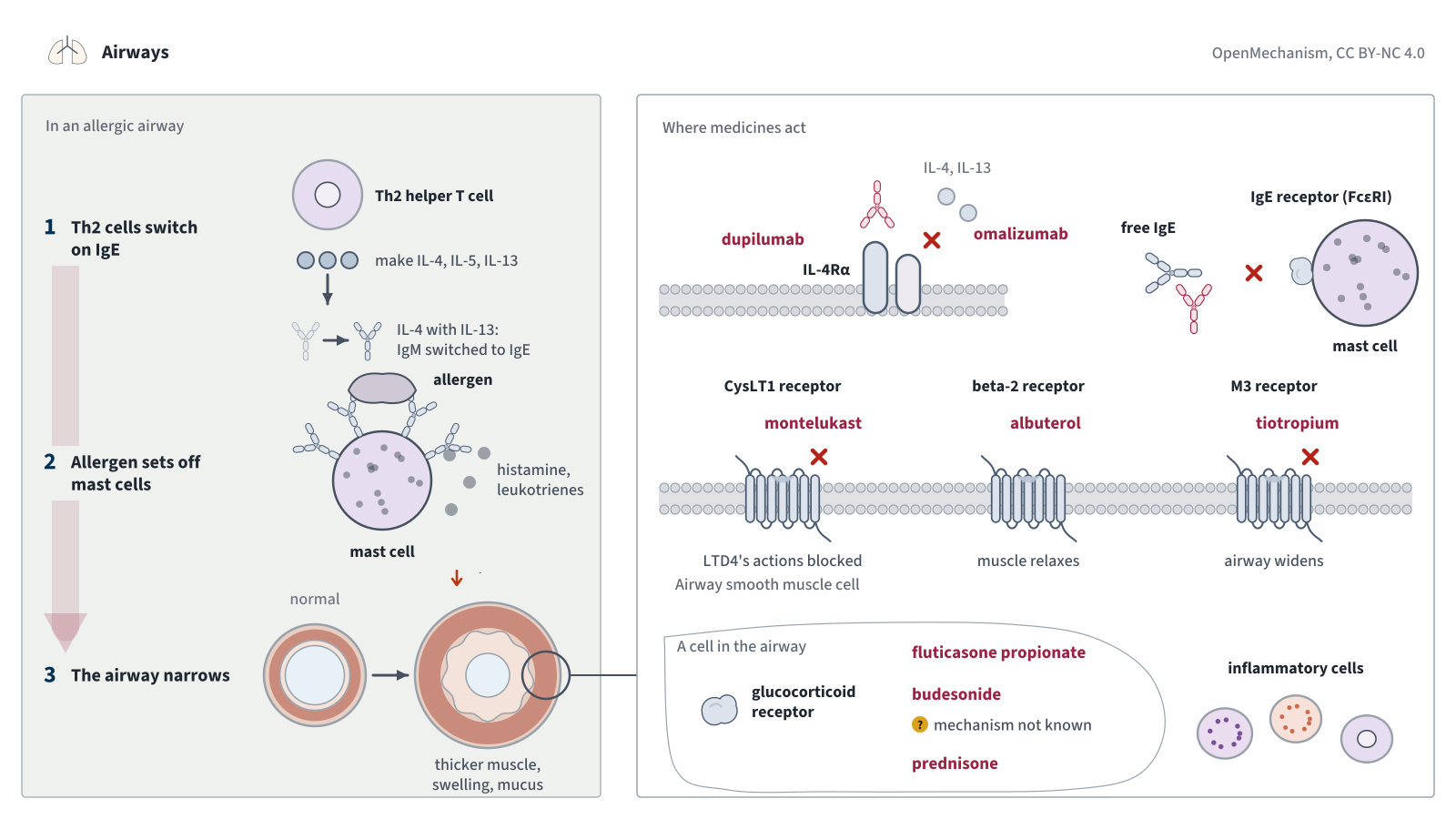
Asthma is a long-lasting inflammation of the airways, which over-react and narrow, usually reversibly. In allergic asthma, an allergen links IgE on mast cells, which release histamine and leukotrienes. Medicines act on IL-4 and IL-13 signals or on IgE, block a leukotriene receptor, relax and widen the airways, or calm the inflammation (corticosteroids).
What goes wrong in asthma, and where medicines act. Schematic, not to scale. License CC BY-NC 4.0.
?Mechanism not known
The Pulmicort Flexhaler (budesonide) label says: The precise mechanism of corticosteroid actions on inflammation in asthma is not known. … These anti-inflammatory actions of corticosteroids may contribute to their efficacy in asthma.
Clinical study: In Laitinen and colleagues' 1992 randomized, double-blind trial, 14 adults with newly diagnosed asthma inhaled budesonide 600 micrograms (7 people) or terbutaline, a beta-2 agonist, 375 micrograms (7 people) twice daily; airway biopsies taken before and after 3 months showed fewer inflammatory cells after budesonide, a change not seen with terbutaline: inhaled budesonide improved lung function and bronchial hyperreactivity in adult subjects with asthma treated for 3 months and that this corticosteroid was more effective in ameliorating abnormalities of the bronchial epithelium and decreasing inflammation in the airways.Laitinen LA et al., J Allergy Clin Immunol 1992 (PMID 1629507)
Cysteinyl leukotriene type 1 receptor. A receptor for cysteinyl leukotrienes, found in the airways (including on smooth muscle cells and macrophages); montelukast blocks it.
FcεRI
High-affinity IgE receptor (Fc-epsilon RI). The receptor on mast cells, basophils and dendritic cells that holds IgE.
IgE
Immunoglobulin E. A type of antibody involved in allergic reactions.
IgM
Immunoglobulin M. A type of antibody; IL-4 with IL-13 signals the switch from making IgM to making IgE.
IL-13
Interleukin-13. A cytokine made by Th2 cells; with IL-4 it signals the switch from IgM to IgE antibodies.
IL-4
Interleukin-4. A cytokine made by Th2 cells; with IL-13 it signals the switch from IgM to IgE antibodies.
IL-4Rα
Interleukin-4 receptor alpha subunit. The receptor part shared by the IL-4 and IL-13 receptors; dupilumab binds it and blocks both signals.
IL-5
Interleukin-5. A cytokine that Th2 cells make, along with IL-4 and IL-13; it recruits and activates eosinophils.
leukotrienes
Cysteinyl leukotrienes. Signal molecules released by cells such as mast cells and eosinophils; in asthma they swell the airways and tighten their muscle.
LTD4
Leukotriene D4. One of the cysteinyl leukotrienes: products of arachidonic acid that cells such as mast cells and eosinophils release.
What goes wrong
Th2 cells switch on IgE. helper make , and ; IL-4 with IL-13 signals the switch from to antibodies.1
What the source says
“the subclass 2 helper T-lymphocytes subset of activated T-lymphocytes produces interleukin (IL)-4, IL-5, and IL-13.”
Allergen sets off mast cells. When an allergen links two IgE molecules on a , the mast cell releases histamine, and other mediators that keep the airway inflamed.1
What the source says
“The cross-linkage of two IgE molecules by allergen causes mast cells to degranulate, releasing histamine, leukotrienes, and other mediators that perpetuate the airway inflammation.”
The airway narrows. Asthma is a long-lasting inflammation of the airways, which over-react and narrow, usually reversibly; the airway wall shows thicker muscle, swelling and extra mucus.1
What the source says
“Asthma is best described as a chronic disease that involves inflammation of the pulmonary airways and bronchial hyperresponsiveness that results in the clinical expression of a lower airway obstruction that usually is reversible.”
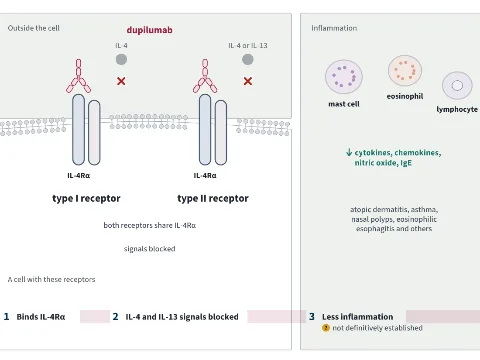
Binds , the receptor part IL-4 and IL-13 share, and blocks their signals; its label says exactly how it works has not been definitively established.2
Used forModerate-to-severe asthma: add-on maintenance, eosinophilic or dependent on oral corticosteroids, age 6 and older; not for relief of acute bronchospasm or status asthmaticus
What the label says
“Dupilumab is a human monoclonal IgG4 antibody that inhibits interleukin-4 (IL-4) and interleukin-13 (IL-13) signaling by specifically binding to the IL-4Rα subunit shared by the IL-4 and IL-13 receptor complexes.”
“DUPIXENT is indicated as an add-on maintenance treatment of adult and pediatric patients aged 6 years and older with moderate-to-severe asthma characterized by an eosinophilic phenotype or with oral corticosteroid dependent asthma.”
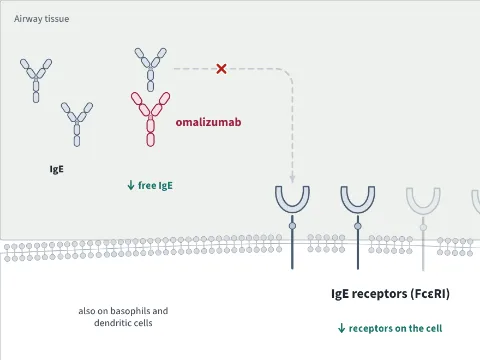
Binds IgE, so less IgE reaches its receptor () on mast cells and other cells, which then carry fewer receptors.3
Used forModerate to severe persistent asthma: age 6 and older, positive skin or lab test to a year-round airborne allergen, not adequately controlled by inhaled corticosteroids; not for relief of acute bronchospasm or status asthmaticus
What the label says
“Omalizumab is a recombinant DNA-derived humanized IgG1κ monoclonal antibody that selectively binds to human immunoglobulin E (IgE).”
“Omalizumab inhibits the binding of IgE to the high-affinity IgE receptor (FcεRI) on the surface of mast cells, basophils, and dendritic cells, resulting in FcεRI down-regulation on these cells.”
“Moderate to severe persistent asthma in adults and pediatric patients 6 years of age and older with a positive skin test or in vitro reactivity to a perennial aeroallergen and symptoms that are inadequately controlled with inhaled corticosteroids”
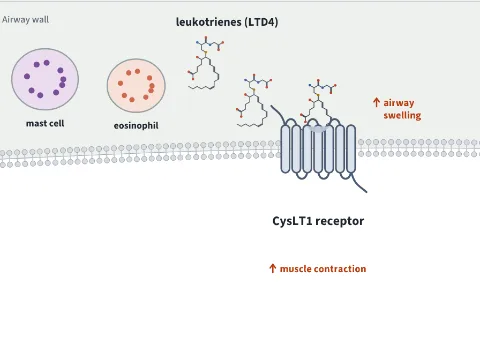
Binds the on airway muscle and other cells and blocks the actions of the leukotriene there.4
Used forAsthma: prevention and long-term treatment, from 12 months of age; not for an acute asthma attack
What the label says
“The CysLT type-1 (CysLT 1 ) receptor is found in the human airway (including airway smooth muscle cells and airway macrophages) and on other pro-inflammatory cells (including eosinophils and certain myeloid stem cells).”
“In asthma, leukotriene-mediated effects include airway edema, smooth muscle contraction, and altered cellular activity associated with the inflammatory process.”
“Montelukast is an orally active compound that binds with high affinity and selectivity to the CysLT 1 receptor (in preference to other pharmacologically important airway receptors, such as the prostanoid, cholinergic, or β-adrenergic receptor).”
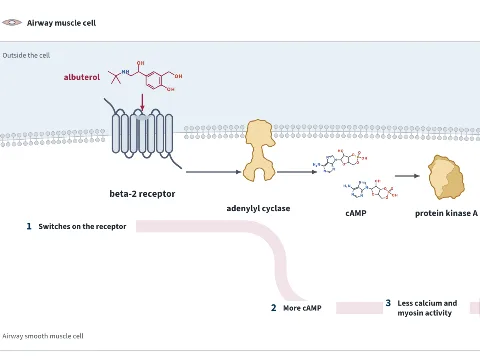
“Activation of beta 2 -adrenergic receptors on airway smooth muscle leads to the activation of adenyl cyclase and to an increase in the intracellular concentration of cyclic-3′,5′-adenosine monophosphate (cyclic AMP).”
“This increase of cyclic AMP leads to the activation of protein kinase A, which inhibits the phosphorylation of myosin and lowers intracellular ionic calcium concentrations, resulting in relaxation.”
“VENTOLIN HFA is indicated for the treatment or prevention of bronchospasm in adult and pediatric patients aged 4 years and older with reversible obstructive airway disease”
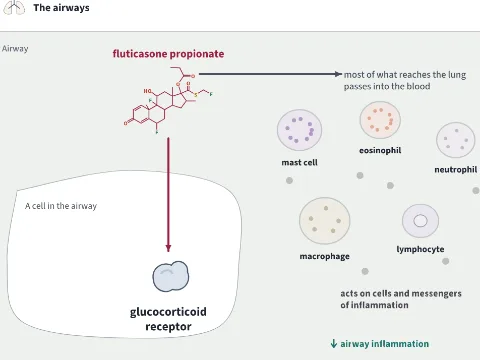
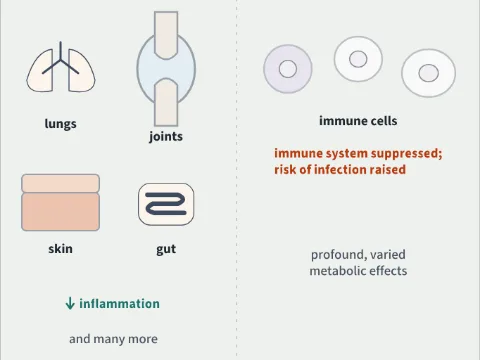
A corticosteroid that binds the glucocorticoid receptor (in laboratory studies); its anti-inflammatory actions on many cells contribute to its effect in asthma.7
Used forAsthma: maintenance treatment to prevent symptoms, age 4 and older; not for relief of acute bronchospasm
What the label says
“Fluticasone propionate is a synthetic trifluorinated corticosteroid with anti-inflammatory activity.”
“Corticosteroids have been shown to have a wide range of actions on multiple cell types (e.g., mast cells, eosinophils, neutrophils, macrophages, lymphocytes) and mediators (e.g., histamine, eicosanoids, leukotrienes, cytokines) involved in inflammation.”
“Fluticasone propionate inhalation aerosol is indicated for the maintenance treatment of asthma as prophylactic therapy in adult and pediatric patients aged 4 years and older.”
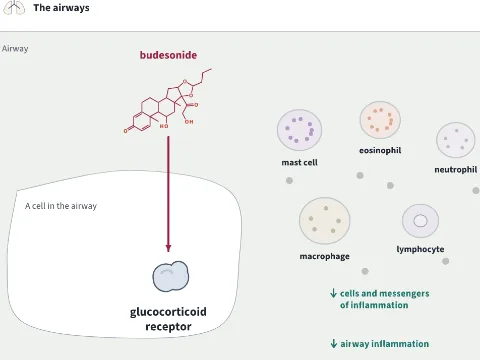
A corticosteroid that binds the glucocorticoid receptor (in laboratory and animal models); its label says the precise way corticosteroids act on inflammation in asthma is not known.8
Used forAsthma: maintenance treatment to prevent symptoms, age 6 and older; not for relief of acute bronchospasm
What the label says
“Budesonide is an anti-inflammatory corticosteroid that exhibits potent glucocorticoid activity and weak mineralocorticoid activity.”
“In standard in vitro and animal models, budesonide has approximately a 200-fold higher affinity for the glucocorticoid receptor and a 1000-fold higher topical anti-inflammatory potency than cortisol (rat croton oil ear edema assay).”
Prednisonetargets the glucocorticoid receptor (as prednisolone)
A glucocorticoid; the liver turns it into its active form, prednisolone, and glucocorticoids act mainly through the glucocorticoid receptor. It is used mainly for its potent anti-inflammatory effects, and it also changes the body's immune responses.9,10,11
Used forSevere or disabling bronchial asthma: not controlled by adequate trials of usual treatment
What the label says
“PredniSONE Tablets contain prednisone which is a glucocorticoid.”
Also used for it, by injection when oral therapy is not feasible: methylprednisolone (“Control of severe or incapacitating allergic conditions intractable to adequate trials of conventional treatment in asthma”12), hydrocortisone (“Control of severe or incapacitating allergic conditions intractable to adequate trials of conventional treatment in asthma”13) and dexamethasone (“Control of severe or incapacitating allergic conditions intractable to adequate trials of conventional treatment in: Bronchial asthma”14).
Allergens are not the only trigger: cold air, exercise, viral upper respiratory infections and cigarette smoke can also set off narrowing. The drawing shows the allergic route.1
Repeated inflammation and repair may change the airway's structure for the long term (remodeling).1
text edf6df739805…; drawings c83549da15f3…; notes eb7cfeeedd46…
AI source check
Claude Opus 5.5 (AI source check), 13 November 2026: 73 statements compared with their sources, 3 flagged for the reviewer. An automated check, not a medical review.
Conflict of interest
Methylprednisolone: Pfizer, the reviewer's former employer, makes or markets this medicine. Hydrocortisone: Pfizer, the reviewer's former employer, makes or markets this medicine. Details
Next review due
14 May 2028
Cite this page
Tran D. Asthma [Internet]. OpenMechanism; 2026 [updated 2026 Nov 13; cited 2026 Nov 13]. Available from: https://openmechanism.com/conditions/asthma