Triamcinolone
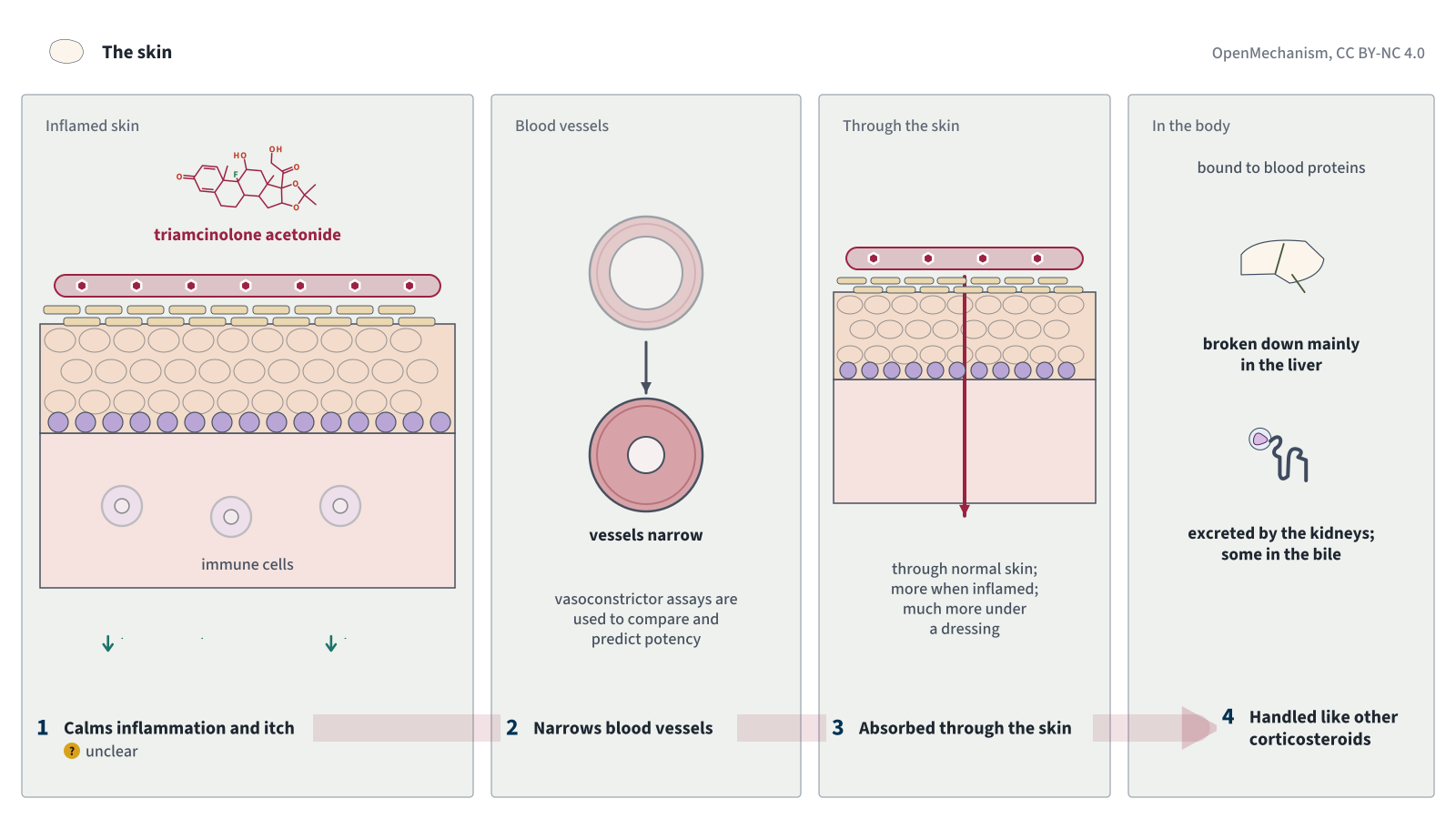
Triamcinolone acetonide cream, a topical corticosteroid, calms inflammation and itching and narrows blood vessels in the skin; how it calms inflammation is unclear. Some passes through the skin, more through inflamed skin or under a dressing, and is then handled like other corticosteroids: broken down mainly in the liver and excreted by the kidneys.
- Acts on
- Corticosteroid (how it calms inflammation is unclear)
- Where
- The skin
- Medicine type
- Small molecule
- Used for
- Skin
- Drug class
- Corticosteroids
Step 1: unclear
The triamcinolone acetonide cream label says: The mechanism of anti-inflammatory activity of the topical corticosteroids is unclear.
Source 1: Triamcinolone acetonide cream (Fougera): FDA label, Indications and Usage; Clinical Pharmacology
Clinical study: A Cochrane review of 177 randomized trials of topical treatments for chronic plaque psoriasis, which measured how much the psoriasis improved, not how the medicines work, found: Most corticosteroids also performed better than placebo
Mason AR et al., Cochrane Database Syst Rev 2013 (PMID 23543539)
This study was picked with a literature search and is not yet checked by our reviewer.
How it works
Calms inflammation and itch. Triamcinolone acetonide cream is a topical corticosteroid, used for inflamed and itchy skin conditions that respond to corticosteroids. Topical corticosteroids share anti-inflammatory, anti-itch (antipruritic) and vasoconstrictive actions; how they calm inflammation is unclear.1
Narrows blood vessels. Vasoconstrictor assays, which measure how much a steroid narrows blood vessels in the skin, are among the laboratory methods used to compare and predict how potent topical corticosteroids are; there is some evidence that this vasoconstrictor potency matches how well they work in people.1
Absorbed through the skin. How much passes through the skin depends on the vehicle, the state of the skin's outer barrier and whether the skin is covered: occlusive dressings substantially increase absorption. It can be absorbed through normal, intact skin, and inflammation and other skin diseases increase absorption.1
Handled like other corticosteroids. Once absorbed through the skin, topical corticosteroids are handled like corticosteroids given systemically: bound to blood proteins in varying degrees, broken down mainly in the liver and excreted by the kidneys; some also leave in the bile.1
For teachers: download this drawing.
See also
Condition pages: eczema (atopic dermatitis).
Other corticosteroids: budesonide, clobetasol, dexamethasone, fluticasone propionate, hydrocortisone, methylprednisolone and prednisone.
Body system: skin, hair & nails.
Sources
- 1Triamcinolone acetonide cream (Fougera): FDA labelIndications and Usage; Clinical Pharmacology
- 2ChEMBL CHEMBL1451Target and action classification: Glucocorticoid receptor agonist
- 3Topical treatments for chronic plaque psoriasisMason AR et al. Cochrane Database Syst Rev 2013 (abstract)
Spotted a mistake? Report an error (hello@openmechanism.com). Since launch, every published error we fix is listed on the corrections page.
Notes and limits
- A schematic teaching drawing: not to scale, not exact structures, binding poses or a complete pathway, and not a guide to dosing, treatment or how a person will respond.
- The label says the mechanism of the anti-inflammatory activity of the topical corticosteroids is unclear.
All recorded limits are on the evidence page, and notes that apply to every page are on How to read a page. Version 1.0.0, not yet medically reviewed.
Cite this page
Tran D. Triamcinolone [Internet]. OpenMechanism; 2026 [updated 2026 Oct 11; cited 2026 Oct 11]. Available from: https://openmechanism.com/medicines/triamcinolone