Progesterone
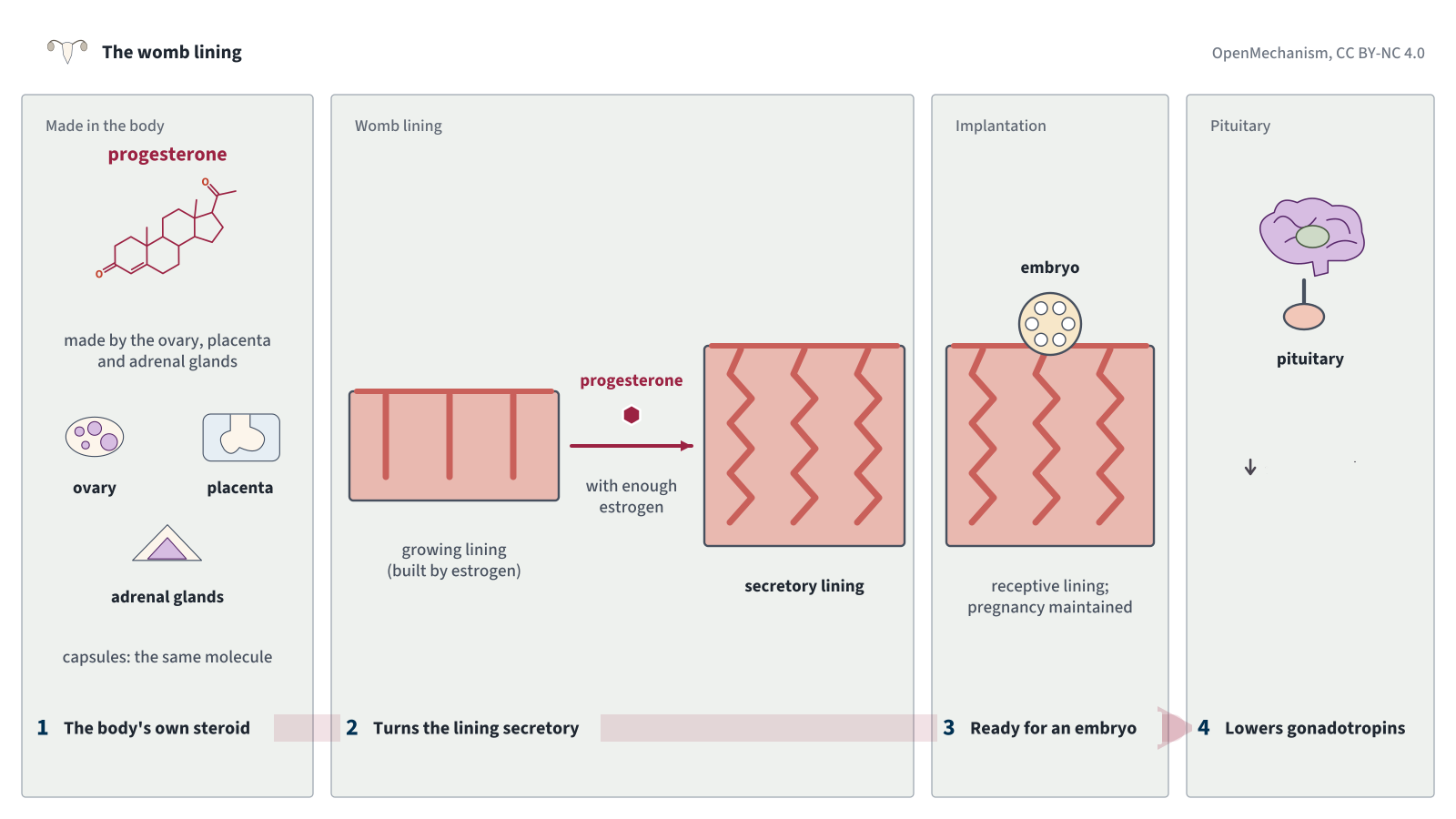
Progesterone is the body's own steroid, made by the ovary, placenta and adrenal gland; the capsules hold the same molecule. With enough estrogen, it turns the growing womb lining into a secretory one that can receive an embryo, and it helps maintain a pregnancy. It also lowers the pituitary's gonadotropins.
- Acts on
- The endometrium (womb lining); gonadotropin release
- Where
- The womb lining
- Medicine type
- Small molecule
- Used for
- Urinary & reproductive
Also called Crinone and Prometrium.
How it works
The body's own steroid. Progesterone is a naturally occurring steroid secreted by the ovary, placenta and adrenal gland; the micronized progesterone in the capsules is chemically identical to progesterone of ovarian origin.1,2
Turns the lining secretory. In the presence of adequate estrogen, progesterone transforms a proliferative (growing) endometrium into a secretory endometrium.1
Ready for an embryo. Progesterone is necessary to increase the endometrium's receptivity for implantation of an embryo; once an embryo is implanted, it acts to maintain the pregnancy.1
Lowers gonadotropins. Progesterone administration decreases the circulating levels of gonadotropins.1
For teachers: download this drawing.
See also
Condition pages: absent periods (secondary amenorrhea).
Other sex hormones (estrogens, progestins, androgens): estradiol; norethindrone and ethinyl estradiol; and testosterone.
Body system: bladder & reproductive organs.
Sources
- 1Crinone (progesterone gel): FDA labelClinical Pharmacology
- 2Prometrium (progesterone capsules): FDA labelClinical Pharmacology
- 3ChEMBL CHEMBL103Target and action classification: Progesterone receptor agonist
Spotted a mistake? Report an error (hello@openmechanism.com). Since launch, every published error we fix is listed on the corrections page.
Notes and limits
- A schematic teaching drawing: not to scale, not exact structures, binding poses or a complete pathway, and not a guide to dosing, treatment or how a person will respond.
All recorded limits are on the evidence page, and notes that apply to every page are on How to read a page. Version 1.0.0, not yet medically reviewed.
Cite this page
Tran D. Progesterone [Internet]. OpenMechanism; 2026 [updated 2026 Oct 11; cited 2026 Oct 11]. Available from: https://openmechanism.com/medicines/progesterone