Clobetasol
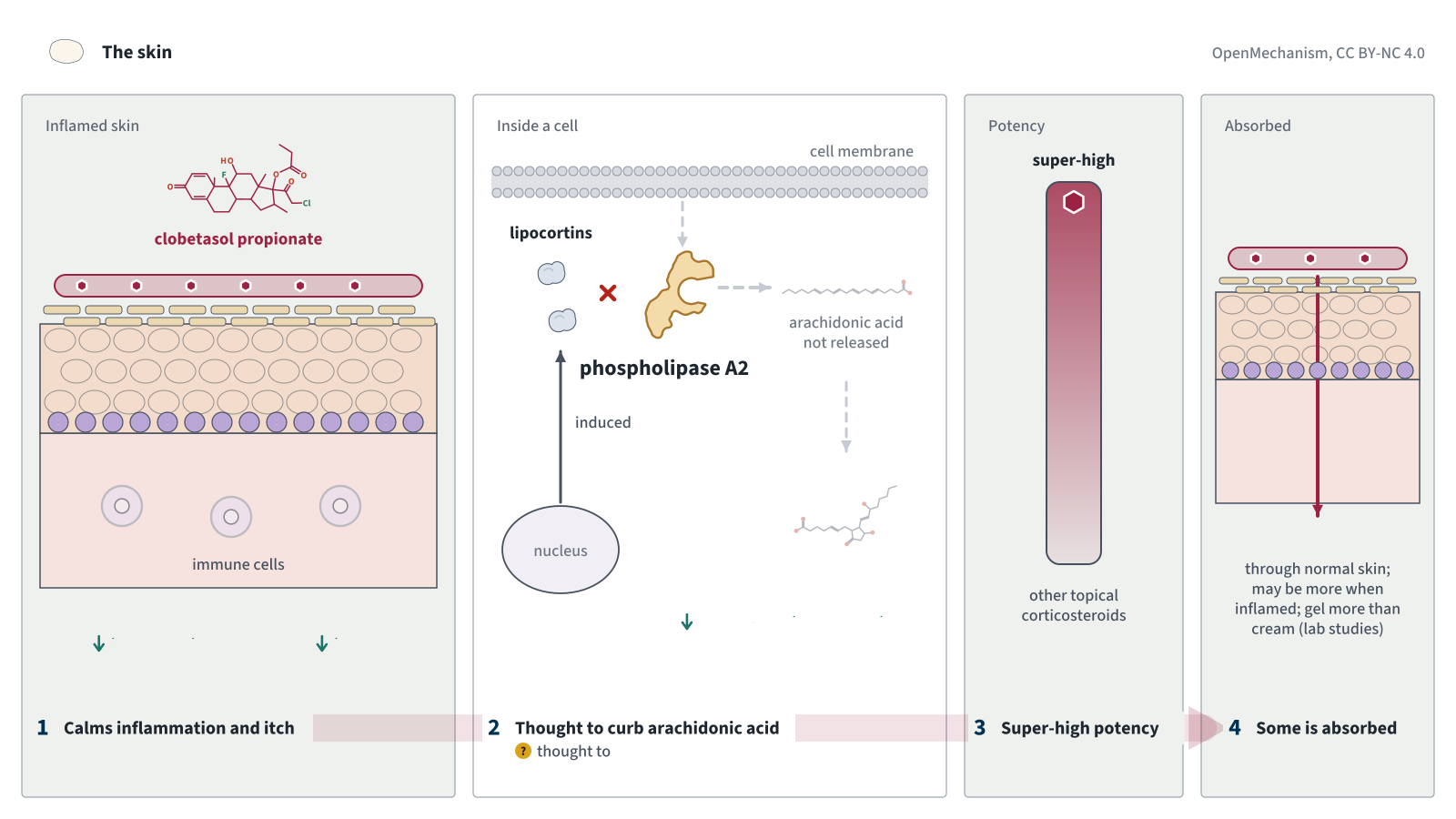
Clobetasol propionate, a topical corticosteroid, calms inflammation and itching. Corticosteroids are thought to work by inducing lipocortins, proteins that block , so that less arachidonic acid is released to make prostaglandins and ; how they calm inflammation is unclear. It is in the super-high range of potency, and some is absorbed through the skin.
- Acts on
- Corticosteroid; thought to act by inducing lipocortins, which inhibit phospholipase A2
- Where
- The skin
- Medicine type
- Small molecule
- Used for
- Skin
- Drug class
- Corticosteroids
Step 2: thought to
The clobetasol propionate label says: The mechanism of the anti-inflammatory activity of the topical steroids, in general, is unclear. … However, corticosteroids are thought to act by the induction of phospholipase A 2 inhibitory proteins, collectively called lipocortins.
Clinical study: In a double-blind trial in 378 people with moderate to severe scalp psoriasis, clobetasol propionate 0.05% scalp application was compared with its vehicle; the trial measured how much the psoriasis cleared, not how clobetasol works: After 2 weeks of twice-daily applications, 81% receiving active drug versus 22% receiving vehicle had clearing of 50% or greater.
Olsen EA et al., J Am Acad Dermatol 1991 (PMID 2061442)
This study was picked with a literature search and is not yet checked by our reviewer.
Key terms in this drawing
- leukotrienes
- Cysteinyl leukotrienes. Signal molecules released by cells such as mast cells and eosinophils; in asthma they swell the airways and tighten their muscle.
- phospholipase A2
- Phospholipase A2. The enzyme that releases arachidonic acid, the shared raw material of prostaglandins and leukotrienes, from cell membranes.
How it works
Calms inflammation and itch. Like other topical corticosteroids, clobetasol propionate has anti-inflammatory, anti-itch (antipruritic) and vasoconstrictive properties. It is used for inflamed and itchy skin conditions that respond to corticosteroids.1
Thought to curb arachidonic acid. How topical steroids calm inflammation is, in general, unclear. Corticosteroids are thought to act by inducing proteins that inhibit phospholipase A2, collectively called lipocortins. Phospholipase A2 releases arachidonic acid from the phospholipids of cell membranes, and lipocortins are postulated to control the making of potent mediators of inflammation, prostaglandins and leukotrienes, by holding back the release of their common precursor, arachidonic acid.1
Super-high potency. Studies of clobetasol propionate gel, cream and ointment place them in the super-high range of potency compared with other topical corticosteroids.1
Some is absorbed. Topical corticosteroids can be absorbed through normal, intact skin. How much depends on the vehicle and the skin's outer barrier, and inflammation and other skin diseases may increase it; in laboratory studies on human skin, more passed through from the gel than from the cream.1
For teachers: download this drawing.
See also
Condition pages: eczema (atopic dermatitis).
Other corticosteroids: budesonide, dexamethasone, fluticasone propionate, hydrocortisone, methylprednisolone, prednisone and triamcinolone.
Body system: skin, hair & nails.
Sources
- 1Clobetasol propionate gel, cream and ointment (Fougera): FDA labelIndications and Usage; Clinical Pharmacology
- 2ChEMBL CHEMBL1159650Target and action classification: Glucocorticoid receptor agonist
- 3A double-blind, vehicle-controlled study of clobetasol propionate 0.05% (Temovate) scalp application in the treatment of moderate to severe scalp psoriasisOlsen EA et al. J Am Acad Dermatol 1991 (abstract)
Also used for the drawing
The phospholipase A2 outline is traced from the crystal structure below.
- 4Human cytosolic phospholipase A2PDB 1CJY; Dessen, A. et al. Cell(Cambridge,Mass.) 1999; 97:349-360
Spotted a mistake? Report an error (hello@openmechanism.com). Since launch, every published error we fix is listed on the corrections page.
Notes and limits
- A schematic teaching drawing: not to scale, not exact structures, binding poses or a complete pathway, and not a guide to dosing, treatment or how a person will respond.
- The label says the mechanism of the anti-inflammatory activity of topical steroids is unclear; corticosteroids are thought to act through lipocortins, and their control of prostaglandins and leukotrienes is postulated.
All recorded limits are on the evidence page, and notes that apply to every page are on How to read a page. Version 1.0.0, not yet medically reviewed.
Cite this page
Tran D. Clobetasol [Internet]. OpenMechanism; 2026 [updated 2026 Oct 11; cited 2026 Oct 11]. Available from: https://openmechanism.com/medicines/clobetasol