Bladder & reproductive organs
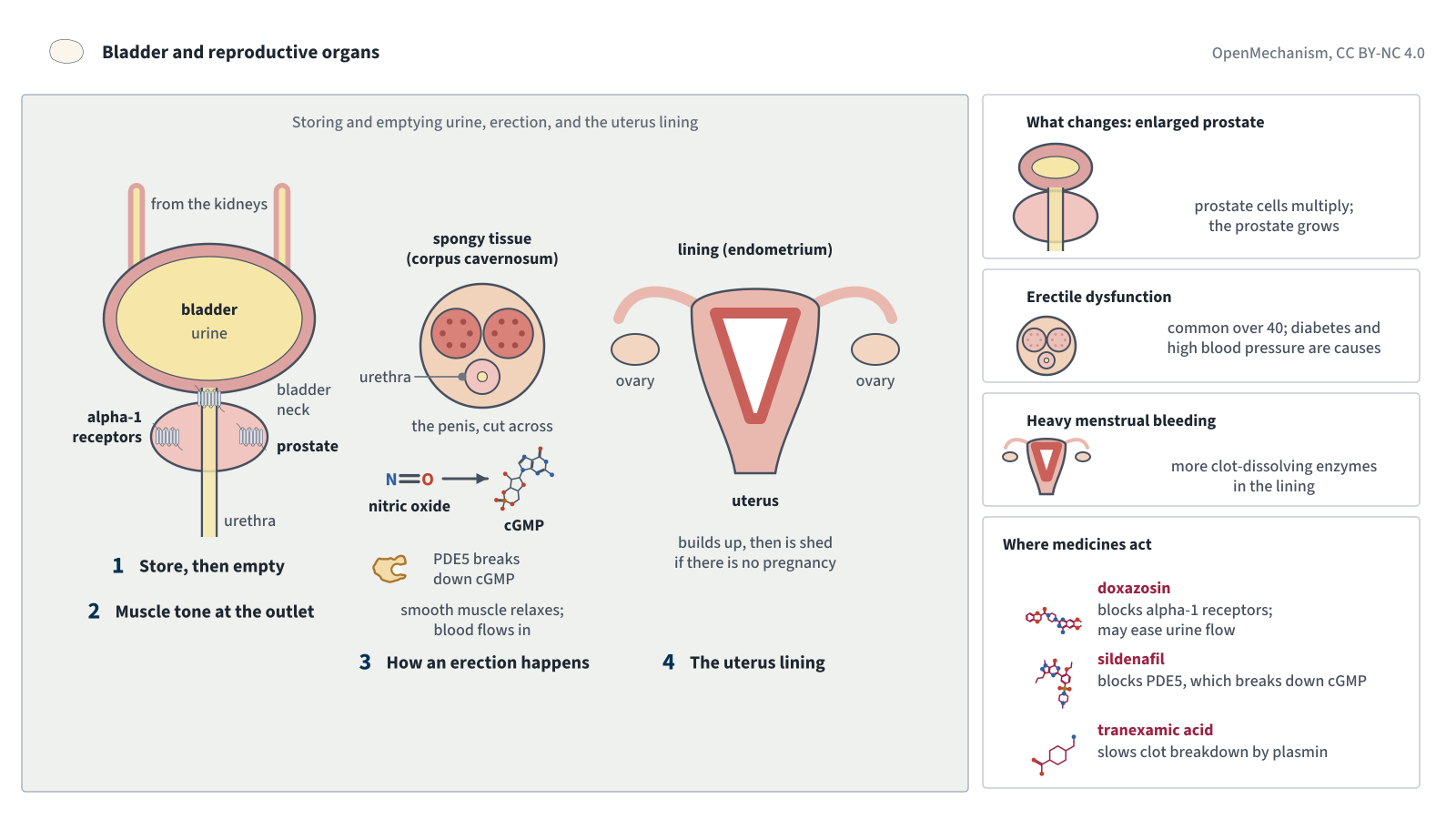
How urine is stored and emptied, how an erection happens, and how the uterus lining renews.
For teachers: download this drawing.
Key terms in this drawing
- alpha-1 receptor
- Alpha-1 adrenergic receptor. Alpha-1 adrenergic receptors come in at least three subtypes, A, B and D; alpha-1A may have a main role in prostate obstruction, alpha-1B in tightening arteries.
- cGMP
- Cyclic guanosine monophosphate. A molecule that rises in smooth muscle when nitric oxide activates guanylate cyclase; the rise leads the vessels to widen.
- NO
- Nitric oxide. A signal molecule released by nerve endings and the cells lining blood vessels; it makes smooth muscle cells produce cGMP.
- PDE5
- Phosphodiesterase type 5. An enzyme that breaks down cGMP in smooth muscle.
How it works
Store, then empty. The bladder and its outlet store urine and empty it from time to time; nerves in the brain and spinal cord coordinate their muscles. Young children empty the bladder without control until about age 3 to 5.1
What the source says
“The functions of the lower urinary tract to store and periodically eliminate urine are regulated by a complex neural control system in the brain, spinal cord, and peripheral autonomic ganglia that coordinates the activity of smooth and striated muscles of the bladder and urethral outlet.”
Source 1“Micturition occurs involuntarily in infants and young children until the age of 3 to 5 years, after which it is regulated voluntarily.”
Source 1Muscle tone at the outlet. Muscle tone in the prostate and the bladder neck is set by , which are packed densely there.2
What the source says
“The degree of tone in this area is mediated by the alpha 1 adrenoceptor, which is present in high density in the prostatic stroma, prostatic capsule and bladder neck.”
Source 2How an erection happens. During sexual stimulation, (NO) is released in the spongy tissue of the penis (corpus cavernosum). It raises , which relaxes the smooth muscle so blood flows in.3
What the source says
“The physiologic mechanism of erection of the penis involves release of nitric oxide (NO) in the corpus cavernosum during sexual stimulation. NO then activates the enzyme guanylate cyclase, which results in increased levels of cyclic guanosine monophosphate (cGMP), producing smooth muscle relaxation in the corpus cavernosum and allowing inflow of blood.”
Source 3The uterus lining. The lining of the uterus (endometrium) prepares for pregnancy. Without pregnancy it is shed in menstruation, set off by a fall in progesterone, and it repairs each month.4
What the source says
“The physiological functions of the uterine endometrium (uterine lining) are preparation for implantation, maintenance of pregnancy if implantation occurs, and menstruation in the absence of pregnancy.”
Source 4“Progesterone withdrawal is the trigger for menstruation.”
Source 4“surface that is required to rapidly repair each month.”
Source 4
What changes in disease
Enlarged prostate. Benign prostatic hyperplasia () is common in older men: prostate cells multiply and the prostate grows, causing urinary symptoms.5
What the source says
“Benign prostatic hyperplasia (BPH), which causes lower urinary tract symptoms (LUTS), is a common diagnosis among the ageing male population with increasing prevalence.”
Source 5“BPH occurs when both stromal and epithelial cells of the prostate in the transitional zone proliferate by processes that are thought to be influenced by inflammation and sex hormones, causing prostate enlargement.”
Source 5Erectile dysfunction. Erectile dysfunction is common, mainly in men over 40; diabetes and high blood pressure are classic causes.6
Heavy menstrual bleeding. Abnormal bleeding from the uterus, including heavy menstrual bleeding, affects one in four women of reproductive age. In heavy bleeding the uterus lining has more clot-dissolving enzymes (plasminogen activators).4,7
What the source says
“Abnormal uterine bleeding (AUB), including heavy menstrual bleeding (HMB), imposes a massive burden on society, affecting one in four women of reproductive age.”
Source 4“An increase in the levels of plasminogen activators has been found in the endometrium of women with heavy menstrual bleeding compared to those with normal menstrual loss.”
Source 7
Where medicines act
- d
Doxazosin
Blocks alpha-1 receptors; may ease the blockage and improve urine flow.
- e
Sildenafil
Blocks PDE5, the enzyme that breaks down cGMP in the penis.
- f
Tranexamic acid
Slows the breakdown of clots by plasmin; used for cyclic heavy menstrual bleeding.
See also
Zoom in: muscle tone in the prostate and labor and after birth.
Conditions
- Absent periods (secondary amenorrhea)
- Acute pain and period pain
- Bedwetting (nocturnal enuresis)
- Bladder bleeding from chemotherapy (hemorrhagic cystitis)
- Bladder cancer
- Cervical cancer
- Endometrial cancer
- Enlarged prostate (BPH)
- Erectile dysfunction
- Heavy bleeding after birth
- Heavy menstrual bleeding
- Low testosterone (male hypogonadism)
- Ovarian cancer
- Overactive bladder
- Preeclampsia and eclampsia
- Prostate cancer
- Syphilis
- Testicular cancer
- Thrush and vaginal yeast infections
- Trichomoniasis and bacterial vaginosis
- Urinary tract infections
More medicines for this area
Sources
- 1Neural control of the lower urinary tractde Groat WC et al. Compr Physiol 2015 (abstract). Saved copy
- 2Cardura (doxazosin): FDA label12.1 Mechanism of Action. Saved copy
- 3Viagra (sildenafil): FDA label12.1 Mechanism of Action. Saved copy
- 4Physiology of the endometrium and regulation of menstruationCritchley HOD et al. Physiol Rev 2020 (abstract). Saved copy
- 5Benign prostatic hyperplasiaChughtai B et al. Nat Rev Dis Primers 2016 (abstract). Saved copy
- 6Erectile dysfunctionShamloul R, Ghanem H. Lancet 2013 (abstract). Saved copy
- 7Antifibrinolytics for heavy menstrual bleedingLethaby A et al. Cochrane Database Syst Rev 2000 (abstract). Saved copy
- 8Tranexamic acid tablets: FDA label1 Indications and Usage; 12.1 Mechanism of Action. Saved copy
- 9The catalytic domain of human PDE5 with sildenafilPDB 1UDT; Sung, B.-J. et al. Nature 2003;425:98-102. The PDE5 outline in the drawing is traced from this structure. Saved copy
Notes and limits
Spotted a mistake? Report an error (hello@openmechanism.com). Since launch, every published error we fix is listed on the corrections page.
Cite this page
Tran D. Bladder & reproductive organs [Internet]. OpenMechanism; 2026 [updated 2026 Oct 10; cited 2026 Oct 10]. Available from: https://openmechanism.com/body/urinary